Discover Iran: Ashuradeh, Iran's only Caspian Sea island and sanctuary for birds, wildlife
By Humaira Ahad
- Ashuradeh, Iran’s only Caspian island, is a shifting ecological sanctuary for migratory birds, wildlife, sturgeon, and fragile dunes.
- Shaped by rivers, wind, and rising seas, the island has shrunk dramatically, preserving rare habitats and biodiversity today.
- Once strategic and inhabited, Ashuradeh now balances ecotourism ambitions with urgent conservation against erosion and climate threats pressures.
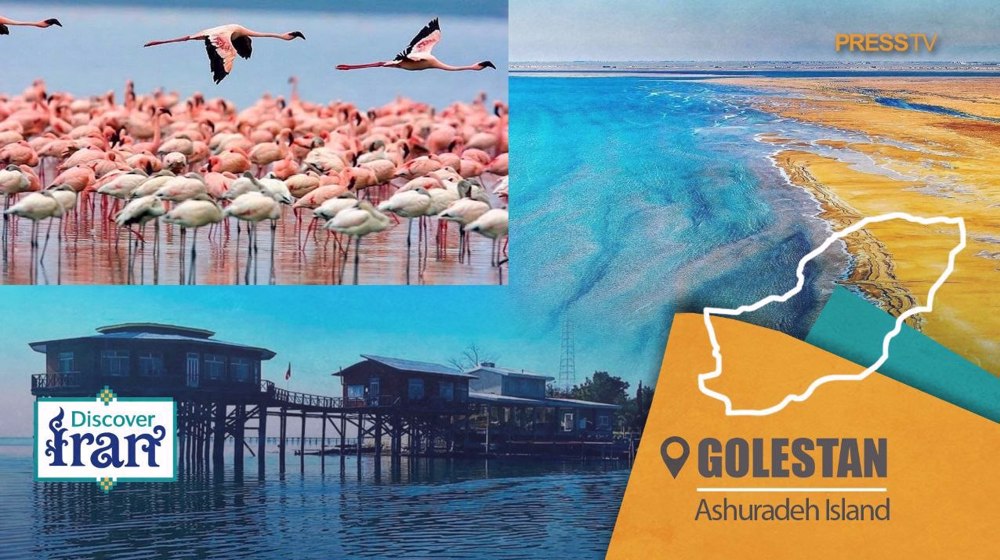
Off the north-eastern coast of Iran, where the Caspian Sea meets the Miankaleh Peninsula, Ashuradeh Island rises as a sanctuary of sand, shrubs, and migratory birds.
Iran’s only island in the Caspian Sea is major attraction for nature enthusiasts and birdwatchers, who are eager to explore its dunes and witness migratory flocks that traverse continents to reach these northern waters.
The beautiful island, largely uninhabited today, has been shaped by human and natural forces. Historically a stopover for Turkmen herders and fishermen, Ashuradeh has seen shifting shorelines due to rising sea levels, and centuries of ecological change.
Its dunes, sparse vegetation, and surrounding waters provide habitat for migratory birds and sturgeon, making it an prime ecological hotspot.
Among Turkmen herders, the island was once known as “Mal Ashir,” a reference to the ancient practice of ferrying livestock by boat to graze on its pastures.
The linguistic history reflects that Ashuradeh was not just a strategic outpost but part of the nomadic economy that defined the region.
Outpost at the edge of the sea
Located just 10 kilometres from Bandar Turkaman and 40 kilometres from Gorgan, Ashuradeh sits at the centre of the Miankaleh Peninsula.
The Caspian Sea borders its northern edge, while the Chapoq oghli Strait cuts along its east. To the west lies the natural Khazini Canal, the channel that once severed it from Miankaleh and to the south, the long sweep of the Gorgan Gulf. Its location places it at the crossroads of ecological forces that have shaped it for centuries.
Ashuradeh was not always a standalone island. Historical accounts suggest that it was once an archipelago of three islands, two small ones to the east and a larger western island.
Rising water levels in the Caspian Sea submerged the smaller islands, leaving today’s solitary landmass. Even that landmass has steadily shrunk from 1,200 hectares to just 400 hectares today, due to flooding and sea-level rise.
Despite that, Ashuradeh is one of Iran’s most important ecological treasures. It was designated a biosphere reserve in 1975, registered under the Ramsar Convention, and was recognized internationally as one of the 59 protected natural reserves.
The Caspian Sea island is considered one of the country’s vital wildlife refuges.
Island formed by rivers and wind
Geologically, Ashuradeh was formed from the alluvial deposits of the Goharbaran (Nekarud) River delta.
Its soil, free of clay and rich in the coarse material carried over centuries makes the island highly vulnerable to erosion. This has led to long, low sand dunes stretching from west to east, also shaped by the winds.
Vegetation is sparse, characteristic of an arid ecosystem. Raspberry bushes, wild thorns, sour pomegranate trees, and remnants of earlier orchards form patches of green across the island. Partly due to overgrazing and environmental challenges, earlier crops such as dates, cotton, and sugarcane have disappeared.
Still, its grasses, even when heavily grazed, play a crucial role in stabilizing the sands and preventing the island from eroding faster.
Wildlife refuge inhabited by birds
The island shelters jackals, foxes, rabbits, wild boars, and even a rare type of wild horse capable of drinking salty water, though their lifespan is short.
And while the Caspian tiger inhabited the island in early 20th century, overhunting and environmental decline drove it to extinction.
The island is also a sanctuary for both local and migratory birds, pheasants, partridges, gulls, sea swallows, sandpipers, glaucous gulls, pelicans, flamingos, ducks, geese, and swans that traverse thousands of kilometres from Siberia and northern Russia to spend winter here.
This avian corridor is one of the reasons Ashuradeh and Miankaleh remain central to Iran’s ecological identity.
Its waters also sustain a vibrant aquatic economy. Roughly 40% of Iran’s caviar, harvested from sturgeon near the island, originates in these waters. The caviar is renowned globally for its quality.
Fish species such as whitefish, carp, kalama, mash, beluga, catfish, and sturgeon contribute both to local livelihoods and regional culture.
Battlefield of empires
Some historians believe Ashuradeh may be the same island that was called Abaskun, where Sultan Muhammad Khwarazm Shah fled during the Mongol invasion and later died in 1220 AD.
Under the Safavids, the island became a royal hunting ground, complete with fortresses and temporary palaces. Yet the name “Ashuradeh” only enters the historical record during the Qajar era, when the island became a focal point of geopolitical tension.
Ashuradeh has long been a strategic outpost in the south-eastern Caspian Sea. In the 18th century, Russian emperor Peter the Great sought to extend Russian influence here, but his death and Nader Shah Afshar’s rise halted these ambitions.
Later, Russian plans to establish a commercial post were blocked by Agha Mohammad Khan Qajar.
By the 19th century, Ashuradeh became a hub for trade and a contested space between Iran and Russia, with Turkmen uprisings adding to the tension.
During Mohammad Shah Qajar’s reign, Turkmen bandits on the island attacked Gorgan, prompting Russian naval intervention under existing treaties.
The Russians occupied Ashuradeh for decades, building military posts, houses, a clinic, and a church, until the 1921 Treaty of Friendship returned it to Iran.
After liberation, the island remained mostly uninhabited until the mid-20th century, when fisheries facilities and settlements were established.
By the 1970s, over 1,000 residents lived on Ashuradeh, relying on fishing, farming, and animal husbandry.
Rising sea levels and floods in 1993 forced most to leave, leaving only fisheries staff and fishermen behind.
Tourism and ecology
Today, Ashuradeh stands at the intersection of development and preservation. It remains a focal point for ecotourism planning in the Golestan province.
The lushness of northern Iran, combined with the island’s rarity as Iran’s only Caspian island, has elevated its status in regional development discussions.
Tourists coming to Ashuradeh often extend their trip to the Miankaleh Wetland, a 70,000-hectare ecological refuge known for its dramatic sunrises and symphony of birds.
During autumn and winter, thousands of migratory birds descend upon this final remnant of the Caspian’s semi-forested terrain.
Ashuradeh’s mild, humid climate and unique flysch formations make it an important case study for geologists and environmental scholars.
Back at Bandar Turkaman, the coastal pier and the bustling Turkaman Port Coastal Bazaar serve as cultural entry points.
Turkmen scarves, felt rugs, jewellery, and local sweets like Qatlama and Pishmeh are the attractions of this bazaar.
Ashuradeh’s future, however, remains uncertain. Rising sea levels, erosion, and shifting sands continue to shrink the island’s surface. Ecologists say long-term conservation strategies are needed to protect the Caspian Sea island.

Discover Iran: Sistan and Baluchestan Science and Tech Park powering innovation and growth
Discover Iran: How once-isolated Makran coast is rising as Indian Ocean’s next strategic powerhouse
Discover Iran: The network of rivers, lakes, and wetlands of Sistan and Baluchestan



As Hezbollah retaliates against Israel, Lebanese govt siding with aggressor: Expert
Iraqi resistance group vows to avenge US assassination of anti-terror commander
US to offer services in illegal West Bank settlements as Israel pushes for annexation
US-Israeli barbaric aggression targets civilians, including children: Health ministry
Iranian missiles, drones dominate skies over the occupied territories: Military spox
IRGC shatters US-Israeli propaganda with new operations to punish aggressors
Smotrich’s son wounded as Hezbollah rockets, drones pound Israeli positions
'Don't tie your security to Trump's lies', Qalibaf tells US allies after carrier retreat



 PressTV NEWSLETTER
now
PressTV NEWSLETTER
now

 This makes it easy to access the Press TV website
