New Shapur I statue in Tehran honors Iranian nation’s unyielding spirit that never bows
By Ivan Kesic
On November 7, 2025, Tehran’s Enqelab Square was transformed into a vibrant stage for national pride and historical remembrance as thousands of citizens gathered for the unveiling of a powerful new statue.
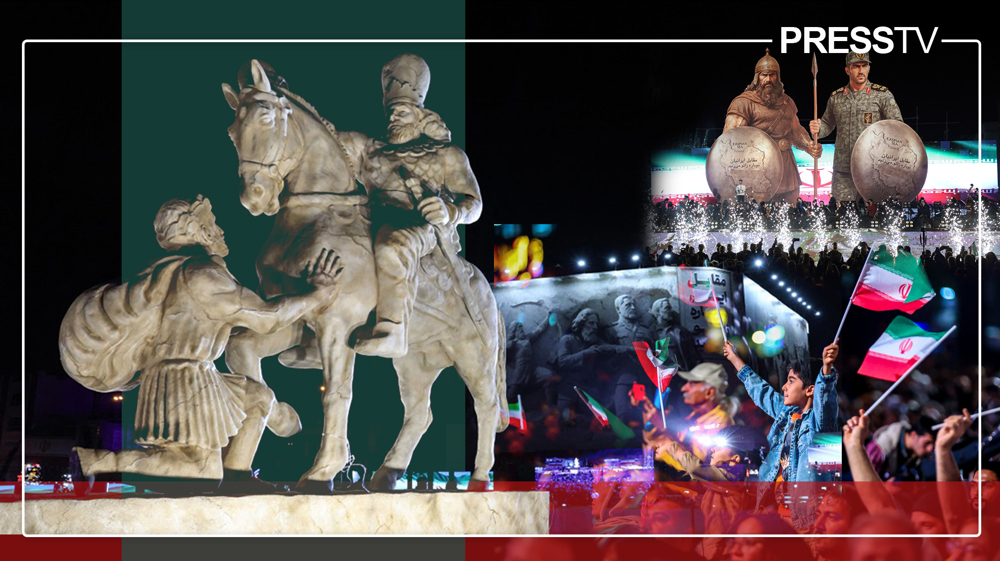
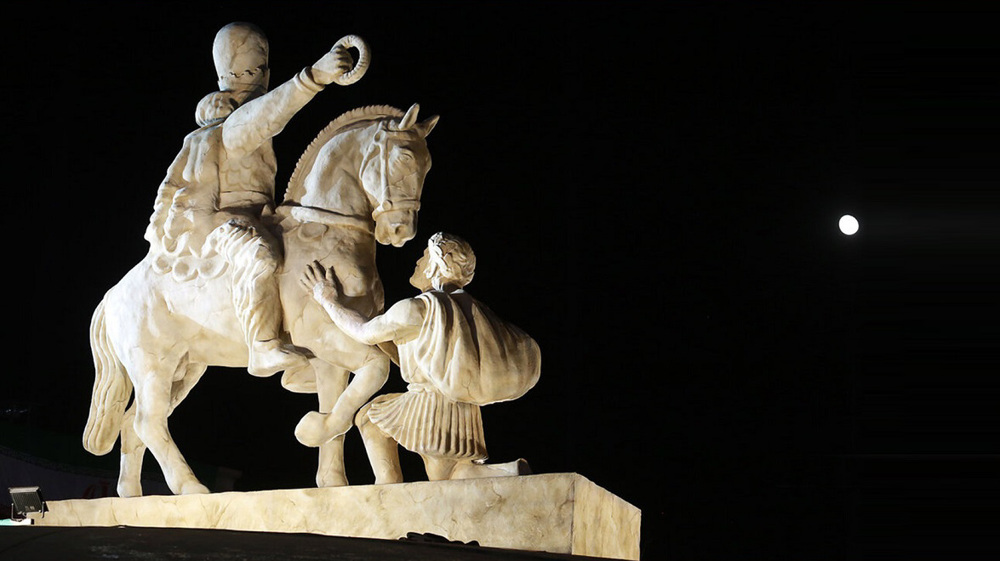
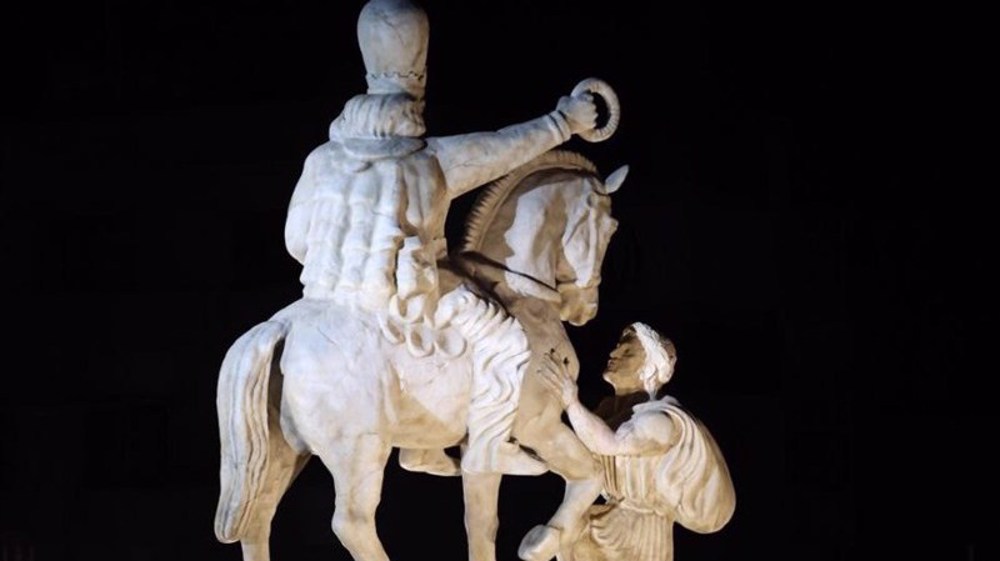
The monumental sculpture, titled “Kneeling Before Iran,” depicts the Sassanid king Shapur I triumphantly mounted on his horse, looming over the kneeling figure of Roman Emperor Valerian, who reaches upward in a gesture of submission and plea for mercy.
This artistic installation is far more than a simple piece of public art; it is a deliberate and potent symbol of national strength, unity, and identity, conceived in the wake of contemporary geopolitical conflicts.
The ceremony, filled with heroic music and waving Iranian flags, was attended by families, youths, artists, and city officials, all participating in a collective act of cultural affirmation that directly links a legendary past victory to the challenges of the present day.
‘Kneel Before Iran’ statue unveiled in Tehran’s Enqelab Squarehttps://t.co/Wq4al14URn
— Press TV 🔻 (@PressTV) November 7, 2025
Echoes from Naqsh-e Rostam: an ancient victory for a modern audience
The statue is a direct and intentional recreation of one of the most significant rock reliefs from ancient Iranian history, located at the Naqsh-e Rostam site near Persepolis.
This original bas-relief immortalizes the decisive Battle of Edessa in 260 CE, a watershed moment where the Sassanid army under Shapur I achieved a stunning victory over the Roman legions.
The battle resulted in the unprecedented capture of a sitting Roman Emperor, Valerian, an event that sent shockwaves through the classical world and marked a zenith of Iranian power.
The ancient relief, carved into a cliff face by order of the victorious king, was designed as an enduring declaration of power, a stone testament to the might of the Sassanid Empire and the humiliation of its greatest rival.
It portrays Shapur in the full regalia of imperial authority, while Valerian, adorned with his Roman crown, is forever frozen in a posture of defeat.
By transplanting this iconic imagery into the heart of the modern capital, the statue creates a tangible bridge across seventeen centuries, insisting that the lessons and legacy of that ancient triumph remain immediately relevant.
Iran heroes commemorated at statue unveiling ceremony
— Press TV 🔻 (@PressTV) November 9, 2025
Maryam Azarchehr reports from Tehran.@TillDLastBreath
Follow: https://t.co/mLGcUTS2ei pic.twitter.com/KKY1T9wThU
The "You Will Kneel Before Iran" campaign: a message of defiance
The statue’s unveiling is the centerpiece of a broader cultural and political campaign, explicitly named after the slogan “You Will Kneel Before Iran Again.”
This phrase is directly drawn from a public message by the Leader of the Islamic Revolution, Ayatollah Seyyed Ali Khamenei, and frames the artwork as a contemporary political statement.
Officials from the Tehran Municipality, which organized the event, have been unequivocal in linking the statue to recent events, specifically citing the 12-day Israeli military aggression against Iran earlier in the year.
Mehdi Mazhabi, head of the Tehran Beautification Organization, stated that the statue artistically expresses the history of the Iranian nation’s resistance, asserting that the people have repeatedly proven they will never yield to bullying powers.
Davoud Goodarzi, Tehran’s deputy mayor, echoed this sentiment, declaring that the statue represents the fact that any entity seeking to violate Iran or its people has ultimately been forced to kneel.
The installation thus functions as a form of psychological and political warfare, a durable, public rebuttal to external pressure and a morale-boosting symbol for the domestic population.
Iran unveils the statue of the Roman Emperor Valerian kneeling before the ancient Iranian King Shapur I, a symbol of the historic resistance and steadfastness of the Iranian nation.
— Press TV 🔻 (@PressTV) November 7, 2025
Follow Press TV on Telegram: https://t.co/LWoNSpkc2J pic.twitter.com/hS34337LxW
Continuous historical tradition: monumentalizing victory in Iranian culture
The erection of this statue is not an isolated act but part of a deep-seated tradition in Iranian civilization, spanning both the ancient and Islamic eras, of using public monuments to commemorate victory and assert sovereignty.
The Sassanid kings themselves were masters of this art, carving their military achievements and royal investitures into the living rock at sites like Naqsh-e Rostam and Taq-e Bostan.
These reliefs were their official chronicles, designed for permanence and public view, to communicate power and piety to their subjects and to rivals.
This practice continued after the advent of Islam, with Iranian Muslim dynasties adorning their palaces, mosques, and public squares with intricate tilework, paintings, and calligraphy that celebrated military successes, depicted legendary heroes from the Shahnameh like Rostam.
The modern statue of Shapur I is a direct continuation of this age-old impulse, utilizing a new medium—a large-scale, freestanding sculpture in a major urban traffic circle—to serve the same timeless purpose: to narrate a story of national resilience and to warn adversaries of the fate that awaits them.
The statue’s installation was accompanied by a rich tapestry of supplementary symbols that fused ancient mythology with modern revolutionary iconography.
Massive banners at the ceremony portrayed not only Shapur but also slain contemporary military figures, such as IRGC commander Qasem Soleimani and aerospace chief Amir Ali Hajizadeh, directly linking their martyrdom to the ancient king’s victory.
Legendary heroes from the Shahnameh, like the mighty warrior Rostam, were displayed vanquishing their foes, alongside reproductions of modern confrontations.
This deliberate juxtaposition creates a continuous historical narrative, suggesting that the spirit of Shapur and Rostam lives on in the soldiers of the Islamic Republic.
📸Unveiling ceremony of the statue depicting Roman Emperor Valerian kneeling before Iranian King Shapur I, in Tehran.
— Press TV 🔻 (@PressTV) November 8, 2025
Follow https://t.co/B3zXG73Jym pic.twitter.com/vdo4vZduoD
Archetype of arrogance: from ancient foes to a modern adversary
To fully appreciate the profound symbolism of Shapur’s victory immortalized in the new statue, one must understand the representation of his captive, Emperor Valerian, as part of a recurring historical archetype of hubris meeting a catastrophic fall in its confrontation with the Iranian world.
Valerian’s story forms a classic trilogy of defeat alongside the Lydian king Croesus and the Roman triumvir Marcus Licinius Crassus, all legendary for their immense wealth and aristocratic status which bred a smug, unshakable confidence in their own military prowess.
Croesus infamously invaded Iran based on a misreading of an oracle, only to be defeated by Cyrus the Great. Centuries later, Crassus, one of the richest men in history, invaded Iran seeking martial glory to match his wealth and was decisively defeated at Carrhae.
Emperor Valerian then repeated this very folly, leading a vast Roman army into Iran with strategic overconfidence, only to be captured by Shapur I.
The statue in Tehran captures the culmination of this specific hubris: the moment of Valerian's utter defeat and humiliation, where, according to Persian and historical narratives, he was forced into a life of subservience as the personal footstool of the Sassanid king.
This transformation of a powerful Roman emperor into a permanent symbol of abject failure and shame is the core of the statue’s message.
It serves as a historical archetype directly extended to a modern context, warning contemporary adversaries like the United States and the Zionist regime that their perceived arrogance will lead them to the same kneeling position as Valerian.
This powerful visual metaphor for compelled submission finds a further parallel with Donald Trump. A clear thematic connection exists in the projection of immense wealth, imaginary invincibility, and hostility towards Iran.
The common thread weaving together Croesus, Crassus, Valerian, and this modern analogue is the dramatic downfall of a powerful individual whose overreach and arrogance, when directed against Iran, transformed their public image from one of success to one of infamy and disgrace.
Pakistani culture minister urges joint film projects with Iran at Fajr Intl. Film Festival
Majid Majidi wins special prize at first Open Eurasian Film Awards
Iran gains UNESCO approval for heritage and cognitive science initiatives



Threatening Iraq's sovereignty, US opens world’s largest consulate in Erbil
US Navy struck by Yemen: USS Truman disasters expose combat strain
Putin, Modi sign landmark deals to cement strategic partnership
VIDEO | Press TV's news headlines
IRGC Navy launches ballistic, cruise missile during major drill
China deploys largest naval force yet amid Japan’s buildup near Taiwan
Netanyahu begs Trump for ‘more’ help for pardon amid corruption case
Yasser Abu Shabab’s destiny is inevitable fate of every traitor: Hamas


 PressTV NEWSLETTER
now
PressTV NEWSLETTER
now

 This makes it easy to access the Press TV website
