
Press TV Website Staff
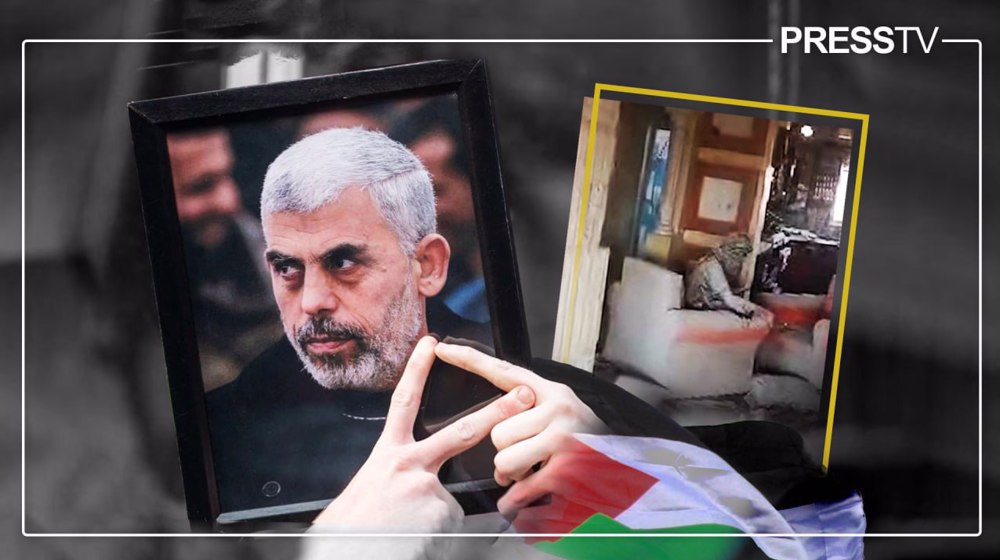
On this day last year, Yahya Sinwar, the leader of the Gaza-based resistance movement Hamas, was killed in active combat in Rafah, southern Gaza, wearing a combat vest with an AK-47 rifle on his side.
He was not hiding in underground tunnels as Israeli propagandists had claimed, nor was he using captives as human shield. He was on the front line alongside his brave fighters, leading the most consequential battle of his life.
Footage that went viral from his final moments showed him severely injured and pinned down as an Israeli military drone approached him, yet he remained firm, even throwing a stick at the drone.
The massive military force that was employed to end his life, combining drone strikes, tank fire, and aerial bombardment, only cemented his legendary stature.
Until his last breath, he fought defiantly for his besieged and battered homeland, for the ultimate goal of the liberation of occupied Palestinian territories from the settler-colonial Zionist occupation.
A charismatic and fearless commander, Sinwar was one of the key figures of the Palestinian struggle against Israeli occupation and the architect of Operation Al-Aqsa Flood that shook the Zionist entity and its Western backers.
Long placed on the Israeli regime’s "most wanted list," he survived numerous attempts on his life both before and after the events of October 7, remaining central to the coordination and oversight of Gaza’s resistance operations over the years.
In a televised address after his martyrdom, Khalil al-Hayya, Hamas leader in Gaza, paid glowing tribute to Sinwar, calling him “steadfast, courageous, and unflinching.”
On October 16, 2024, Yahya Sinwar, a legendary Hamas resistance leader, was killed by Israeli occupation forces in the Tel al-Sultan neighborhood of Rafah, with his final act of defiance immortalized as a symbol of resistance.
— Press TV 🔻 (@PressTV) October 16, 2025
Follow: https://t.co/B3zXG73Jym pic.twitter.com/I6uuHbGqjn
Sinwar, he said, “offered his life for the liberation of our homeland,” adding that he “fell with his weapon in hand, fighting until his final breath.”
Hayya recalled that Sinwar “had lived as a devoted mujahid since his youth, resisting the occupier even in prisons, and after his release through a prisoner swap, resuming the struggle with renewed vigor and faith.”
After succeeding Ismail Haniyeh as Hamas political bureau chief in August 2024, following Haniyeh’s assassination in Tehran, Sinwar courageously led from the front.
He had often spoken of his yearning for martyrdom and never shied from confronting the enemy head-on. His combination of tactical brilliance and eloquent oratory made him deeply revered among resistance fighters and followers alike.
In an undated clip that resurfaced online after his martyrdom, Sinwar said that “the greatest gift the enemy could offer me is to kill me,” adding, “I long to be martyred.”
One year since he attained martyrdom, the resistance remains intact and the Israeli regime has been forced to accept a ceasefire with Hamas, the same group it sought to eliminate for more than 700 days.
In a nutshell: Who was the martyred leader of Hamas Yahya Sinwar?
— Press TV 🔻 (@PressTV) October 15, 2025
Follow https://t.co/B3zXG73Jym pic.twitter.com/WNPYDFSxJY
Emergence on the resistance scene
Yahya Ibrahim Hassan Sinwar, known as Abu Ibrahim, was born on October 19, 1962, in a refugee camp west of Khan Yunis, southern Gaza. His family hailed from al-Majdal Asqalan—now Ashkelon—from where they were expelled during the 1948 Nakba.
He completed primary school locally, graduated from Khan Yunis Secondary School for Boys, and later studied Arabic literature at the Islamic University of Gaza.
Active in campus politics, he spent five years in the university’s Student Council, successively serving as Secretary of the Art and Sports Committees, Vice President, President, and later Vice President again between 1982 and 1987.
During his university years, Sinwar joined the Islamic Student Bloc, the precursor to Hamas, alongside Haniyeh, Hayya, and others. His leadership in the bloc and strong debating skills soon earned him recognition as one of its key ideologues.
In that period, he helped establish Palestine’s first Islamic art troupe, Al-A’idoun (The Returnees), under the guidance of Hamas movement founder Sheikh Ahmed Yassin.
By 1983, Sinwar helped form Hamas’s initial security body, Security of the Call, led by Sheikh Yassin. Three years later, he and other young activists founded Majd (the Jihad and Da’wa Organization), which later evolved into the Ezzedine al-Qassam Brigades, Hamas’s military wing.
Between 1982 and 1988, Sinwar directed numerous military operations against Israeli forces and was repeatedly detained, first serving six months at Fara’a prison in 1982.
In 1988, he was arrested again and sentenced to four life terms, spending 23 years in Israeli jails, including nearly four years in solitary confinement.
Behind bars, he often led the Hamas prisoners’ high command and organized hunger strikes in 1992, 1996, 2000, and 2004.
🎥 Lebanon's War: Sinwar
— Press TV Documentary (@presstvdoc) October 13, 2025
🔻This documentary follows Yahya al-Sinwar, a Gaza fighter and legendary symbol of resistance.
📺Tune into Press TV
🗓Premieres Wed, Oct. 15 | 06:30 GMT
📺Rebroadcasts:
Wed 15:30 & 21:30 | Thu 04:30 & 23:30 | Fri 07:30 & 19:30 GMT pic.twitter.com/CnsHReWCzC
Rise through the ranks
Released in the 2011 Wafa al-Ahrar prisoner exchange, Sinwar played an instrumental role in shaping the deal’s details, a move that reportedly prompted Israel to isolate him before his eventual release.
By 2012, he was a member of Hamas’s political bureau in Gaza, overseeing its security affairs and later joining the general bureau, where he handled the resistance movement’s military portfolio.
In 2015, he took charge of the file concerning Israeli captives held by the al-Qassam Brigades. That same year, the United States added him to its list of “global terrorists.”
Sinwar became Hamas’s political bureau chief in Gaza in February 2017 and was re-elected in 2021. He survived four assassination attempts: his home was bombed in 1989, 2014, 2021, and again amid the 2023 genocidal war on Gaza.
Following Haniyeh’s assassination in Tehran, Sinwar was unanimously elected as the new head of the Hamas political bureau on August 6, 2024.
Senior Hamas official Osama Hamdan stated that his election reflected the movement’s understanding of the confrontation, choosing a leader who had fought relentlessly on the battlefield since October 7, 2023.
It was a recognition for his decades of selfless and exemplary service to the cause of Palestinian resistance against Israeli occupation and apartheid.
✍️ Feature- Yahya Sinwar, Gaza’s iconic freedom fighter, was also an intellectual, writer, and thinker
— Press TV 🔻 (@PressTV) November 1, 2024
By @HumairaAhad_83 https://t.co/CbgrMOnbhR pic.twitter.com/y4PPznUoss
A fighter, thinker, and writer
Sinwar was fluent in both Arabic and Hebrew, authoring several political and security-related works that revealed his sharp and strategic mind. His writings and speeches showed a clear philosophy centered on steadfast resistance and self-reliance.
In his 2004 novel Thorns and Carnations, Sinwar explored themes of resistance, endurance, and sacrifice through the fictional lives of Ahmad and Ibrahim—symbols of Palestine’s struggle and ideal leadership.
During his 23 years in captivity, he mastered Hebrew language and studied Jewish history to understand his enemy better.
He translated Shabak Between the Remains and Israeli Parties (1992) and authored Hamas: Experience and Mistakes and Al-Majd, an exposé on Israel’s Shin Bet agency.
“It was quite clear that he was a kind of calm and decisive leader, who read the strategy of the Shin Bet leaders" as per the rule of "know your enemy,” a former head of Israel’s spy agency, Shin Bet, once said.
David Remnick, editor of The New Yorker, said Sinwar viewed Israeli prisons as an “academy” where he could study the language, mindset, and history of the settler-colonial enemy.
Sinwar mastered Hebrew and regularly engaged with Israeli newspapers, radio programs, and writings on Zionist thinkers, politicians, and intelligence leaders.
After his 2011 release, Sinwar married in 2012. He was a father to three children, sons Ibrahim and Abdullah, and daughter Reda
 This makes it easy to access the Press TV website