Silence shattered: World’s top genocide scholars agree Israel’s Gaza war is genocide
By Maryam Qarehgozlou
The world’s leading genocide scholars have, after more than 22 months of genocide in Gaza, which has killed over 63,000 people so far, acknowledged that the regime’s actions in the besieged Palestinian territory indeed meet the legal definition of genocide.
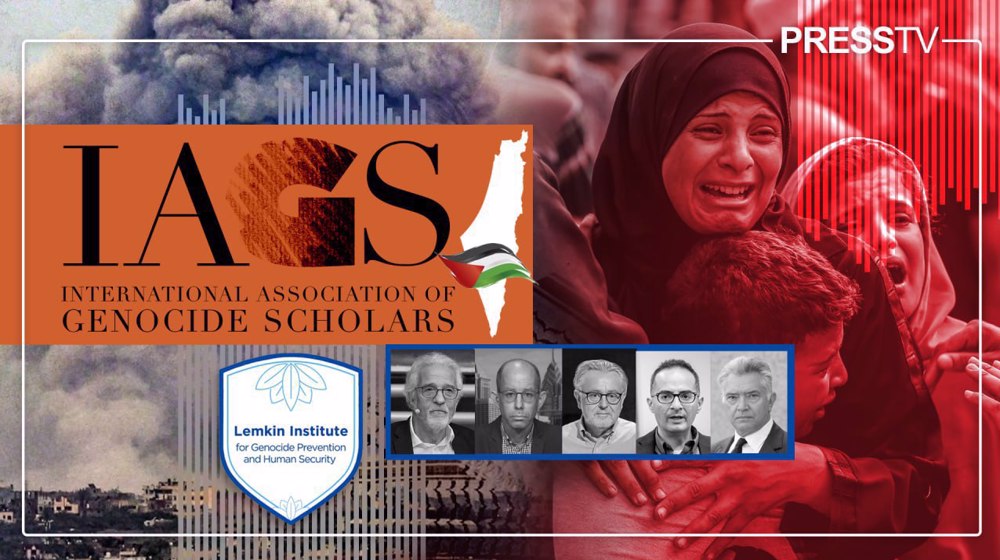
The International Association of Genocide Scholars (IAGS), a 500-member academic body founded in 1994, is the latest to admit that Israel’s policies and actions in Gaza, especially since October 2023, violate all five conditions outlined in the 1948 United Nations Convention on the Prevention and Punishment of the Crime of Genocide.
The three-page resolution passed on Monday received overwhelming support, with 86 percent of participating members voting in favor. It marks a landmark intervention by leading experts in the field of international law on the ongoing genocidal war on Gaza.
The IAGS, the oldest and largest association of genocide scholars, found that since the Hamas-led Al-Aqsa Storm operation of October 7, 2023, Israel has engaged in systematic and widespread crimes against humanity, committing war crimes and genocide.
These included indiscriminate and deliberate attacks on civilians, medical and aid workers, journalists, and civilian infrastructure such as hospitals, homes, and businesses.
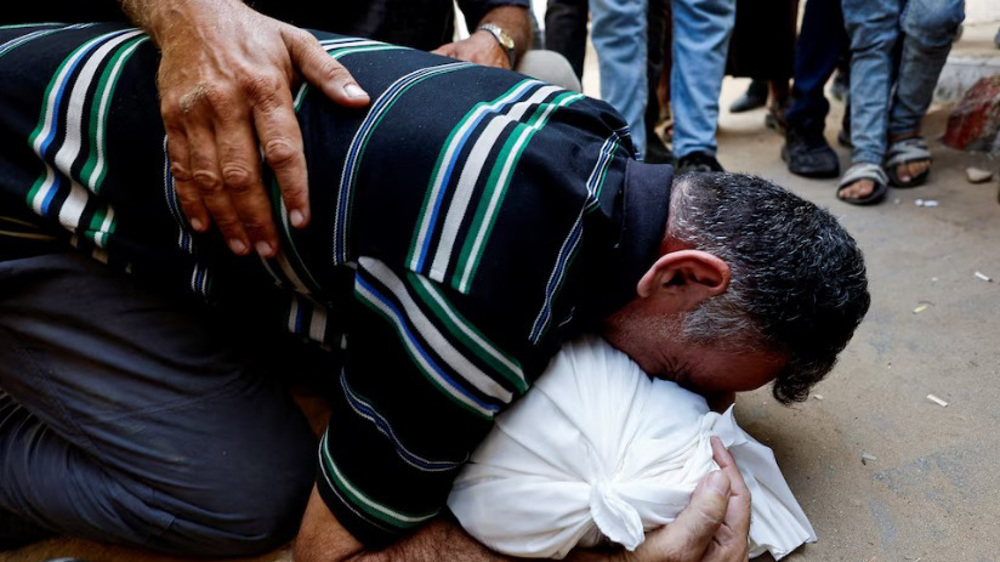
The resolution also cited the repeated forced displacement of Gaza’s entire population and the killing or injuring of more than 50,000 children.
“This destruction of a substantial part of a group constitutes genocide,” the association concluded in its report, referring to Israel’s brutal and deliberate attacks on children.
The IAGS called on the Israeli regime to halt “deliberate attacks on civilians, including children; starvation; deprivation of humanitarian aid, water, fuel, and other essentials; sexual and reproductive violence; and forced displacement.”
Melanie O’Brien, IAGS president and professor of international law at the University of Western Australia, said, “This is a definitive statement from experts in the field of genocide studies that what is going on the ground in Gaza is genocide.”
Emily Sample, a member of the association’s executive board, also noted they were “very surprised at the level of consensus there was.”
Sample added that the timing of the association’s resolution — long after the war began — may have stemmed from fear of “personal and professional consequences.”
🔸Opening of Justice 🔸
— Press TV Documentary (@presstvdoc) September 1, 2025
Gaza Genocide on Trial
South Africa takes Israel to the International Court of Justice, exposing war crimes and genocide in Gaza. pic.twitter.com/GKufh1aklZ
Losing livelihoods for speaking out
Members of the association had lost jobs in the United States and been denied visas to travel there for speaking out, she said.
IAGS resolution adds to a growing chorus of human rights organizations, UN experts, and academics, who have concluded that Israel is committing genocide in Gaza, where more than 63,600 people—most of them women and children—have been killed.
Israel now faces a genocide case at the International Court of Justice (ICJ), brought by South Africa, for violating international law by committing and failing to prevent genocidal acts.
The International Criminal Court has also issued arrest warrants for Israeli Prime Minister Benjamin Netanyahu and former minister of military affairs Yoav Gallant for war crimes and crimes against humanity.
Francesca Albanese, UN Special Rapporteur on the Occupied Palestinian Territories, authored two reports last year asserting that genocide was taking place in Gaza.
She now faces sanctions from the US government and is not allowed to travel to the occupied Palestinian territories.
Craig Mokhiber, an international human rights lawyer who previously served as the director of the New York office of the UN’s High Commissioner for Human Rights, described Israel’s actions in his October 2023 resignation letter as a “textbook case of genocide,” urging the UN to respond more forcefully.
He stepped down over the organization’s response to the genocidal war on Gaza, and called on the UN to attach the same standards to Israel as it does when assessing human rights violations against others around the world.
Last week, hundreds of UN staff members at the Office of the High Commissioner for Human Rights wrote to High Commissioner Volker Turk, urging him to explicitly call the Gaza war an unfolding genocide.
In Israeli-occupied territories, where public support for the onslaught in Gaza has been broad, divisions have emerged among academics.
Shmuel Lederman, an Israeli genocide scholar and political theorist at the Open University and University of Haifa, said that nearly all Israeli experts specializing in genocide studies now agree that Israel’s actions amount to genocide.
Thousands of Iranians took to the streets of Mashhad in solidarity with the people of Gaza and the resistance, denouncing the ongoing Israeli genocide.
— PressTV Extra (@PresstvExtra) July 25, 2025
Follow Press TV on Telegram: https://t.co/0EMmcJsEtj pic.twitter.com/VGqs9RFYD3
Growing chorus of ‘genocide’
Once hesitant to use the term himself, Lederman said in recent months, more of Israel’s academics, particularly international law experts, have changed their views after Israel announced a total blockade of humanitarian aid in March, which triggered a man-made famine across the besieged and war-torn territory.
“What we’ve been seeing is since late March, because of the starvation, the declaration of ethnic cleansing as an official aim, it’s not just genocide scholars — there seems to be a broader and broader agreement with legal scholars that we are seeing [genocide],” said Lederman, who recalled that he personally reached a similar conclusion in the spring of 2024.
“The bottom line is, there is a reason why so many people in this field of study agree. It’s very hard to be a genocide scholar and not say it’s genocide,” he added.
Professor William Schabas, one of the world’s foremost experts on international criminal law and genocide studies, echoed that view.
In an interview with the European Center for Populism Studies (ECPS) last month, the Middlesex University professor said that the genocide case brought by South Africa against Israel at the ICJ is “arguably the strongest case of genocide that has ever come before the Court.”
Schabas said genocidal intent can be inferred not only from Israel’s military actions but also from statements by senior officials, such as Gallant’s remarks about cutting off food, water, and electricity to Gaza.
“We have more than just a pattern of conduct—we also have statements and clear indications of policy. All of these must be considered together when making a final judgment,” said Schabas, who comes from a family of Holocaust survivors.
He also warned about Netanyahu’s populist rhetoric, framing Gaza’s population as an “existential threat,” saying, “Racist populist rhetoric has often been part of genocidal contexts, mobilizing mass support for atrocities. We see elements of that dynamic in Israel today.”
He further cautioned that third-party states—including the US, Germany, and Canada—could face legal accountability under Article III of the Genocide Convention for aiding and abetting Israel through military and political support.
“To the extent that they are providing material assistance of a significant nature, they can be held responsible as accomplices to genocide,” he warned.
“Ban against Israel is a positive but insufficient step”
— Highlights (@highlightsnews1) August 7, 2025
Sara Flounders highlights the effect of the growing international boycott against Israel for its genocide in Gaza.
Follow Press TV on Telegram: https://t.co/mtgZgtmxsz pic.twitter.com/F2XwNYkiw7
‘Absolutely a genocide’
In April, Schabas said that Israel’s onslaught on Gaza was “absolutely” a genocide.
Just days after the events of October 7, and the devastating war on Gaza that ensued, Raz Segal, an Israeli genocide researcher at Stockton University in New Jersey, US, called Israel’s assault on Gaza a textbook case of “intent to commit genocide.”
Israel’s exceptionalism and comparisons of its Palestinian victims to “Nazis” are used to “justify, rationalize, deny, distort, disavow mass violence against Palestinians,” Segal said.
A year later, in an interview with Vox, Segal reaffirmed his stance: “I fully stand behind my description of Israel’s attack on Gaza as a ‘textbook case of genocide’ because we’re still actually seeing, nearly a year into this genocidal assault, explicit and unashamed statements of intent to destroy”.
“The way that intent is expressed here is absolutely unprecedented.”
In July, Omer Bartov, a leading Israeli-American scholar, stated in a New York Times op-ed: “I’m a genocide scholar. I know it when I see it,” he wrote, concluding Israel is committing genocide against the Palestinian people.
“My inescapable conclusion has become that Israel is committing genocide against the Palestinian people … I have been teaching classes on genocide for a quarter of a century. I can recognize one when I see one,” he added.
In November 2023, Bartov believed Israel had committed war crimes, but claimed that the evidence did not meet the legal threshold for genocide. Over time, however, he concluded otherwise, citing overwhelming evidence.
Acknowledging his personal struggle, Bartov—who says he grew up “in a Zionist home,” lived in occupied territories, and served in the Israeli army—said he had resisted this “painful conclusion” as long as he could.
Amos Goldberg, historian and Chair in Holocaust Studies at the Hebrew University of Jerusalem, stated in October 2024 that Israel’s actions in Gaza, causing widespread destruction, forced displacement, and dehumanization, reflect genocide.
“What is happening in Gaza is genocide because Gaza does not exist anymore,” he said.
Ernesto Verdeja, an Associate Professor of Peace Studies and Global Politics at the University of Notre Dame’s Kroc Institute, and a genocide studies scholar, in January published an article, “The Gaza Genocide in Five Crises,” in the Journal of Genocide Research.
In an interview with Vox in October 2024, Verdeja said the war on Gaza could be “called a genocide, even in a narrow legal sense, for several months now,” given the accumulation of Israeli attacks clearly and consistently targeting the civilian population in Gaza.
“We have to hold Israel accountable for the genocide”
— Press TV 🔻 (@PressTV) August 28, 2025
Pro-Palestine protesters gathered in Paris to condemn the US-Israeli genocide in Gaza and urge European leaders to stop supporting the regime.
Follow Press TV on Telegram: https://t.co/LWoNSpkJSh pic.twitter.com/rYULaE6tRh
Dam of denial has broken
Adam Jones, a professor of political science at the University of British Columbia and a writer of a textbook on genocide, also told Vox at the same time that “Any early hesitation I had about applying the ‘genocide’ label to the Israeli attack on Gaza has dissipated over the past year of human slaughter and the obliteration of homes, infrastructure, and communities.”
Martin Shaw, British professor at the Institut Barcelona d’Estudis Internacionals, emeritus professor at the University of Sussex and author of the book What Is Genocide, has also repeatedly described the Gaza situation as genocide in talks and writing.
In a July article for New Lines Magazine titled “The dam of Gaza genocide denial has broken,” Shaw criticized the reluctance of politicians and media outlets to recognize genocide.
Even when some now admit it, he said, they do so with resignation: “Yes, it’s a genocide, but what can we do about it?”
In reality, he noted, they are effectively still in denial, failing to report on how Israel’s policies are enabled by wider Western support and therefore unable to explore ways in which it might be halted.
In December 2023, the Lemkin Institute for Genocide Prevention also declared the Israeli campaign genocidal, citing the massive civilian death toll, including children, tens of thousands injured, and explicit genocidal rhetoric.
A May investigation by Dutch newspaper NRC found that a growing number of leading genocide scholars worldwide believe Israel’s actions in Gaza constitute genocide.
The paper interviewed seven prominent genocide researchers from the Netherlands, the US, the UK, Australia, Croatia and Canada and occupied territories, all of whom described the Israeli bloodshed in Gaza as genocidal.
The scientists interviewed by NRC are Lederman, Anthony Dirk Moses, an Australian professor at the City University of New York and editor-in-chief of the Journal of Genocide Research, O’Brien, Segal, Shaw, Ungor, and Iva Vukusic, a Croatian genocide researcher at Utrecht University.
Many said their colleagues shared the same view.
“Can I name someone whose work I respect who does not think it is genocide? No, there is no counterargument that takes into account all the evidence,” Segal told NRC.
Professor Ugur Umit Ungor of the University of Amsterdam and NIOD Institute for War, Holocaust and Genocide Studies said that while there are certainly researchers who say it is not genocide, “I don’t know them.”
The Dutch paper reviewed 25 recent academic articles published in the Journal of Genocide Research, the field’s leading journal, and found that “all eight academics from the field of genocide studies see genocide or at least genocidal violence in Gaza.”
“And that is remarkable for a field in which there is no clarity about what genocide itself exactly is,” it noted.
Netanyahu begs Trump for ‘more’ help for pardon amid corruption case
Yasser Abu Shabab’s destiny is inevitable fate of every traitor: Hamas
Trump set to unveil Gaza governance plan before Christmas: Report



VIDEO | Press TV's news headlines
VIDEO | UAE-backed separatists seize key provinces in eastern Yemen
VIDEO | New data reveals India’s exports slide sharply over US tariffs
Man shot dead leaving mosque as Israeli raids, settler violence sweep West Bank
Niger accuses French nuclear giant Orano of ‘mass crimes’
Iran, Russia sign agreement to boost AI, cyber security cooperation
Lebanon’s Parliament Speaker: Talks under fire ‘unacceptable’
Video shows US killing shipwreck survivors in Caribbean strike, lawmakers say


 PressTV NEWSLETTER
now
PressTV NEWSLETTER
now

 This makes it easy to access the Press TV website
