‘Apocalyptic’ wildfire reaches Turkey’s Bursa as southern Europe grapples with blazes
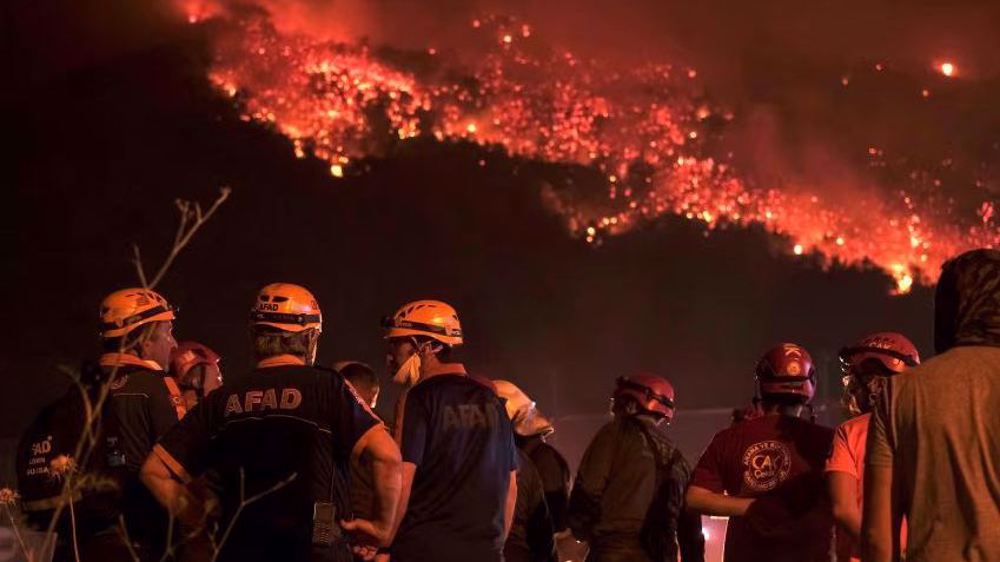
An "apocalyptic" wildfire has reached Turkey’s fourth-largest city, Bursa, as southwestern Europe grapples with devastating blazes.
Turkey's Disaster and Emergency Management Authority (AFAD) reported on Sunday that over 5,000 firefighters, more than 100 aircraft, and thousands of ground vehicles have been deployed to combat the 84 wildfires raging through the western provinces, resulting in 14 fatalities and forcing thousands to evacuate.
The General Directorate of Forestry, in coordination with all relevant institutions under the Türkiye Disaster Response Plan, is leading firefighting efforts both aerially and on the ground in high-risk provinces, including Karabuk, Bursa, Antalya, Mersin, Ankara, and Kahramanmaras.
A surge of wildfires has been impacting the country daily since late June, attributed to record high temperatures exceeding 50 degrees Celsius, along with dry conditions and strong winds.
"Yesterday, we faced 84 fires across the country—36 in forested areas and 48 in non-forest regions," Agriculture and Forestry Minister Ibrahim Yumakli stated. He cautioned that the risk of wildfires remains high nationwide.
Yumakli urged the public to remain vigilant in the face of the escalating wildfire threat in the coming days. "We are entering a period of heightened risk for forest fires. Not only must we, but all our citizens, stay alert until October 2025."
He noted that firefighters throughout the country were engaged in battling multiple blazes in forests and rural areas on Saturday.
Yumakli emphasized that the northwest region, including Karabuk, faces the greatest threat, where wildfires have been active since Tuesday.
On Friday, Turkey recorded its highest temperature ever at 50.5 degrees Celsius in the southeastern city of Sirnak. “As the Ministry of Agriculture and Forestry, we are present on the ground fighting these forest fires with our planes, helicopters, and unmanned aerial vehicles in the air, alongside our dedicated ground teams and local support from AFAD, provincial governors, and non-governmental organizations.
“We are prepared, but the most effective way to extinguish fires—without cost or complication—is to prevent them from starting.”
According to the General Directorate of Meteorology, temperatures are expected to rise by another 10 degrees starting Saturday.
Overall, 133 locations in Turkey recorded their highest temperatures for July.
Meanwhile, flames are rapidly approaching Bursa, Turkey’s fourth-largest city, in the northwest.
Orhan Saribal, an opposition parliamentarian from Bursa, described the situation as “apocalyptic.”
The wildfire has scorched 3,000 hectares around the city, and over 1,100 firefighters continue to battle the flames. The highway linking Bursa to the capital, Ankara, has been closed as surrounding forests burn.
The government has declared two western provinces, Izmir and Bilecik, disaster zones as of Friday.
In recent weeks, 14 people have perished, including 10 rescue volunteers and forestry workers who lost their lives in a fire in Eskisehir on Wednesday.
Justice Minister Yilmaz Tunc revealed late Saturday that prosecutors have investigated fires in 33 provinces since June 26, leading to legal action against 97 suspects.
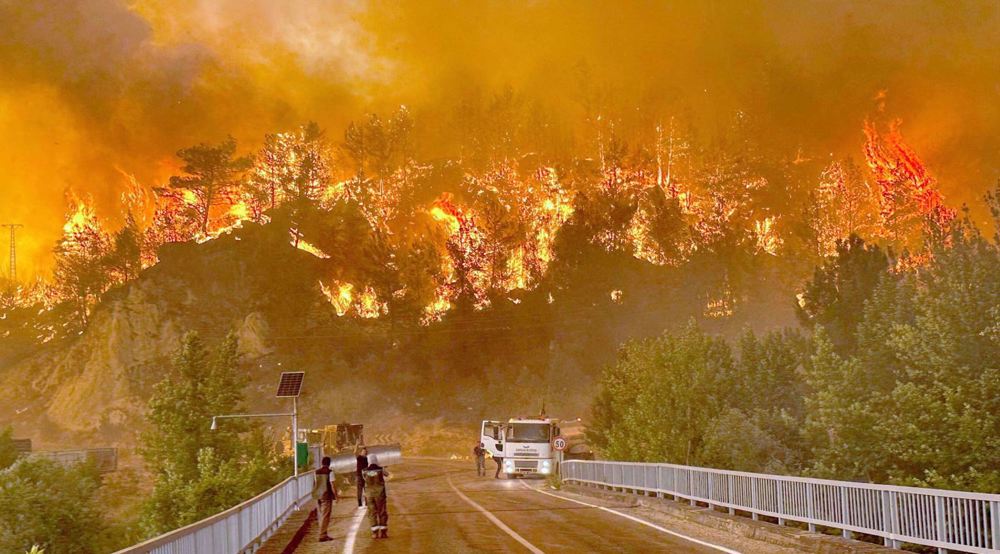
Simultaneously, wildfires have erupted elsewhere in Europe, wreaking havoc in Greece, where temperatures have soared above 44 degrees Celsius, and affecting Italy, Montenegro, and Albania.
In Italy, the ANSA news agency reported over 50 wildfires igniting in recent days near Sicily's tourism capital, Palermo, which experienced record temperatures exceeding 40 degrees Celsius.
Several wildfires have also emerged in eastern Sicily, particularly near Mineo and the city of Catania, where firefighting teams are actively engaged.
In the town of Partinico, seven fires caused damage to two homes and affected a large area, prompting the evacuation of around 30 houses. One firefighter was hospitalized due to smoke inhalation.
On the island of Sardinia, another popular tourist destination, a wildfire near Serramanna was brought under control in the evening.
In Athens, Greece’s capital, parts of the city have been evacuated following more than 50 wildfires that broke out within 24 hours.
Residents of Kryoneri, about 20 km northeast of Athens, were advised to move to safer areas on Saturday.
At least five individuals, predominantly elderly individuals with respiratory issues, have received treatment for burns or smoke inhalation.
Greek authorities have warned that the unseasonably high temperatures, dry conditions, and strong winds fueling the wildfires are likely to persist. “These conditions are expected to continue in the coming days," stated Greek fire service spokesperson Vassilis Vathrakoyannis.
In Albania, 26 wildfires broke out on Saturday, following a significant fire near the southern town of Delvina on Friday, which injured three people and forced the evacuation of about 2,000 residents.
Reports indicated that wildfires have scorched the landscape near Bulqiza as emergency services worked tirelessly to contain the flames.
In Kosovo, firefighters successfully extinguished 17 wildfires fueled by strong winds, while 12 remain active, according to officials.
Montenegro's capital, Podgorica, also experienced wildfires on Sunday, with smoke billowing from charred tree branches and flames dangerously close to city towers.
Climate experts attribute the unusually high temperatures, dry conditions, and strong winds to the surge of wildfires affecting holiday hotspots across southeastern Europe this summer.

Muslims must set disputes aside, unite and trade: Pres. Pezeshkian
Turkish military plane with 20 onboard crashes in Georgia
Turkey issues ‘genocide’ arrest warrants for Netanyahu, top Israeli authorities



‘Sickening’: Trump’s ‘Peace Prize’ moment at World Cup draw sparks worldwide cringe
Iran drawn against Belgium, Egypt, New Zealand in 2026 FIFA World Cup Group G
VIDEO | Slamming ‘Greater Israel’ project
VIDEO | Press TV's news headlines
VIDEO | UAE-backed separatists seize key provinces in eastern Yemen
VIDEO | New data reveals India’s exports slide sharply over US tariffs
Man shot dead leaving mosque as Israeli raids, settler violence sweep West Bank
Niger accuses French nuclear giant Orano of ‘mass crimes’




 PressTV NEWSLETTER
now
PressTV NEWSLETTER
now

 This makes it easy to access the Press TV website
