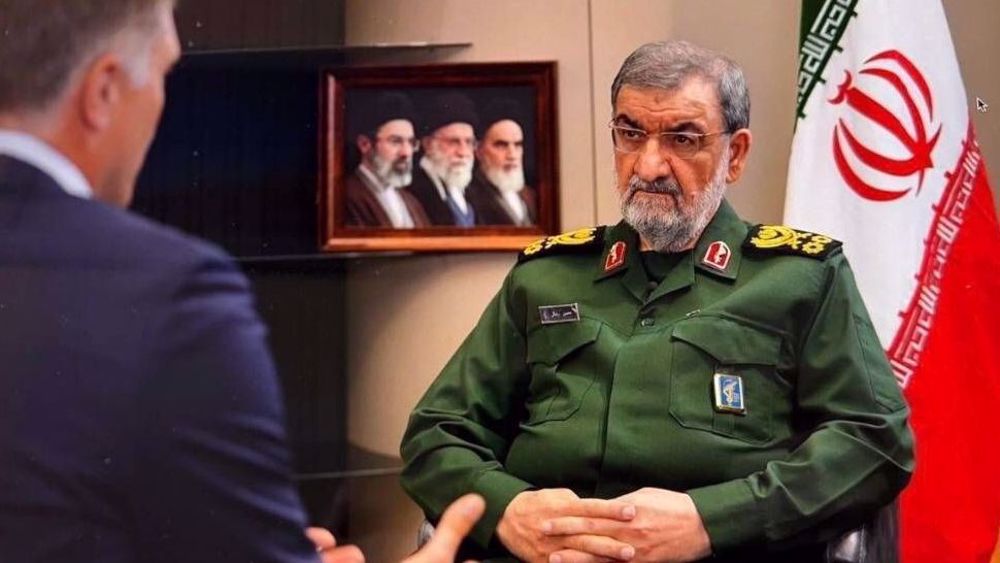
A senior advisor to Leader of the Islamic Revolution Ayatollah Seyyed Mojtaba Khamenei has strongly warned the United States against leading itself into a quagmire by renewing aggression against Iran.
"They know that the cost of negotiations is far lower than the cost of war. If they choose military action again, they will enter a dark and endless corridor," former chief commander of the Islamic Revolution Guards Corps (IRGC), Mohsen Rezaei told CNN in an interview on Friday.
Iran's armed forces: Enemy forced to accept new Iranian ruleshttps://t.co/UycQygsQrB
— Press TV 🔻 (@PressTV) June 3, 2026
Warning about extra-regional conflict
Rezaei followed his remarks with a warning about the potential geographical consequences of such ill-advised aggression.
Commenting on the US's repeatedly threatening to target Iran's infrastructure, he said, "If the war continues and the blockade persists, we will expand the conflict beyond the region, from the Indian Ocean to the Red Sea, the Bab el-Mandeb Strait, and the Mediterranean Sea. That would be very bad for the United States."
The United States and the Israeli regime launched their latest bout of unprovoked aggression against Iran on February 28.
Iran responded by waging at least 100 waves of decisive and successful retaliatory strikes against sensitive and strategic American and Israeli targets throughout the region.
The Islamic Republic also shut down the Strait of Hormuz to enemies and their allies, sending shockwaves throughout the global energy markets, including in the United States, where energy prices and, by extension, the prices of various commodities began to skyrocket.
Amid the situation, Trump announced a unilateral ceasefire on April 7.
✍️ Analysis - End of 'tit-for-tat' era: Iran’s broad, asymmetric response to US attacks redraws the deterrence equation
— Press TV 🔻 (@PressTV) June 3, 2026
By Press TV Strategic Analysis Deskhttps://t.co/MVDp8qqOZQ
'Negotiations are at an impasse'
Rezaei argued that US President Donald Trump was the principal obstacle to progress in diplomatic engagement between the two sides.
"The ball is now in America's court. Trump is the main problem in the negotiations," he said.
"He speaks ambiguously, and according to his own statements, this is his method. However, that approach does not work with Iran. He must speak clearly."
Negotiations are at an impasse that Trump must resolve, Rezaei added, noting that "a profound atmosphere of mistrust" currently dominates the issue of interaction between the two sides.
'Unfreezing assets a confidence-building test'
When told that Trump has claimed he is waiting for Iran's response, Rezaei said, "Iran has clearly stated that our frozen assets should be released, but the Americans provide ambiguous responses."
"This is a test of confidence-building and a way to prove the minimum level of seriousness in negotiations."
The official also advised the American president to decide independently of the Israeli regime, set personal gains aside, and prioritize Americans' interests.
'No trust in nuclear deal with Trump'
Discussing Iran's nuclear energy program, the advisor said the Islamic Republic had acted within international regulations and the Nuclear Non-Proliferation Treaty (NPT).
He pointed to the Joint Comprehensive Plan of Action (JCPOA), noting how Trump tore up the 2015 nuclear deal.
"Therefore, we are highly suspicious of Trump's insistence on dismantling Iran's nuclear program," he said.
"We do not trust any nuclear agreement with Trump, and at present, there will be no negotiations on the nuclear issue."
'Insecurity to be confronted in Strait of Hormuz'
Addressing the situation brought about by the unprovoked American-Israeli aggression in the strategic Strait of Hormuz, the advisor said the waterway "is not dangerous for commerce," but attempts at sowing insecurity and military deployment targeting the chokepoint would be confronted.
"It is the United States that has made this region dangerous."
The official also addressed Washington's opposition to Tehran's imposing environmental and transit service fees in the Strait of Hormuz.
"The Strait of Hormuz belongs to Iran and Oman, and its management is our responsibility," he said, adding that the fees should, therefore, be collected.
Rezaei rejected allegation against the Islamic Republic concerning an alleged attack on Kuwait Airport. "We targeted the US base in Kuwait in response to American aggression."
He added that throughout the joint aggression too, Iran targeted only American bases and interests in retaliation, despite some neighboring countries' making their airspaces fully available to Iran's adversaries.
Asked whether a meeting between Trump and Iran's Leader could take place after Trump said such a meeting would be an "honor" for him, Rezaei responded, "That will not happen."
Reflecting on what Iran had learned from the war, Rezaei said the aggression had demonstrated the growing importance of asymmetric warfare.
"The war also demonstrated that the era of conventional warfare is coming to an end and that asymmetric warfare combined with innovation and creativity is now more effective," he said.
He, meanwhile, rejected the notion that Iran's military power rested solely on missiles and drones.
"In fact, we were waiting for a US ground invasion so that the world could see Iran's real power, because our Ground Forces are also extremely powerful."
 This makes it easy to access the Press TV website