Iran renews warning about Israeli intentions amid diplomatic engagement with US
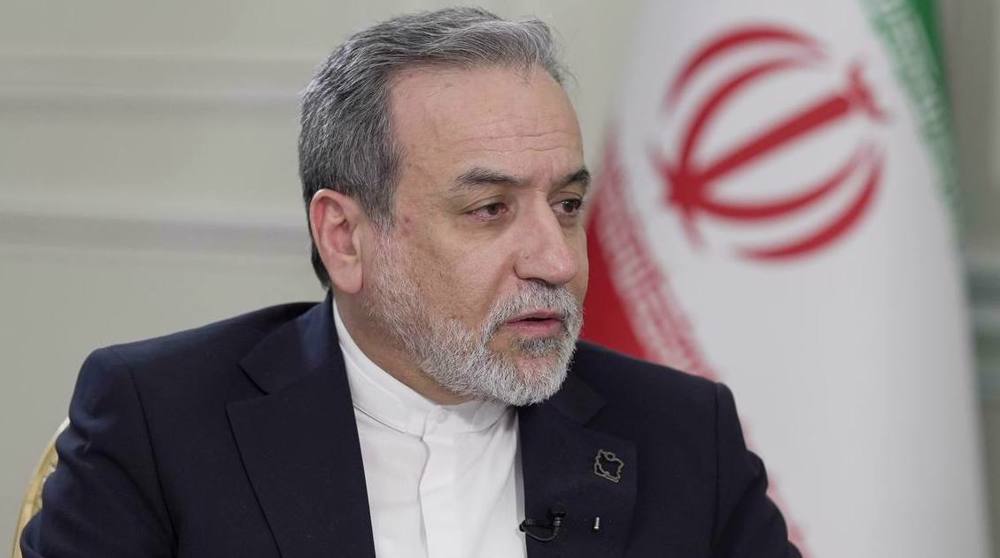
Foreign Minister Abbas Araghchi has renewed Iran’s warning about the Israeli regime’s desire to drag the United States into another war against the Islamic Republic amid renewed nuclear negotiations between Tehran and Washington.
The top diplomat made the remarks in an interview with Russia Today on Tuesday, when asked about Israeli prime minister Benjamin Netanyahu’s pending visit to the White House, where the latter is expected to try to adversely affect the diplomatic process.
Araghchi described Netanyahu as a “warmonger” who “doesn’t like” peace or diplomacy. “In the past two years, he has attacked seven countries in our region,” the foreign minister said, noting that the last target was Qatar, “an ally to the US, a friend to the US and the West.”
Netanyahu “has no solution in his mind but war” and has repeatedly tried “to drag the United States into war with Iran,” he added.
The official cited the regime’s prior such attempt that saw Washington join Tel Aviv halfway through the latter’s imposed war on the Islamic Republic in June.
He described the experience as “a disaster” for both the regime and the United States, referring to the Islamic Republic’s decisive and successful retaliation that forced Tel Aviv to call for a ceasefire through Washington.
“And if they try a failed experience, once again, the result would not be any different,” Araghchi said.
The Israeli premier’s pending visit is reportedly going to feature his trying to push the US president to include the issue of Iran’s missile program in the talks.
Tehran has roundly ruled out such prospect, identifying its missile capability as an integral part of its defensive might and, therefore, a sovereign right.
Our missiles have put Zionist regime in its place: Iran’s top security official https://t.co/AODVkdlXcr
— Press TV 🔻 (@PressTV) February 10, 2026
On the indirect talks, the latest round of which took place in the Omani capital Muscat on Friday, Araghchi said the Iranian delegation’s interlocutors, including Trump’s son-in-law Jared Kushner and Washington’s regional envoy Steve Witkoff, were “trying to avoid war and to find a diplomatic solution.”
The official characterized this approach as “the wisest decision that President Trump can make.”
He, however, once again reminded that Netanyahu “doesn’t like the fact that the talks are going well.”
The foreign minister, meanwhile, emphasized that the Islamic Republic’s commitment to the process depended on that of the United States, stating, “If they are serious, which we are still not completely sure about, we are serious too.”
‘Iran doesn’t fully trust US, but deal still possible’
Araghchi recalled the Joint Comprehensive Plan of Action (JCPOA), the nuclear deal that was reached in 2015 between Iran and the P5+1 – the US, Russia, China, the UK, France, and Germany.
The agreement led to removal of some nuclear-related sanctions against Iran in exchange for imposition of certain limits on the Islamic Republic’s peaceful nuclear energy program.
Three years later, however, Trump withdrew from the deal during his previous tenure, re-imposed the sanctions, and even subjected the Islamic Republic to more illegal and unilateral coercive measures.
Araghchi reminded the history, besides making fresh reference to the American betrayal of the diplomatic process in June, noting that, in light of such experiences, Iran did not fully trust the United States. “That was a very, very bad experience for us,” he said, adding that Tehran needed “a tangible guarantee” that such a scenario would not be repeated.
Citing his two decades of experience in nuclear negotiations, however, the foreign minister said he believed it was still possible to reach an agreement with Washington.
Such a deal could even be better in nature than the JCPOA, he noted, saying he had instructed his team to work on a practical proposal that would ensure the peaceful nature of Iran’s nuclear program, while safeguarding its rights to peaceful nuclear technology for electricity generation, medicine, agriculture, and other civilian uses.
The foreign minister reiterated the Islamic Republic’s categorical rejection that the talks could come to include matters other than the nuclear issue, such as Iran’s missile program or regional influence and ties.
‘Iran prefers diplomacy, but defends itself if necessary’
The Islamic Republic’s preference lies in diplomacy, Araghchi concluded, but stressed that the country was also equally ready to defend itself against any new aggression if necessary.
The official warned that the Iranian Armed Forces would, among other things, target the US bases and other assets in the region if Washington targeted the nation’s soil in a fresh act of military adventurism.
FM Araghchi says Iran will cease defensive strikes if unprovoked attacks are halted

Iran’s Jewish community condemns US-Israeli attack on synagogue in Tehran

Civilized Iran will win over US logic of brute force: FM spokesman



Lebanon part of Iran-US truce deal: Pakistani ambassador to Washington
Hezbollah returns fire with fire; vows to sustain strikes until US-Israeli aggression ends
Israel's priority lies in destroying chances of peace between Iran, US: Ex-UN nuclear chief
President Pezeshkian calls ceasefire in Lebanon key condition in Iran’s 10-point ceasefire proposal
US-Israeli aggression on Iran: What happened on 40th day of the imposed war
Speaker Qalibaf says ceasefire, negotiations with US ‘unreasonable’, citing truce violations
US military morale 'extremely low' as troops question point of going to war against Iran: Report
Pezeshkian: Iran will respond decisively to any ceasefire violation



 PressTV NEWSLETTER now
 This makes it easy to access the Press TV website