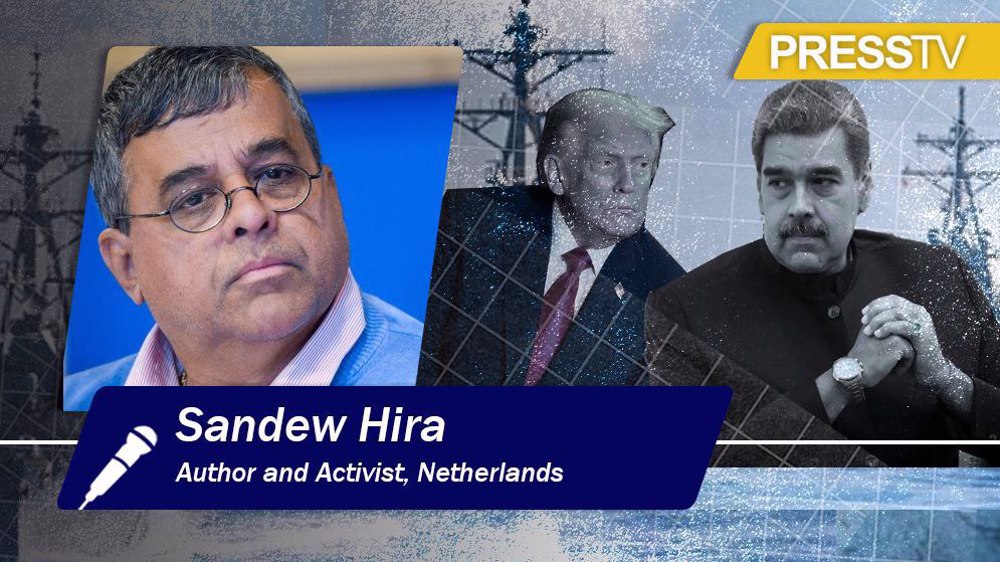
By Mohammad Ali Haqshenas
US military buildup against Venezuela is part of a long-standing pattern of attempts to reshape Latin America, and today’s military threats are aimed squarely at "regime change" in Caracas and securing control of the country’s vast oil resources, says an expert.
Sandew Hira, secretary of the Decolonial International Network Foundation (DIN) and a noted expert on decolonial studies, told the Press TV website in an interview that Washington’s current threats against Caracas mirror earlier episodes of US interventionism across the region.
“The military threat against Venezuela fits in a long history of military interventions by the USA in Latin America and the Caribbean,” said Hira, whose real name is Dew Baboeram.
He traced that history back to the mid-19th century, recalling the US annexation of large parts of Mexico before the abolition of slavery.
After the Civil War, he noted, a victorious liberal capitalist system "focused on building an economic empire for US companies,” and that push defined decades of American involvement in the hemisphere.
The analyst and author pointed to the 1898 Spanish-American War, which resulted in the US occupation of Cuba, Puerto Rico, Guam, and the Philippines, and to President Theodore Roosevelt’s support for Panama’s separation from Colombia in 1903 to secure a canal zone.
Hira noted that US troops “intervened multiple times” in the following decades and later invaded Cuba, Nicaragua, Haiti, the Dominican Republic, Honduras, Guatemala, and Grenada.
He said Washington also orchestrated coups across the region to install far-right governments, listing Guatemala in 1954, Brazil in 1964, Chile in 1973, Uruguay in 1973, and Argentina in 1976.
To illustrate the mindset behind such actions, he quoted Maj. Gen. Smedley Butler, who famously described himself as “a high-class muscle man for Big Business, for Wall Street and the bankers,” and “a racketeer; a gangster for capitalism.”
Butler’s account, the decolonial expert said, captured the consistent logic of US power projection.
“Venezuela is the next on the list of the US military, and it's not about drugs, but about oil,” Hira said.
He asserted that US sabre-rattling in Latin America today reflects this same pattern. The goal, he said, is not counternarcotics but political engineering.
The Venezuelan president, Nicolas Maduro, says Venezuela wants peace, but peace with sovereignty, equality, and freedom.
— Press TV 🔻 (@PressTV) December 2, 2025
Follow: https://t.co/mLGcUTS2ei pic.twitter.com/IoWBzEEaNf

“The aim of the US military action is regime change,” he noted, adding that Venezuela has held repeated elections with broad participation and retains a strong base of pro-government mobilization.
Hira, however, stated that any bombing campaign against people in Latin American countries could inflict damage on infrastructure, “but it cannot destroy the spirit of resistance.”
Ordinary Venezuelans, he added, oppose war and would rally around the government, especially if foreign forces intervened. In the event of a ground invasion, he said the US would face not only the Venezuelan army but “millions of militia members.”
The remarks come as Washington has expanded its military footprint in waters near Venezuela.
Over recent months, the US Navy has deployed the USS Harry S. Truman strike group to the Atlantic and intensified attacks under the guise of anti-narcotics enforcement.
Since September, US forces have conducted more than 20 lethal strikes in the Caribbean and eastern Pacific, killing over 80 people, with human rights bodies slamming them as extrajudicial killings.
The threats have not stopped there. Over the weekend, US President Donald Trump used his social media platform to claim that airlines should treat Venezuela’s airspace as “entirely closed.”
Caracas condemned the threat as political posturing aimed at isolating the country.
Authorities revoked the licenses of six international airlines that halted operations, for aligning with US pressure and contributing to “state terrorism.”
Venezuela subsequently slammed the move as a “colonial threat.” In a formal statement, it rejected Washington’s attempt to assert extraterritorial jurisdiction over its airspace, saying the move endangered the country’s “territorial integrity, aeronautical security and full sovereignty.”
It described the warning as “another extravagant, illegal and unjustified aggression.”
✍🏻 Viewpoint - Cartels or conquest? The phony US ‘war on drugs’ masks a Venezuelan oil grab
— Press TV 🔻 (@PressTV) November 25, 2025
By Mohammad Molaeihttps://t.co/0SqxDTWMfO
Hira said Venezuelans view such pressure through the lens of decades of political education, adding that the country’s electoral cycle, since Hugo Chávez’s rise to power in 1998, has produced a population well-versed in recognizing foreign interference.
“Each election is a massive campaign in education of how imperialism works,” he told the Press TV website, describing repea ted electoral victories by Chavistas as a reflection of that political awareness and organizational strength.
Tensions have also deepened as Washington signaled potential ground action. In his Thanksgiving message to troops, Trump suggested that the US could “very soon” take action by land against Venezuela. Days before that, the deployment of the USS Gerald R. Ford marked one of the largest US military presences in the Caribbean in decades.
The Venezuelan government has warned that such moves are tied to US ambitions over the country’s natural resources.
President Nicolás Maduro, in a letter to OPEC members and the group’s secretary general, said Washington intends “to take control of Venezuela's vast oil reserves, the largest on the planet, through the use of lethal military force.”
He said the claim undermines global energy stability and violates the principles of peaceful coexistence.
Maduro insisted that Venezuela would defend its resources with “legality and dignity” and would not succumb to threats or coercion.
Hira echoed that sentiment, saying Venezuelans understand the stakes and remain committed to preserving the gains of the Bolivarian Revolution.
Press TV’s Gladys Quesada from Caracas provides the latest updates regarding Trump’s decision to close the airspace over and around Venezuela.
— Press TV 🔻 (@PressTV) November 30, 2025
Follow Press TV on Telegram: https://t.co/LWoNSpkc2J pic.twitter.com/B13JAWclZP
He said the country’s resistance is rooted in political consciousness and historical experience. Previous attempts by Washington to cultivate opposition forces, especially since 2015, have failed, he argued, because they lacked organic support and underestimated the depth of the popular movement.
He said US-backed strategies misread the country’s institutions and society, which he described as strongly shaped by decades of participatory politics.
The threats may escalate, he said, but they reinforce rather than weaken national unity.
“There is a popular revolution,” he said, and a population prepared to defend it.
In that sense, he added, Washington’s push toward confrontation exposes the limits of its power. A campaign aimed at regime change, he said, overlooks the resilience of Venezuelan society.
“It will strengthen the support for the revolution, because ordinary Venezuelans are against war,” he said. “If a ground war takes place, then the US military has to deal not only with the army, but also with millions of militia members.”
 This makes it easy to access the Press TV website