Catherine Connolly: Ireland’s new president minces no words on Gaza genocide, US-NATO militarism
By Humaira Ahad
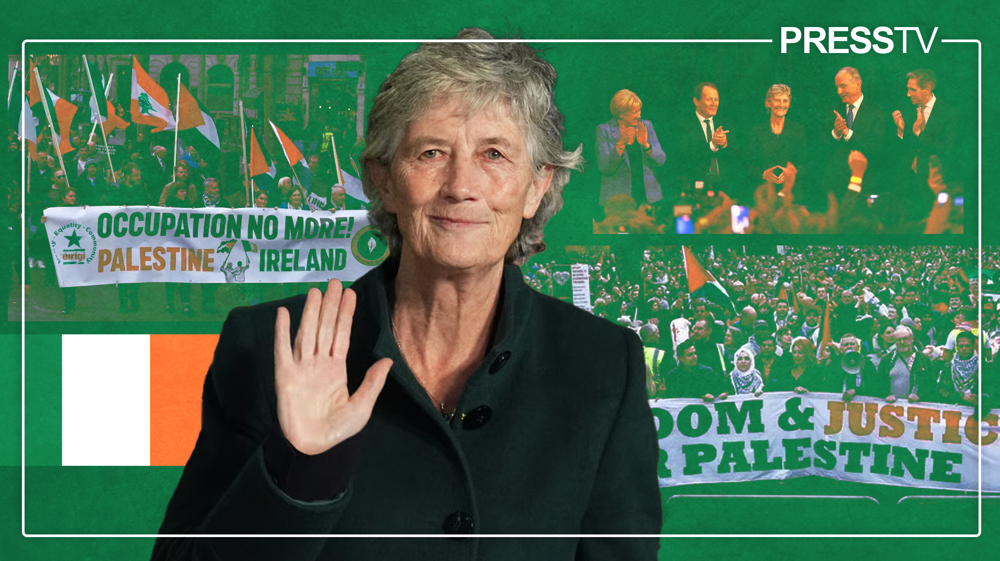
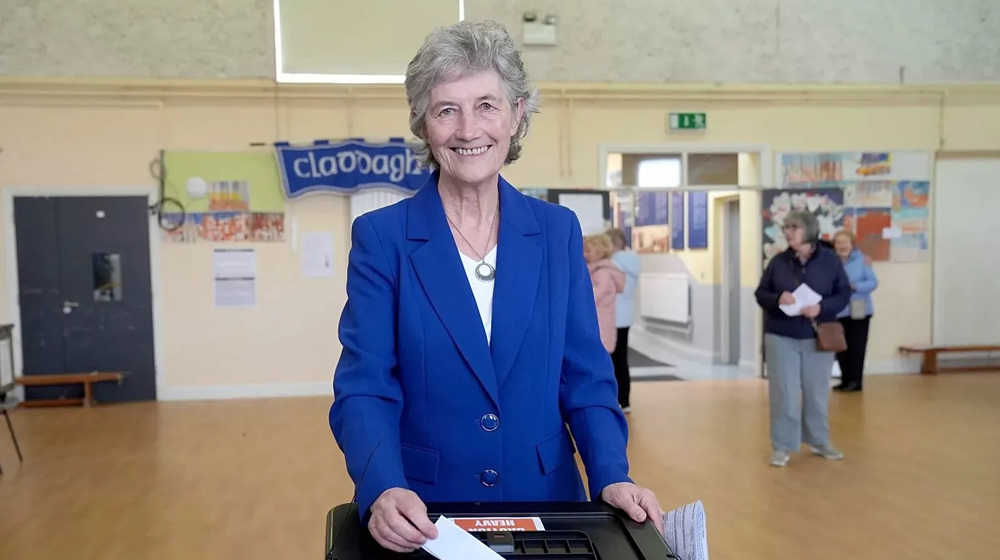
At Dublin Castle on Saturday evening, visibly excited and thrilled, Catherine Connolly stood to greet supporters, hours after the results of the Irish presidential elections were declared.
“I will be a president who listens, who reflects and who speaks when it’s necessary,” Connolly told the cheering crowd. “Together we can shape a new republic that values everybody.”
The 68-year-old left-wing independent politician secured 63 per cent of the vote, defeating her centre-right rival, former Cabinet minister Heather Humphreys.
Connolly’s victory has been widely seen as a clear signal that Irish voters are ready for a presidency that will confront traditional approaches to foreign policy, challenge the country’s controversial military alliances, and bring back social justice in national discourse.
Journey from Galway to Áras an Uachtaráin
Connolly’s story began in a suburb of Galway, a harbour city on Ireland’s west coast, one of 14 children in a social housing unit. Her mother died when she was only nine, and her father worked at a local shipyard to provide for the family.
As a student, Connolly volunteered with a Catholic organisation to help older people, while taking on additional community roles. She later earned degrees in clinical psychology and law, and practised as a lawyer before entering politics.
Her political career began in 1999 when she was elected as a Labour Party member of Galway City Council. She became mayor of Galway five years later, in 2004, and left Labour in 2007 to continue her career as an independent.
For nine years, she served as an opposition socialist lawmaker in the Irish parliament, building a reputation for speaking forcefully on inequality and foreign policy issues, particularly those involving Western military interventions.
Connolly’s rise to the presidency represents a generational and ideological shift. She is Ireland’s tenth president and the third woman to hold the post.
Her campaign drew the backing of left-leaning parties, including Sinn Féin, the Labour Party, and the Social Democrats, appealing particularly to younger voters who valued her social justice and pro-Palestine positions.
Catherine Connolly won Ireland’s presidential election in a sweeping victory, securing 63% of the vote. The 68-year-old independent, known for her pro-Palestine stance, was officially declared the winner after all 43 constituencies completed their count on Saturday evening. pic.twitter.com/rX3vajaK0v
— Press TV 🔻 (@PressTV) October 26, 2025
Pro-Palestine and anti-Israel stance
Throughout her election campaign, Connolly was outspoken in denouncing Israel. She repeatedly condemned the regime’s genocide in Gaza and called it “a terrorist state.”
“If we in this Dáil can’t recognise that Israel is a terrorist state, then we’re in serious trouble,” she said in a video shared on her campaign’s Facebook page in June, referring to the lower house of the Irish legislature where she served.
At a campaign event in September, she linked Ireland’s history of colonisation with her caution about foreign powers telling a “sovereign people” how to run themselves, referring to Palestine.
“I come from Ireland, a history of colonisation, and I would be very wary of telling a sovereign people how to run their country. The Palestinians must decide in a democratic way who they want to lead their country.”
In September, she asserted that the Palestinian resistance movement Hamas, which has been at the forefront of the Palestinian struggle for liberation from the Zionist settler-colonial regime, is “part of the fabric of the Palestinian people.”
In various interviews and campaign appearances, Connolly said Hamas was elected in 2006 before the Israeli regime imposed a blockade on Gaza.
“They are part of the civil society of Palestine,” and the media and others rely on casualty figures from Hamas because it is the party in charge of public institutions there, including the Palestinian health ministry, she noted.
She has openly condemned Israel for carrying out genocide in Gaza, and for its military assaults in the wider West Asian region, including its unprovoked aggression against the Islamic Republic of Iran in mid-June, which claimed the lives of more than 1,000 people, including military commanders and nuclear scientists.
These remarks and her critique of the Israeli regime’s settler-colonial and genocidal policy became a hallmark of her campaign.
Her strong pro-Palestine stance and her commitment to social justice, among other issues, resonated strongly with young voters who have been prioritising a vocal, independent stance on global human rights issues.
Independent candidate who called Israel ‘terrorist state’ elected Ireland’s president https://t.co/sr3bZSeMEy
— Press TV 🔻 (@PressTV) October 26, 2025
Questioning the United States and NATO
Connolly’s positions extend beyond the West Asian region. She has consistently criticised US involvement in wars where American funding supports military operations worldwide.
“Genocide was enabled and resourced by American money,” she said in a final televised presidential debate last week.
When asked how she would treat US President Donald Trump, who has a golf resort in Ireland and plans to visit when it hosts the Irish Open next year, Connolly said:
“If it’s just a meet and greet, then I will meet and greet. If the discussion is genocide, then that’s a completely different thing.”
In an interview in August, Connolly slammed US hegemonic policies, describing Trump as “volatile, unpredictable, acting like a bully” and warning that the human cost of American-backed genocidal war on Gaza was being overlooked.
“Have I a trust problem with America? I think everyone in the country has a trust problem with America. We have a President Trump who’s volatile, unpredictable, acting like a bully, bringing in tariffs when it suits them,” she said.
She highlighted the humanitarian crisis in Gaza, “We keep talking about the consequences of tariffs, but we never talk about the consequences of genocide … Famine has been created in Gaza like it was in Ireland in 1845, a man-made famine.”
She has also criticised the Western military-industrial complex. In parliament and public statements, she has often expressed scepticism towards NATO and the European Union’s increasing militarisation in the wake of NATO’s proxy war in Ukraine.
She drew parallels between current EU armament trends and historical military buildups, including comparisons with Nazi-era rearmament in the 1930s, and questioned NATO’s eastward expansion.
She argued that the United States, the United Kingdom and France were deeply implicated in the global arms trade and that their foreign-policy decisions.
“What is behind their motivation is simply an arms industry, more war” and “making huge profits”. She also said, “That needs to be called out over and over.”
In parliament, she consistently highlighted the human consequences of military interventions and Western policies, not only in Gaza, but also in Syria, which she visited in 2018.
She has framed her opposition to certain Western powers and military alliances as consistent with Ireland’s historical experiences and commitment to neutrality.
The new Irish president has also stressed she wants to defend Ireland's tradition of military neutrality, in the face of calls for the country to contribute more to European defence.
During her campaign, she said there should be a referendum on a government plan to remove the “triple lock”, the conditions for the deployment of Irish soldiers on international missions.
A pro-Palestine left-wing politician was elected Ireland's 10th president by a landslide margin.
— Press TV 🔻 (@PressTV) October 26, 2025
Follow: https://t.co/mLGcUTSA3Q pic.twitter.com/7fWPmOzg82
Domestic and international reactions
Connolly’s election triggered reactions across Ireland’s political spectrum.
Heather Humphreys, her centre-right competitor, said Catherine will be a president “for all of us, and she will be my president, and I really would like to wish her all the very, very best.”
“Catherine Connolly is Ireland's new President, despite the best efforts of Mainstream Media who did everything to stop her. Catherine opposed the Militarisation of EU, opposed NATO War Machine, opposed Western Imperialism,” he said.
In a message congratulating the Irish people, renowned Irish documentary filmmaker Sean Murray said, “A win against corporatism, war criminals, corruption and all the dirty tricks of the establishment. But most of all an emphatic win for the Irish people.”
International observers have highlighted the significance of her foreign policy positions.
Media coverage has described Connolly as outspoken on the Gaza genocide, critical of the Israeli regime, and wary of NATO and US interventions.
Her election reflects a convergence of factors, including growing dissatisfaction with inequality, support for a neutral foreign policy, and the mobilisation of younger voters who support progressive social and foreign policy agendas.
She has pledged to focus on listening and reflection, asserting: “Together we can shape a new republic that values everybody, that values and champions diversity and that takes confidence in our own identity, our Irish language, our English language, and new people who have come to our country.”
Domestically, experts believe Connolly’s presidency may strengthen the visibility of left-wing positions on social justice, equality, and inclusivity.
Internationally, she signals that Ireland may take a more assertive stand on humanitarian issues, a stance that aligns with the convictions she has articulated throughout her career.
Hamas: Huckabee’s remarks expose ‘American bias towards Zionist domination, annexation’
Family of US citizen killed by Israeli settler demands end to impunity
Hezbollah confirms 8 fighters killed in Israeli strikes on eastern Lebanon



VIDEO | US support for Israel’s expansionist agenda
Palestinians granted only 66 building permits in West Bank over 11 years: Report
Somaliland ready to give US access to its minerals, military bases: Minister
VIDEO | Iran's game changing retaliation boxes- part 1
VIDEO | Iran's game changing retaliation boxes- Part 2
VIDEO | Palestinian widow raises three kids in Gaza as her husband killed by Israel
Palestinian teen killed as raids and settler violence intensify across West Bank
Iran’s layered arsenal primed to deter – and decimate – US warships in Persian Gulf



 PressTV NEWSLETTER
now
PressTV NEWSLETTER
now

 This makes it easy to access the Press TV website
