Israeli military tanks roll out of Gaza as children sing over land ravaged by ecocide
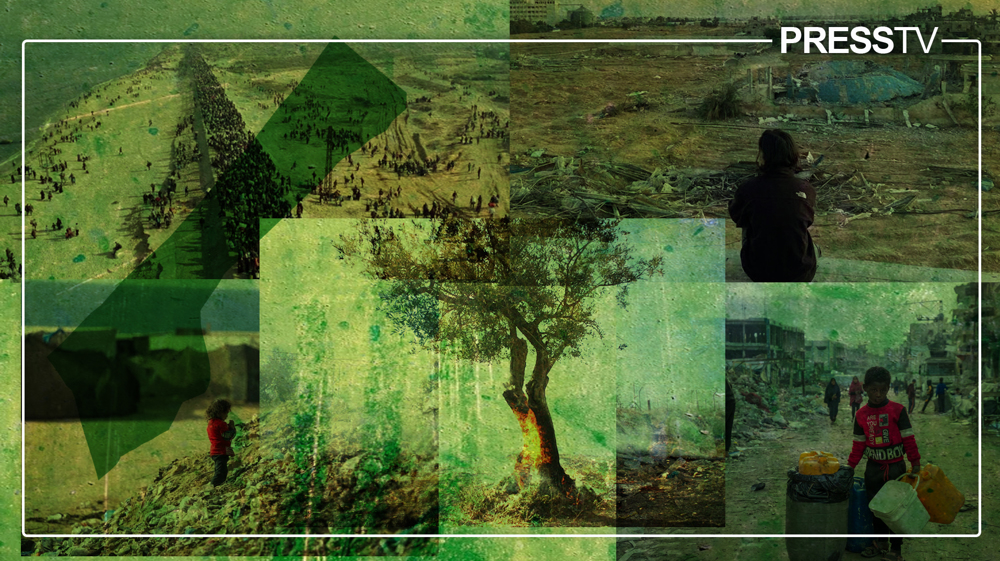
By Nahid Poureisa
Watching social media footage of displaced people returning home after the announcement of a ceasefire in Gaza touches the hearts of anyone, no matter where they come from.
Seeing young children dance and sing beautiful Arabic songs about their battered and bruised homeland, waving flags larger than their small bodies, brings smiles to faces.
Yet these scenes are far from normal. For the past two years, the daily reality has been livestreamed genocide – watching those same children reeling under bombs from US-supplied Israeli jets or killed mercilessly at so-called “aid sites.”
How can this tiny strip of land, which is not even one-tenth the size of Tehran, and used as a laboratory of destruction by Western powers through the hands of Zionists, still provide for survivors of such devastation?
The scorched-earth strategy spared nothing: land, sky, and sea. Gaza became a laboratory for colonizers to unleash the ugliest forms of destruction on both people and the planet, using endless resources and time to obliterate food, humans, animals, plants, and every source of life, aiming to erase the very possibility of a future.
Children in Gaza express their joy and celebrate the announcement of the ceasefire agreement.
— Palestine Highlights (@PalHighlight) October 9, 2025
Follow Press TV on Telegram: https://t.co/AorBZd0e2T pic.twitter.com/CeeRsLxcjd
If ethnic cleansing of all 2.3 million people was impossible, the alternative was ecological destruction – ensuring that the land itself could no longer sustain its inhabitants.
That is ecocide, in full measure.
The ghost of a land
Hours after the announcement of the ceasefire, the one no one actually trusts, and which every supporter of the cause watches with wary vigilance, footage emerged of occupation tanks rolling out. As they were leaving, the camera captured a land that looked like a ghost.
The soil has been turned to dust by the Israeli settler-colonial military and buildings lie flattened in rubble. Gaza no longer looks livable after two years of genocide.
Over the horrific silence of two years of death and destruction, the sound of children singing rises.
But how can life return here? How can the celebration of a ceasefire, even for a fleeting moment, take root in a land stripped of its soil, poisoned by bombs, where forests have been reduced to ashes and more than 90 percent of agricultural land has been destroyed?
A place once known for its Mediterranean beauty, known for its olive groves, citrus orchards, and the gentle rhythm of life tied to the earth, is now poisoned, toxic, and scarred.
From genocide to ceasefire: Gaza’s fragile step toward healing
— Press TV 🔻 (@PressTV) October 10, 2025
Follow Press TV on Telegram: https://t.co/LWoNSpkc2J pic.twitter.com/nKUvOjJxdj
From reconstruction to resurrection
Now, what can Palestinians do with more than 40 million tons of rubble covering the besieged Palestinian territory? Before anyone can rebuild homes, they will have to move mountains of debris – layer by layer, year by year.
This is not reconstruction; it is resurrection.
And yet, despite it all, the people are celebrating – the right to breathe, the right to exist.
But what kind of soil are they returning to? The land has been bombed, burned, and poisoned with chemicals and toxins. Even if the war ends, the earth will still bear its wounds.
How can children play football on such ground? How can olive trees – the very symbol of Palestine – take root again in poisoned soil?
Air heavy with death
The air in Gaza, this tiny strip of land that has suffered far more than its size suggests, is heavy with death. It carries the weight of destruction that the world itself could scarcely bear.
From soil to sky, everything has been wounded.
Explosions over two years have filled the air with poison: carbon dioxide, nitrogen oxides, sulfur, and countless particles that make every breath perilous.
According to Nemirok et al. (2024) from the Palestinian Institute for Climate Strategy, 362 million tons of CO₂ were released in Gaza by Israel in just 15 months, more than what over 100 countries emit in a year.
Rubble removal operations underway following the exodus of Israeli forces from the Gaza Strip as the ceasefire took effect.
— Palestine Highlights (@PalHighlight) October 11, 2025
Follow Press TV on Telegram: https://t.co/AorBZd0e2T pic.twitter.com/CI2KbkL3D5
Since the Nakba of 1948, Israel and its allies have generated a climate liability of $148 billion through military emissions (Palestinian Institute for Climate Strategy, 2025).
Is this the air that the happy, singing children dancing in the streets today will breathe tomorrow?
The air that now carries their songs once carried smoke. It carries invisible wounds: particles that will linger in their lungs for years, causing disease, heart problems, and cancer.
There is no proper infrastructure to confront what is coming – no hospitals, no universities, no functioning institutions to heal either the land or its people.
According to the Gaza Media Office, over 200,000 tons of explosives have been dropped on Gaza in the past two years, equivalent to over 13 times the force of the Hiroshima bomb.
A total of 268,000 homes have been destroyed, 2 million people displaced, 94 percent farmland ruined and fisheries totally obliterated.
Eco-genocide in practice
This is the very definition of eco-genocide in practice: the destruction of a living ecosystem, the erasure of every element that sustains life. Not just the people, but the planet itself has been attacked. The soil, the water, the air—everything that nourishes life has been violated.
Historical records show that during the Nakba in 1948, which expelled around 750,000 Palestinians, Israeli forces employed biological warfare.
Systemic ecocide: Israel’s 2-year war devastates Gaza’s environment
— Press TV 🔻 (@PressTV) September 21, 2025
Follow: https://t.co/B3zXG73Jym pic.twitter.com/wWO0OJFXan
Operation “Cast Thy Bread” involved poisoning village wells with typhoid bacteria to prevent Palestinians from returning.
In Acre, this campaign caused a typhoid outbreak that sickened hundreds. Sanctioned by David Ben-Gurion, the founder of the Zionist entity, these acts were part of a broader plan of ethnic cleansing to reshape the demographic fabric and create “vacant” land for illegal settlements.
Life after eco-genocide
When all the military tanks leave Gaza, their ghosts will still remain. They leave behind a haunted landscape: a Mediterranean paradise turned into a wasteland of phosphorus and nitrogen, where olive trees once stood as symbols of peace and continuity.
The pristine beauty of Gaza, once defined by its groves and sea breezes, is now cloaked in dust and poison. Those who survived the genocide are condemned to die every day.
And yet, somehow, the children still sing. They still dance. They still remind the world that life, even when buried under eco-genocide, finds a way to rise again.
Nahid Poureisa is an Iranian analyst and academic researcher focused on West Asia and China.
(The views expressed in this article do not necessarily reflect those of Press TV.)

Hezbollah chief: Lebanon faces ‘dangerous, expansionist’ Israeli aggression

Israel is the ‘troublemaker’ in region, Saudi Prince Turki says

Israeli reservist ends his life after participation in Gaza genocide



Hezbollah chief: Lebanon faces ‘dangerous, expansionist’ Israeli aggression
Israeli reservist ends his life after participation in Gaza genocide
Israel is the ‘troublemaker’ in region, Saudi Prince Turki says
Threatening Iraq's sovereignty, US opens world’s largest consulate in Erbil
US Navy struck by Yemen: USS Truman disasters expose combat strain
Putin, Modi sign landmark deals to cement strategic partnership
VIDEO | Press TV's news headlines
IRGC Navy launches ballistic, cruise missile during major drill



 PressTV NEWSLETTER
now
PressTV NEWSLETTER
now

 This makes it easy to access the Press TV website
