

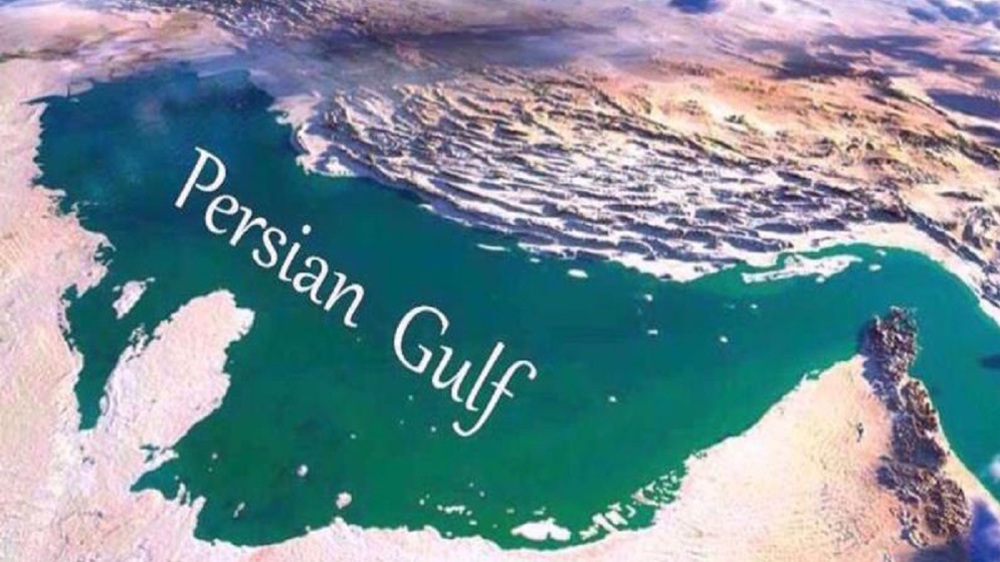
Iran’s Parliament speaker says that the nation “will not show the slightest leniency” on matters of territorial integrity, following baseless claims questioning Iranian sovereignty over the islands of Abu Musa, Greater Tunb, and Lesser Tunb in the Persian Gulf.
Speaking during an open session of Parliament on Wednesday, Mohammad Baqer Qalibaf strongly condemned the “meddlesome and baseless claims” made in the joint statement of the meeting of foreign ministers of the Persian Gulf Cooperation Council (GCC) and the European Union (EU).
On Monday, the GCC and the EU held their 29th Joint Council, during which they repeated their baseless claims regarding Iran’s sovereignty over the Persian Gulf trio islands.
The islands have historically been part of Iran, proof of which can be found and corroborated by countless historical, legal, and geographical documents in Iran and other parts of the world. However, the United Arab Emirates has repeatedly laid claim to them.
They fell under British control in 1921, but on November 30, 1971, a day after British forces left the region and just two days before the UAE was to become an official federation, Iran’s sovereignty over the islands was restored.
Qalibaf said that the territorial integrity of Iran “has been sealed and consolidated with the blood of hundreds of thousands of brave young people of this land, and the Iranian nation will not show the slightest leniency over it to any delusional party.”
Elsewhere in his remarks, the Parliament speaker marked the second anniversary of Operation Al-Aqsa Flood, saying that it “not only dealt a technical and strategic blow” to Israel, but also “disrupted the calculations of global arrogance.”
He further noted that the operation plunged Israel “into a quagmire of defeat” and destroyed its “plots for the future of the Middle East.”
According to Qalibaf, the operation not only “broke Israel’s hegemony, but also led the world towards de-Americanization, support for the oppressed, and the complete failure of the project of normalizing relations with the Zionist regime.”
He argued that Israel now faces an “existential crisis” in the wake of the operation, while Israeli Prime Minister Benjamin Netanyahu’s attempts to manage the situation through psychological operations cannot conceal the truth of the regime’s survival.
Iran values the strength and bravery of Hamas, Islamic Jihad, Hezbollah, and the resistance movements across the region, from Yemen and Iraq to all corners of the geography of resistance, he said.
The borders of this geography, he went on, are no longer limited to Gaza, Sana’a, or Beirut, but now extend to cities such as Sydney, Berlin, Barcelona, Madrid, London, Amsterdam, Toronto, and even across American cities and universities.
He added that global boycott campaigns against Israel have spread worldwide, and the international Sumud Flotilla stands as a symbol of this unified and far-reaching resistance.
On Friday, the Israeli navy intercepted the last vessel that had joined the flotilla, which had set sail from Barcelona late last month on a mission to challenge what human rights groups have condemned as one of the harshest and most inhumane blockades in the world.
The Israeli military seized more than 40 boats, detained the activists on board, and took them to Israeli-occupied territories.
 This makes it easy to access the Press TV website