By Press TV Website Staff
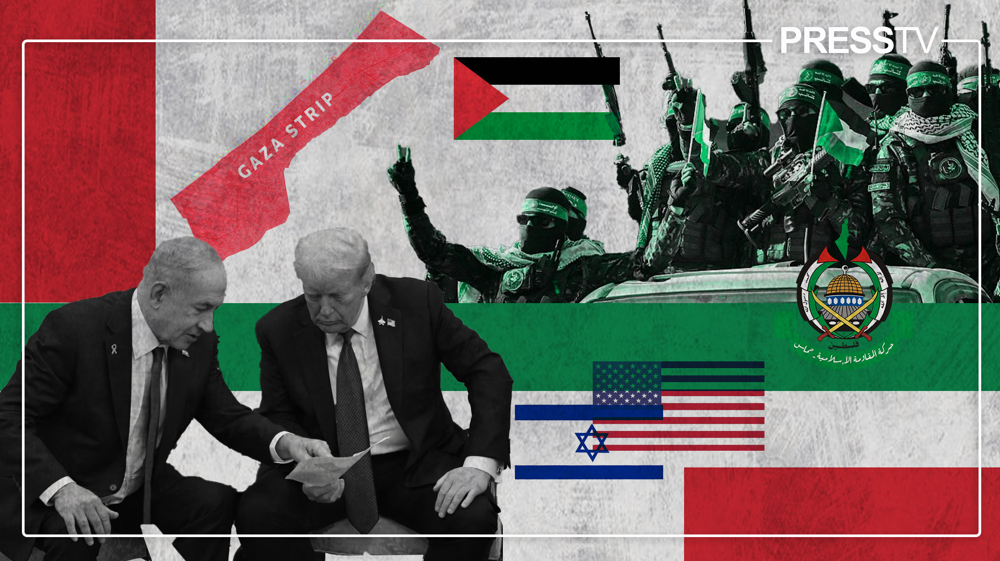
In a move that surprised many astute political pundits, the Gaza-based resistance movement Hamas released a very strategic and diplomatic response on Friday to US President Donald Trump’s 20-point “Gaza plan.”
The group agreed, in principle, to release all remaining Israeli captives and to transfer administrative authority to a transitional body as part of a framework to end the year-long genocidal war on Gaza.
However, Hamas underscored that any decision concerning Gaza’s future governance must be rooted in national consensus and determined by the Palestinian people themselves, not by external actors.
Political analysts described Hamas’s response as a diplomatic masterstroke that caught Israeli Prime Minister Benjamin Netanyahu off guard and exposed his plans to again derail the process.
Trump welcomed the response, going so far as to publish Hamas’s full statement on social media, noting the group is “ready for lasting peace” and calling on Israel to “immediately stop the bombing of Gaza.”
What did Trump’s 20-point plan include?
Trump’s much-advertised 20-point “proposal” claimed to offer Gaza a pathway to peace – a “deradicalised, terror-free zone” rebuilt under international supervision and led by Trump himself.
Marketed as a plan for peace and reconstruction, observers see it as an attempt to reshape Gaza’s future while reasserting Israeli and American control over its affairs – both political and economic.
The proposal’s promise is deceptively simple: if both sides agree, the war ends immediately. Israel would halt its genocidal bombardments and withdraw to the agreed-upon lines, freezing the front until conditions are met for a staged withdrawal.
Within 72 hours of Israel’s acceptance, all captives would be returned — alive or deceased. In exchange, Israel would release a limited number of Palestinian prisoners, including 250 serving life sentences and 1,700 others detained since October 7, 2023.
Beyond that, the deal sketches out a political order that amounts to external administration of Gaza — with local governance subordinated to a so-called “Board of Peace” chaired by Trump and including controversial pro-war figures such as former British Prime Minister Tony Blair.
The board would oversee Gaza’s redevelopment, economic planning, and even its political transition for five years, until a reformed Palestinian Authority is deemed “ready” to take over.
Many say it looks alarmingly like a twenty-first-century protectorate — a zone stripped of sovereignty and rebuilt according to the priorities of foreign hegemonic powers and private investors.
Under the plan, Gaza’s reconstruction would be driven by what is being called the Trump Economic Development Plan, inspired by the gleaming modernist cities of the Persian Gulf
Reactions are pouring in after Hamas announced its partial agreement to the US-proposed truce plan for Gaza.
— Press TV 🔻 (@PressTV) October 4, 2025
Follow: https://t.co/B3zXG74hnU pic.twitter.com/arhWB2eByf
A special economic zone would offer preferential tariffs and investment incentives, while a panel of experts would design a “modern, efficient governance” model intended to attract capital.
In theory, jobs, infrastructure, and opportunity would replace despair and radicalization. In practice, the plan seeks to entrench dependency on foreign money and influence, sidelining local political agency, in line with the blueprint Americans applied in Afghanistan for nearly two decades.
Even the proposal’s humanitarian provisions carry conditions. The influx of aid would be controlled entirely by international institutions such as the UN and the Red Crescent, excluding Palestinians. The Rafah crossing would reopen only under the same mechanism as the January 2025 humanitarian agreement, reinforcing Gaza’s isolation from its own borders and neighbors.
Security, too, would no longer be in Palestinian hands. A new so-called International Stabilisation Force (ISF), organized by the US and its partners, would assume responsibility for internal order and border control. The ISF would train vetted Palestinian police, coordinate with Israel and Egypt.
Israeli occupation forces would gradually withdraw, retaining a “security perimeter” until Gaza is deemed fully stable, a vague condition that effectively leaves Israel in control for an undefined period.
The demilitarization process, while presented as essential for peace, reads like total disarmament under occupation. All tunnels, weapons, and production facilities would be destroyed, with independent monitors verifying compliance.
While the plan insists that no one will be forced to leave Gaza, it also signals that Hamas members would have to leave. The language of “deradicalisation” raises further concerns about how dissent, resistance, or even political expression would be defined or suppressed under the Trump-led regime.
What did Hamas say in its response to Trump’s plan?
In its response, which came following Trump’s theatrical threat of “all hell breaking loose,” Hamas made it categorically clear that it seeks peace and order without any compromises.
“Out of keenness to stop the aggression and the war of extermination to which our steadfast people in the Gaza Strip are being subjected, and based on national responsibility, and out of concern for the constants, rights, and supreme interests of our people, the Islamic Resistance Movement "Hamas" conducted in-depth consultations within its leadership institutions, wide-ranging consultations with Palestinian factions and forces, and consultations with brother mediators and friends, to reach a responsible position in dealing with the plan of American President Donald Trump,” read the statement.
The movement appreciated the Arab, Islamic, and international efforts, as well as Trump, for seeking an end to the genocidal war, the exchange of captives, the entry of aid, the rejection of the occupation of the strip, and the rejection of the displacement of Palestinian people from it.
In this context, Hamas announced its approval to release all Israeli captives, living and deceased, according to the exchange formula mentioned in Trump's proposal, provided that the field conditions for it are secured, affirming its readiness to immediately enter into negotiations through the mediators to discuss the details.
Hamas also agreed to hand over the administration of Gaza to a Palestinian body of technocrats “based on Palestinian national consensus” and based on Arab and Islamic support.
Hamas says it accepts parts of the ceasefire plan proposed by US President Donald Trump, while asserting that some elements of the proposal require further negotiation.
— Press TV 🔻 (@PressTV) October 3, 2025
Follow: https://t.co/LWoNSpkc2J pic.twitter.com/jDYtj8Rt62
“As for the other issues mentioned in President Trump's proposal concerning the future of the Gaza Strip and the authentic rights of the Palestinian people, this is linked to a comprehensive national position and based on relevant international laws and resolutions, and it will be discussed through a comprehensive Palestinian national framework of which Hamas will be a part and to which it will contribute with full responsibility,” the statement noted.
Essentially, Hamas’s response was divided into two parts. In the first, the group addressed issues within its mandate to negotiate — the release of captives in exchange for ending the war, the withdrawal of Israeli forces from Gaza, and the delivery of aid and reconstruction efforts.
The second part dealt with the question of Gaza’s future. Here, Hamas called for a national consensus, asserting that it is the Palestinian people and their institutions — not external powers — who must determine their own political and administrative destiny.
How did resistance movements react to Hamas' response?
In a series of statements that point to both pragmatism and firm red lines, Hamas leaders expressed readiness to enter direct negotiations over a potential ceasefire and captive exchange — while emphatically rejecting any proposal that would place Gaza under foreign administration.
Speaking to Al-Araby, senior Hamas official Osama Hamdan said the movement is prepared to begin “immediate direct negotiations” to arrange the exchange of Israeli captives and Palestinian prisoners and set the necessary conditions for implementing such a deal.
“This matter requires entering into direct negotiations for its arrangements,” Hamdan said in the interview. “We believe that once we enter into the details, more time will be needed than the 72 hours mentioned in the proposal.”
Hamdan stressed that Hamas is willing to engage on all issues within its mandate, including the release of captives, ending the genocidal war, and the reconstruction of Gaza, but drew a sharp line at the idea of non-Palestinian governance of the territory.
“We do not accept that the affairs of Gaza, as a part of Palestine, be managed by any non-Palestinian party. The entry of foreign forces or a foreign administration into the Gaza Strip is an issue that is not acceptable to Palestinians,” he asserted.
Instead, Hamas reaffirmed its support for handing over Gaza’s administration to a Palestinian technocratic body, composed of professionals and linked to the Palestinian Authority.
“There is a Palestinian national agreement,” Hamdan said, “that a national Palestinian body, connected to the Palestinian Authority, will manage the Gaza Strip.”
In an exclusive interview with Press TV, Khaled Qaddoumi, the Hamas representative in Iran, touched on the crucial question of whether recognizing the Palestinian state will lead to practical measures on the ground to stop the genocide.
— Press TV 🔻 (@PressTV) September 22, 2025
Follow: https://t.co/mLGcUTS2ei pic.twitter.com/FUm1OIj7Ve
He emphasized that the question of Gaza’s political future — and, more broadly, the future of the Palestinian state — must be resolved within a “broad national framework.”
Hamas, he said, does not claim the exclusive right to make such decisions. “Future issues related to the Palestinian state must be answered within a broad national framework... Hamas does not monopolize the right to answer them alone.”
At the same time, Hamdan dismissed attempts to marginalize Hamas politically. “Attempts to exclude Hamas from the Palestinian political process will not succeed,” he warned.
Meanwhile, Hamas political bureau member Musa Abu Marzouk, speaking to Al-Jazeera, also said that the movement is ready to negotiate not only the exchange deal but all aspects of the proposed plan, including sensitive issues related to governance and weapons.
He also addressed the proposed deployment of a multinational peacekeeping force — one of the most controversial elements of the plan. “All details related to the peacekeeping force require understanding and clarification,” he asserted.
Marzouk insisted that Hamas remains a national liberation movement, rejecting the label of terrorism contained in the plan. “The definition of terrorism in the plan cannot be applied to Hamas,” he said
Palestinian Islamic Jihad movement also released a statement supporting Hamas’s position.
It described Hamas’s response to the Trump plan as “an expression of the position of the Palestinian resistance forces,” confirming that Islamic Jihad “participated responsibly in the consultations that led to this decision.”
How did Israel react to Hamas’ response?
Following the announcement of Hamas’ response to Trump’s proposal, the Israeli occupation forces intensified their bombing campaign in the northern Gaza Strip.
According to reports, intense aerial bombardment and shelling were witnessed across Gaza City.
More than ten Israeli airstrikes struck the Al-Sabra neighborhood in Gaza City on Saturday, igniting fires and leaving large parts of the area in ruins.
Witnesses reported that three armored vehicles were also detonated amid the ongoing bombardment, which has intensified across several fronts of the city.
Two of the strikes hit near the Al-Nour Center for the Blind, sending plumes of smoke over nearby residential blocks. Continuous shelling and bursts of gunfire from Israeli ground vehicles and aircraft echoed across Gaza’s northern, eastern, and southern axes, trapping residents in a tightening circle of violence.
Netanyahu rejects Trump’s call for peace with Hamas: Report https://t.co/BiIxJg0QaG
— Press TV 🔻 (@PressTV) October 4, 2025
As explosions took place through the night, large numbers of displaced civilians were seen moving through the streets of Al-Sabra, families carrying what little they could salvage, searching for shelter in a city where safe spaces have all but disappeared.
Israeli Prime Minister Benjamin Netanyahu has, meanwhile, rejected Trump’s proposed plan. According to a report by Axios, Netanyahu instructed his team to adhere to their existing strategy rather than the framework outlined by the US president.
Netanyahu was surprised by Trump’s announcement and wanted to make sure it did not become established that Hamas had given a positive answer to Trump’s plan, Axios reported.
 This makes it easy to access the Press TV website