16 years ago today, a tanker airstrike exposed US-German war crimes in Afghanistan
By Ivan Kesic
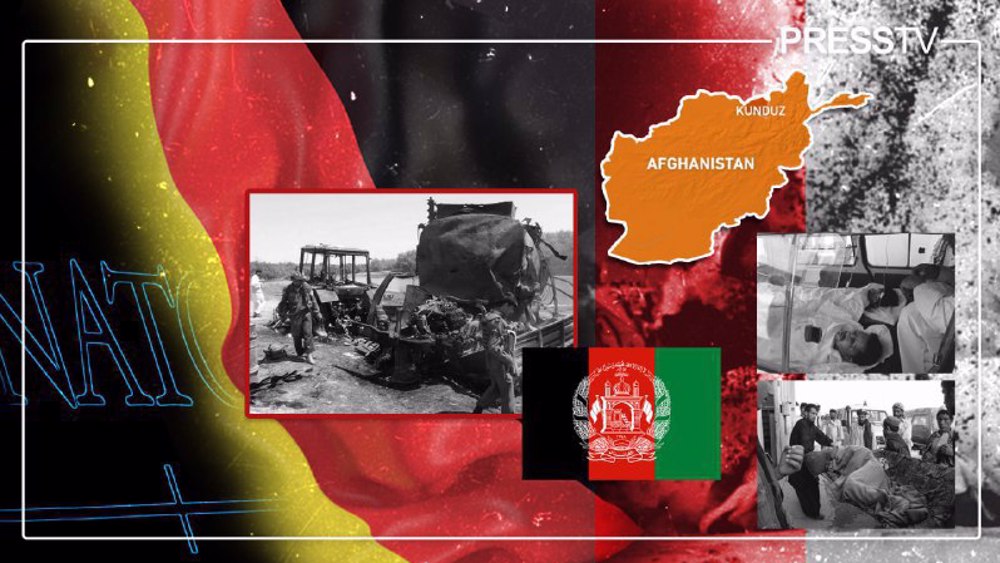
Sixteen years ago today, a catastrophic airstrike ordered by a German military commander and carried out by an American bomber crew near the village of Omar Khel in Kunduz, northern Afghanistan, became a haunting symbol of reckless decision-making and the devastating human toll of Western military invasions.
In the early hours of September 4, 2009, near the village of Omar Khel in Kunduz, one of the deadliest single incidents of civilian casualties in the NATO-led mission in Afghanistan unfolded.
A US Air Force B-1B Lancer, acting on the orders of German Colonel Georg Klein, bombed two hijacked fuel tankers, killing over 140 Afghans.
This event, the deadliest German military operation since World War II, stands as a grim testament to the fatal flaws of Western military intervention in Afghanistan that saw the NATO military alliance commit horrific crimes against civilian Afghans.
The incident represented a systemic disregard for civilian life, which was followed by a campaign of obfuscation and denial of accountability on the part of both Germany and the US.
A deadly tragic event
On the morning of September 4, 2009, the deafening roar of a US Air Force B-1B Lancer bomber shattered the silence in a small Afghan village. Circling two miles above, the crew received authorization to engage.
What followed was a seven-minute indiscriminate barrage of two 230-kilogram GBU-38 satellite-guided bombs, tearing apart two fuel tankers stranded in a shallow riverbed.
The bombing was cataclysmic, its fiery explosion visible for miles. When the flames finally subsided and the smoke cleared, a horrifying truth emerged: the victims were not Taliban insurgents but local civilians who had gathered around the tankers.
As many as 142 Afghan men, women, and children—many drawn to the scene to siphon fuel from the trucks—were killed, including scores of teenagers.
Sixteen years on, the Kunduz airstrike stands as a damning indictment of systemic failures, moral abdication, and the devastating human toll of the NATO-led war on Afghanistan, with Germany and the US sharing full responsibility.
The chain of events leading to the catastrophe reveals a lethal cocktail of incompetence, desperation, and a trigger-happy culture.
The crisis began when Taliban fighters allegedly hijacked the two fuel tankers. When the vehicles became bogged down in the sand of the Kunduz River, they invited local villagers to take the fuel.
German Bundeswehr, then commanding Regional Command-North under the NATO-ISAF mandate, decided to strike without checking the situation or ascertaining the identity of the crowd.
📜 TODAY IN HISTORY | Sept 4, 2009
— Today In History (@TodayHistoryPTV) September 4, 2025
German airstrike in Kunduz, northern Afghanistan, targeted fuel tankers that killed over 100 civilians, sparking outrage and global condemnation. The attack was a textbook case of NATO’s terrorism in the country.#KunduzAttack #NATO pic.twitter.com/bYxEkyNk4h
German recklessness and strategic panic
Criticism of the Kunduz bombing must begin with its architect: the German command, and specifically Colonel Georg Klein. The chain of events reveals a decision born not of military necessity, but of desperation and a desire to intimidate local Afghan population.
Despite lacking confirmed visual identification of Taliban fighters hours after the initial report, and in direct defiance of his own legal advisor’s warning of a high risk of civilian casualties, Klein ordered the fateful airstrike.
His post-facto justification, claiming an “imminent threat” that the hijacked fuel tankers could be turned into massive vehicle-borne bombs, has been widely dismissed as a convenient excuse.
As documented by the European Center for Constitutional and Human Rights (ECCHR), Klein catastrophically failed in his obligation under International Humanitarian Law (IHL) to take all feasible precautions to ensure the target was a legitimate military objective and that civilians were not present.
His failure was compounded by the omission of standard NATO precautionary measures, such as low flyovers or warning shots, that could have dispersed the crowd at the site of the incident.
The strike was carried out 40 minutes after Klein’s request, ample time for more civilians to gather, magnifying the tragedy. This was not a calculated military response; it was an act of strategic panic.
American complicity and a brittle kill-chain
Responsibility for the strike also lies with the US, which provided and executed the instrument of destruction. The crew of the B-1B bomber, operating under the US chain of command, failed its own duty of due diligence.
They accepted the German request for a “troops in contact” strike, a designation that implies an active firefight and often accelerates authorization.
Yet from their high-altitude vantage point, they saw no hostile fire, no clearly identifiable combatants. Their sophisticated infrared sensors revealed only a large gathering of human heat signatures.
Reports indicate that the American crew knew about the civilian presence, but they were convinced by the German command that only insurgents were on the ground. This is where US culpability becomes glaring.
The Kunduz strike exposed a dangerous flaw at the heart of America’s warfighting doctrine: an overreliance on aerial surveillance and remote killing, a brittle, error-prone system that becomes catastrophic when fused with flawed intelligence and a reflexive desire to “support” allied partners.
The US did not simply provide the weapon; it provided the unquestioning execution, serving as a blunt instrument for a German command that had already discarded its legal and ethical safeguards.
The choice of weaponry further underscored the attack’s grotesque disproportionality. Dropping 230-kilogram GBU-38 JDAMs on immobilized tankers in a crowd-filled area was a guarantee of mass civilian slaughter.
✍️ Feature - 20 years, $2tr, a nation in ruins: How US ended its longest war in Afghanistan this day in 2021 https://t.co/5xDjJmv6fE
— Press TV 🔻 (@PressTV) August 30, 2025
Masterclass in obfuscation and denial
The aftermath of the strike was as damning as the incident itself, exposing a deep-seated pathology: the presumption that Western credibility outweighed the value of Afghan civilian lives.
Germany’s leadership, under Franz Josef Jung, immediately and falsely claimed that only Taliban insurgents had been killed. This lie was clung to for weeks despite mounting evidence to the contrary.
Investigations by Der Spiegel later revealed that the German Chancellery, Foreign Ministry, and intelligence service (BND) were aware of civilian casualties almost immediately yet actively filtered information before it reached the public.
Even after Defense Minister Karl-Theodor zu Guttenberg received an International Red Cross report confirming civilian deaths, he publicly defended the strike as “militarily appropriate.”
The orchestrated cover-up, designed to shield the government ahead of the 2009 federal election, eventually led to the resignations of Jung and General Wolfgang Schneiderhahn, but not before the official narrative had been corrupted.
The US military, through ISAF command under General Stanley McChrystal, initially echoed Germany’s line, asserting that the strike had targeted “a group of insurgents.”
It was only through the persistence of Afghan officials, journalists, and human rights advocates that the grim truth emerged — a truth Western powers had been unwilling to confront.
McChrystal later admitted to civilian harm after personally visiting the site, a belated acknowledgment that did little to erase the initial impression of calculated indifference.
Whitewash and insulting compensation
The subsequent investigations into the Kunduz bombing were widely criticized as exercises in organized irresponsibility. Germany’s Federal Prosecutor’s Office closed its case in April 2010, concluding that Klein had acted reasonably and violated no laws.
This investigation was superficial, lacking on-site examinations and independent witness interviews. It was a classic whitewash, designed to protect the institution rather than pursue accountability, according to legal experts.
This intent was made explicit in February 2010 when the German government took the extraordinary step of reclassifying its Afghanistan deployment as an “armed conflict within the parameters of international law.”
This legal maneuver, criticized by opposition parties and human rights groups, was a deliberate attempt to shield soldiers like Klein from prosecution under German criminal law for actions deemed "militarily necessary." It represented a stunning abdication of legal and moral responsibility.
The final insult to the victims was compensation. In June 2010, Germany offered payments of $5,000 per family to the bereaved, an ex gratia payment that explicitly did not admit liability.
Former Afghan Commerce Minister Amin Farhang rightly called this sum “laughable,” a transactional gesture that could never amount to justice.
The promotion of Klein to Brigadier General in 2013 was seen, rightly, as a clear signal that the German military establishment saw no wrongdoing in the incident worthy of punishment.
The US, for its part, offered no formal apology or compensation whatsoever, hiding behind NATO’s collective structure and Germany’s lead role.
This failure of justice was ultimately codified in international law. While the European Court of Human Rights' 2021 ruling in Hanan v. Germany found that Germany’s investigation had been inadequate, it focused on procedural compliance rather than the legality of the strike itself, denying victims the full accountability they sought.
Permanent stain on Western intervention
Kunduz airstrike is a microcosm of the failed Western military intervention in Afghanistan that was based on a false premise. It illustrated the disconnect between high-tech militaries and the human terrain they operate in, and the devastating consequences of allowing tactical expediency to override international humanitarian law.
Germany demonstrated that its military was unprepared for the realities of combat, willing to bypass its own rigorous rules to save face, and then engage in a cynical political cover-up to evade responsibility.
The US demonstrated its role as an enabling force, a dealer of death-on-demand whose technological prowess was matched only by its moral carelessness and lack of independent judgment when taking the word of an ally.
The victims in Omar Khel were not collateral damage but deliberate targets of a deeply flawed and reckless military decision-making process.
Their killings are a permanent stain on the records of both Germany and the US, a stark reminder that when Western powers project force far from their shores, the consequences are measured not in political points or strategic gains, but in the lifeless bodies of innocent people.
Iran urges restraint, immediate ceasefire as Afghanistan–Pakistan fighting escalates
Kabul residents call for calm as tensions escalate with Pakistan
Iran urges Afghanistan, Pakistan to hold dialogue amid new escalation


Iran will hold no negotiations with US: Larijani
Despite Leader's martyrdom, Islamic Republic firmly in control and punishing the enemy
At least 31 killed in Israeli aggression on southern Lebanon after Hezbollah strikes
Iran writes to UN, warns about dire consequences for perpetrators following Leader's martyrdom
Hezbollah strikes occupied Haifa in retaliation for Leader's assassination
Ansarullah mourns Leader's martyrdom as 'great loss' caused by 'most wretched terrorists'
Hezbollah offers condolences to Iranian nation over Leader’s martyrdom
US-Israeli strike targets IRIB facility; broadcasts continue


 PressTV NEWSLETTER
now
PressTV NEWSLETTER
now

 This makes it easy to access the Press TV website
