
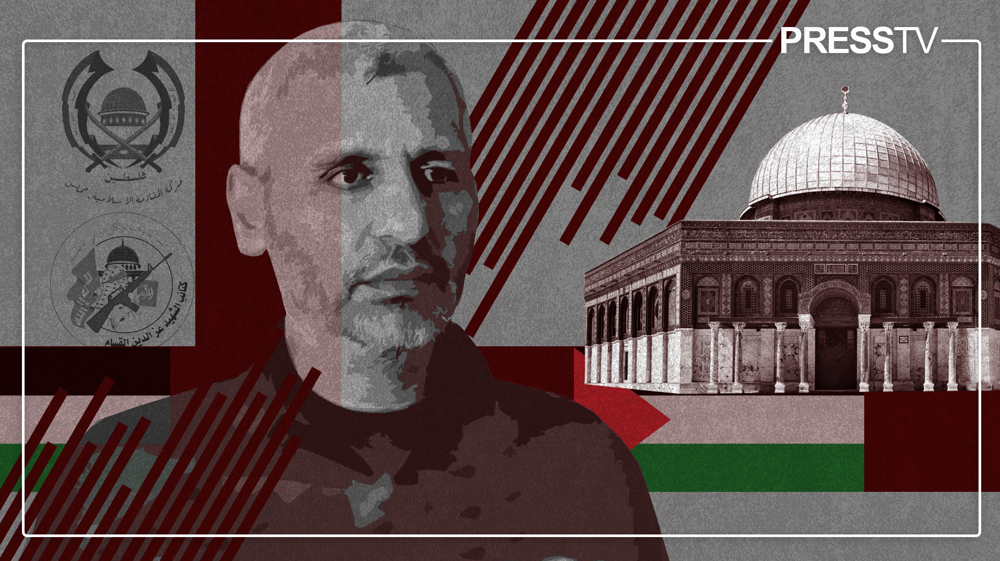
By Press TV Staff Writer
It has been one year since the famed military commander of the Gaza-based resistance movement Hamas was martyred by Israeli occupation forces in the besieged territory.
Mohammed Deif, who served as the chief of staff of Hamas’s military wing, the Al-Qassam Brigades, was a legendary and elusive commander who survived numerous assassination attempts on his life.
In a powerful tribute on Sunday, Abu Obeida, spokesperson for the Al-Qassam Brigades, said Deif, alongside his fellow fighters, led Operation Al-Aqsa Flood (Storm), delivering “the most severe blow” to the Zionist regime.
This blow, he said, led to the permanent erosion of Israeli deterrence, unified national energy, reoriented collective focus towards Palestine, and brought the Palestinian cause back to global prominence after decades of indifference.
“Deif revived in the entire nation the memory of the Companions and early Mujahideen like Ali, Khalid, Al-Qa'qa', Al-Muthanna, and other conquering leaders. For decades, he remained an inspiration for generations who did not know his image but were proud of the actions of his victorious brigades, and he will remain, like other great leaders, a beacon for all free people of the world,” the statement noted.
Exactly a year ago, the Hamas military spokesperson had confirmed the martyrdom of several top military commanders in battles against the regime forces in Gaza, including Deif.
Deif was celebrated as a key strategist of Operation Al-Aqsa Flood (Storm), the historic military campaign that shook the Zionist entity and its Western backers on October 7, 2023.
Among the other high-ranking officials martyred with Deif were deputy military commander Marwan Issa; commander of weapons and combat services Ghazi Abu Tama’a; head of manpower and logistics Raed Thabet; Northern Brigade commander Ahmed al-Ghandour; Central Brigade commander Ayman Nofal; and Khan Younis Brigade commander Rafeh Salama.
Who is Muhammad Deif, and what role has he played in the Palestinian resistance? pic.twitter.com/mdrZ9liOd9
— Press TV 🔻 (@PressTV) January 31, 2025
According to the Al-Qassam spokesperson, these commanders were martyred while resisting the enemy during the Al-Aqsa Flood operation—whether from command centers, during direct combat, or while managing and coordinating the battle.
“These martyred commanders departed after a life of immense struggle, during which they fought heroic battles, inflicted heavy losses on the enemy, and placed their downfall and defeat on an inevitable path,” Abu Obeida said at the time.
“This is the legacy of our leader, Mohammed Deif (Abu Khaled)—who exhausted the enemy for over 30 years. How could Mohammed Deif be remembered in history without the title of martyr and the honor of martyrdom in the path of Allah?”
In a separate, more detailed statement, Hamas hailed the “great, heroic martyr commander Deif,” describing him as “a steadfast and courageous fighter whose prowess and battles are etched into the soil of Palestine—its villages, towns, and refugee camps in the Gaza Strip and the West Bank.”
“He was among the first to sow the seeds of blessed military action, alongside his martyred comrades in struggle—Imad Aqel, Zakariyya al-Shurbaji, and Salah Shehadeh. He nurtured and guided this movement as it grew in strength, blossoming into unique acts of heroism and advanced military engineering powered by innovative Palestinian minds, inflicting heavy blows on the enemy’s army and imposing new equations in the struggle,” the statement noted.
“The path and story of the martyred Commander Abu Khaled will remain an inspiration for generations of our people and our [Islamic] nation. The spirit of struggle and resistance he breathed into our people will never die or be extinguished.”
Who was Mohammed Deif?
Deif, whose full name was Mohammed Diab Ibrahim al-Masri, served as the commander of the Izz al-Din al-Qassam Brigades, the armed wing of the Palestinian resistance group Hamas.
His nickname “Deif” (meaning "guest" in Arabic) reflected his constant movement and refusal to remain in one place, a tactic that helped him evade Israeli assassination attempts.
Even Israeli officials acknowledged that he never spent two nights in the same house.
IRGC: Martyrdom of Hamas commanders inject fresh blood in the veins of the Palestinian Islamic resistance.
— Press TV 🔻 (@PressTV) February 1, 2025
In a statement, the IRGC offered condolences on the assassination of al-Qassam Brigades’ chief commander, Mohammed Deif, by Israel. pic.twitter.com/ZX0Q6lr8vk
Deif was born in 1965 in the Khan Yunis refugee camp in southern Gaza, which was established in 1948 following the forced displacement of Palestinians during the Nakba—the catastrophe marking the birth of the illegitimate Zionist entity.
His family came from the village of al-Qubeiba, near ar-Ramleh in central historic Palestine, a village destroyed during the early Zionist occupation.
He pursued higher education in physics, chemistry, and biology at the Islamic University in Gaza, where he earned a science degree. During his student years, he led the university's arts committee and even performed in theater productions.
In 1987, Deif joined the Hamas resistance movement during the First Intifada against Israeli occupation.
Two years into the uprising, he was arrested by Israeli occupation forces in 1989 and spent 16 months in Israeli prisons before being released in a prisoner swap.
He was one of the founding members of the Al-Qassam Brigades and played a central role in its engineering divisions, where he oversaw the development of rockets, explosives, and tunnel networks.
Deif was especially close to two influential figures—Hamas commander Yahya Ayyash and Hezbollah’s Imad Mughniyeh. Following strategic guidance from Iran’s top anti-terror commander, General Qassem Soleimani, he helped construct a vast tunnel system in Gaza over nearly a decade.
This extensive underground network eventually expanded to hundreds of kilometers, proving vital for the resistance’s resilience and playing a decisive role in the success of the Al-Aqsa Flood operation on October 7, 2023.
Since the 1990s, Deif had been at the top of Israel's most-wanted list.
✍️ Feature - Mohammed Deif’s wife unravels secretive life of the iconic ‘shadow commander’
— Press TV 🔻 (@PressTV) February 4, 2025
By Maryam Qarehgozlouhttps://t.co/SqV86tmKh4 pic.twitter.com/MPMG90znjy
In 2000, acting on Israel’s request, the Palestinian Authority detained him for several months, but he escaped with help from fellow resistance members.
The Zionist regime attempted to assassinate Deif at least seven times, four of which occurred in the early 2000s. His refusal to use digital communication devices helped him avoid capture and death.
Some unverified reports claim he lost limbs and an eye during these attempts, with some suggesting he was confined to a wheelchair. However, an official image released following his martyrdom by Hamas showed Deif with both eyes intact.
In August 2014, during the Israeli genocidal war on Gaza, an Israeli airstrike targeted his home in Gaza City, killing six people, including his wife and two of his children.
Deif rarely appeared in public or issued statements. His most notable public address came on October 7, 2023, when he spearheaded the historic Operation Al-Aqsa Flood.
Speaking via Hamas TV, Deif said he had repeatedly warned the Israeli regime to cease its crimes against Palestinians, release prisoners, and stop stealing Palestinian land. He said the operation was a direct response to Israeli aggression and violations at Al-Aqsa Mosque.
Following the announcement of his martyrdom, Palestinian media aired an old video showing Deif announcing the capture of an Israeli soldier in 1994 and demanding the release of Sheikh Ahmed Yassin.
His unmatched capabilities, decades of dedication, and successful leadership of anti-Israeli operations made him one of the most legendary figures in the resistance movement.
Just like his commander, Yahya Sinwar, Mohammed Deif has etched his name into history – his martyrdom sealing his place among the immortal heroes of Palestine.
 This makes it easy to access the Press TV website