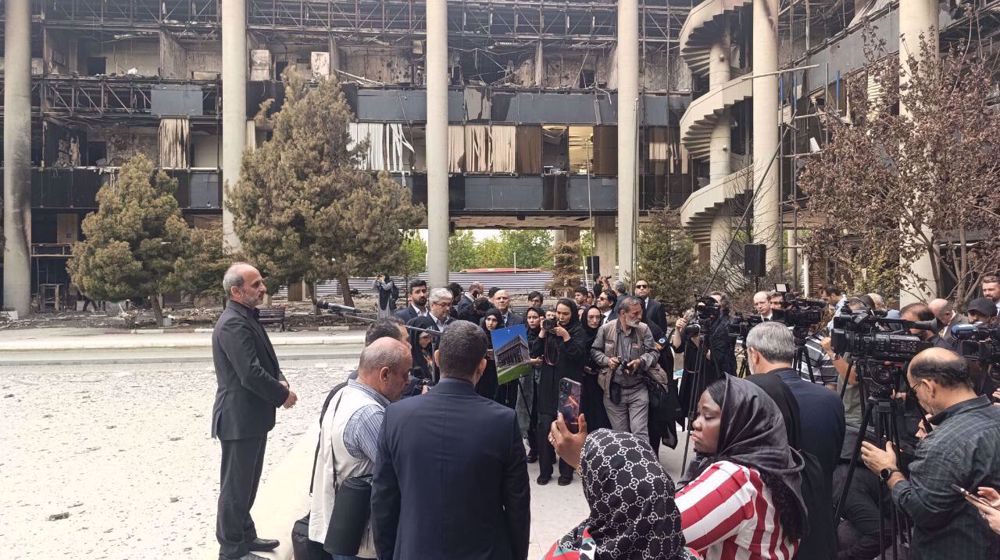
Head of the Islamic Republic of Iran Broadcasting (IRIB), Peyman Jebelli, has hosted ambassadors from 28 countries in Tehran during a tour of one of the state broadcaster's buildings that was targeted by Israel last month.
During the visit on Sunday, Jebelli acknowledged the absence of ambassadors from certain countries and expressed regret that representatives of states that supported the Israeli regime during the war were not present to witness the aftermath firsthand.
The building was targeted on June 16 while IRIB presenter Sahar Emami was delivering a live broadcast on Israel’s war of aggression against Iran. The attack was widely condemned as a violation of international humanitarian law, which prohibits attacks on journalists during armed conflict.
In an exclusive interview with Press TV, @Jebelli_ir, Head of IRIB, elaborates on the various aspects of the heinous crime committed by the Zionist regime in its attack on an IRIB building.
— Press TV 🔻 (@PressTV) July 13, 2025
Follow Press TV on Telegram: https://t.co/mLGcUTS2ei pic.twitter.com/HPSnLH8Abm
Jebelli went on to say that the targeted building is considered a significant symbol of Iranian architecture, adding that it was hit by at least 11 missiles, including bunker-busting bombs, by the Israeli regime.
The intention behind the attack was to destroy the building and silence the national media by targeting journalists, he added.
The IRIB chief further stressed that the attack is not something new to the Iranian people and all those targeted by Israel.

So far, nearly 300 journalists have been intentionally killed by the Israeli regime in Gaza. Additionally, in Lebanon, there have been instances of the regime targeting media buildings during different conflicts, he said.
Jebelli further said that during the 12-day Israeli aggression, IRIB served as a prominent platform to demonstrate national unity in Iran, adding that this display of national unity provoked Israel and ultimately resulted in the brutal attack on the television building.
He pointed out that from the start of the war, it was anticipated that the Israeli regime would target the IRIB in an attempt to sow discord in Iranian society.
However, the Iranian people's response defied the occupying regime's expectations, showcasing remarkable solidarity, cohesion, and national unity during the 12-day war.
On June 16, the Israeli regime carried out a fresh act of aggression by targeting the central building housing IRIB’s news department, while a live news broadcast was underway.

At the time of the attack, news anchor Emami was presenting the news. Despite the building trembling under the first strike, she stood her ground and continued the broadcast.
On June 13, Israel launched a blatant and unprovoked act of aggression against Iran, assassinating many high-ranking military commanders, nuclear scientists, and ordinary civilians.
In response, the Iranian Armed Forces, led by the Islamic Revolution Guards Corps (IRGC), launched a powerful retaliatory campaign, Operation True Promise III, against the Israeli regime by targeting key military, intelligence, industrial, energy, and R&D facilities across the occupied territories.
On June 24, Iran, through its successful retaliatory operations against both the Israeli regime and the US, managed to impose a halt to the illegal assault.
 This makes it easy to access the Press TV website