General Soleimani — Master strategist who built the architecture of Axis of Resistance
By Shabbir Rizvi
In April of 2024, the mood within the occupied Palestinian territories was tense. Israeli regime had launched strikes on Damascus aimed at the Iranian diplomatic mission, resulting in the martyrdom of Islamic Revolution Guards (IRGC) Brigadier General Mohammad Reza Zahedi and other senior officers.
The escalation was unprecedented in terms of the Israeli aggression within the region - the occupation’s arrogance in the face of a multi-front resistance campaign against it forced it to sink to new lows in terms of its criminal ambitions within the region.
The strike on an Iranian embassy was a red line that Tehran had promised would not go unanswered.
Tehran vowed strong retaliation. During the year’s Quds Day procession, which came a few days after the Israeli aggression, the Iranian public demanded revenge, and the political and military leadership vowed to deliver.
As Iran made preparations for retaliation, the Israeli occupation was already confounded in a multi-front war. Within Gaza, Israel’s occupation was reaching its sixth month with no results to show for stopping the resistance.
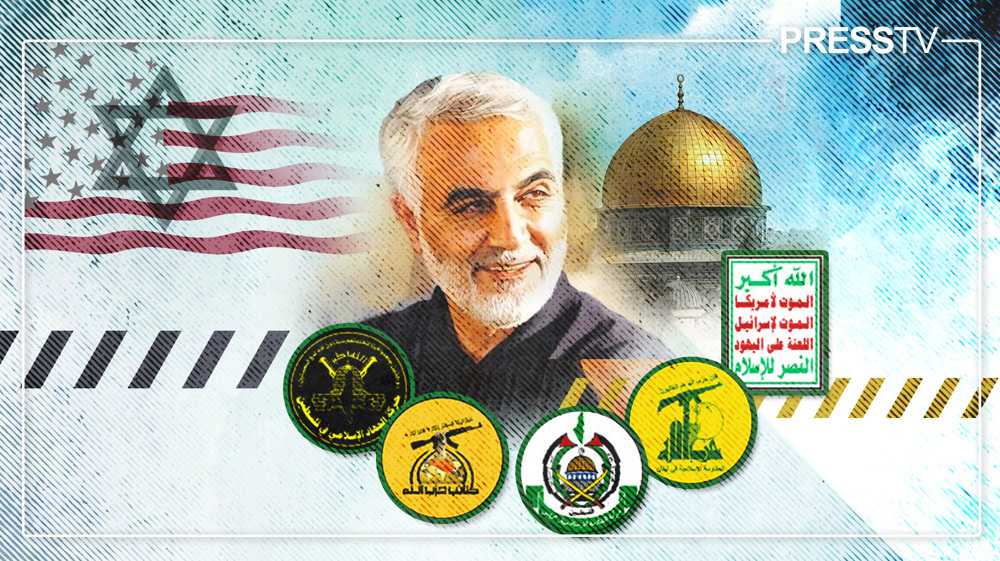
Hamas, Palestinian Islamic Jihad, and other groups were posting near-daily videos of point-blank confrontations with Israeli military tanks, demonstrating to the world the steadfastness and bravery of the Palestinian resistance and the legitimacy of their cause.
In the northern occupied territories, Hezbollah was raining down drones and rockets, creating a crisis for Zionist settlers as they were forced to flee. The north’s economy came to a standstill as the Lebanese resistance targeted and destroyed strategic surveillance equipment, outposts, depots, and barracks.
By their own admission, Zionist forces are still unable to return settlers to the north to this day because of the damage and the threat of Hezbollah’s arms.
To the east, Iraqi resistance forces from the Popular Mobilization Forces (PMF) lobbed rockets and drones into the occupied Golan and Eilat docks with the assistance of a then-friendly Syria, which functioned as a route for arms, logistical support, and an early-warning response system for Zionist aggression.
Eilat was also a popular target of Yemen’s Ansarallah resistance movement, which, through its Red Sea blockade and targeting of Israeli occupation ports, forced the port of Eilat to a total halt.
On April 14, the IRGC finally delivered what was described as the “Operation True Promise."
Pounding Tel Aviv and military installations in the Negev for the first time, the IRGC deployed dozens of drones and missiles that pounded the occupation entity, striking key targets while evading and exhausting the much-hyped “Iron Dome” air defense system.
Marketed as a complete block of aerial assaults against the entity, Iran reduced this system to a mere myth, all while taking note of the Israeli occupation’s weak points, defensive maneuvers, and overall behavior for strikes that would come again on October 1st (True Promise II) and in June 2025 (True Promise III/ the “Twelve Day War).
Leading to and during the operation, all limbs of the resistance were moving - from Yemen, Iraq, and Lebanon came rockets and drones. The transfer of intelligence on the enemy paved the way for each group's success. The “ring of fire” - as the Israeli Occupation had dubbed it - was in effect.
This cooperation was not driven by spontaneous self-interest on either party's part. This cooperation, from the bullets and rockets that landed on enemy positions to the intelligence shared to make the launches successful, was the doctrine of resistance created by Martyr Lieutenant General Haj Qassem Soleimani - the late commander of the IRGC’s Quds Force.
“Gen. Soleimani’s assassination turned him into an immortal and an unforgettable iconic figure”
— Press TV 🔻 (@PressTV) January 1, 2026
Press TV’s Gisoo Misha Ahmadi reports from a ceremony at Tehran’s Grand Mosalla commemorating the martyrdom anniversary of Iranian Lieutenant General Qassem Soleimani. pic.twitter.com/m1kZQzxLxv
Architecture of resistance: Palestine and Lebanon
General Soleimani achieved martyrdom on January 3, 2020 in a US drone strike that targeted him and PMF commander Abu Mahdi al-Muhandis while he was on a diplomatic mission in Baghdad, Iraq.
The cowardly assassination of the two resistance leaders sparked anger worldwide, as the United States engaged in a clear act of war, resulting in marches and demonstrations that spilled into the very cities of the United States.
General Soleimani’s funeral was attended by millions from Iraq to Iran, from Palestine to Pakistan, from New York to London, as people gathered in the streets to pledge allegiance to the late anti-terror commander's cause - resistance against the empire, against the terrorist Israeli entity.
For the first time, many in the West asked themselves: Who was Qassem Soleimani?
A veteran of the Holy Defense against West-backed Iraqi dictator Saddam Hussein’s aggression on Iran, General Soleimani’s steadfastness, intelligence, and bravery in battle allowed him to climb the ranks of IRGC leadership in 1998, specifically in the Quds Force.
Remaining firm to the Islamic Republic of Iran’s commitment to the liberation of Palestine, General Soleimani began critical work in coordinating with the Palestinian resistance in the late 90s and early 2000’s during the Second Intifada.
Meeting with Palestinian resistance leaders, including Hamas founder and martyr Sheikh Ahmed Yassin, General Soleimani established a working committee between the different Palestinian factions that dispelled all myths of sectarianism between Palestinian resistance and the Islamic Republic of Iran.
He oversaw the shipment of thousands of weapons into the hands of the Palestinian resistance - weapons that are still wielded to great effect today. But the real assistance provided by General Soleimani was the training and self-sufficiency that he cultivated within the Palestinian resistance.
General Soleimani understood the aggressive, homicidal nature of the illegitimate Israeli entity - assassinations, bombings and sabotage, without regard for civilian lives. He understood that weapons shipments can be intercepted, bugged, or sabotaged. From this calculus, he understood that, for the resistance to succeed, they had to work with what they had - on terrain they knew.
This understanding paved the way for the development of tunnels underneath Gaza and the rockets that were then launched into Tel Aviv from Gaza.
In 2021, a Palestinian Islamic Jihad Movement representative said that General Soleimani developed “Palestinians' resistance from stone to the missile.”
It was shortly after the conclusion of the Second Intifada that the Israeli attempted invasion of Lebanon would begin in 2006, which brought - until this year - Israel’s most crippling humiliation. Israeli military tanks and helicopters fell while Israeli troops were deterred from the Litani by Hezbollah weaponry.
On Lebanese soil, General Soleimani oversaw strategy and logistics.
With the launch of Operation Al-Aqsa, the world saw for itself the powerful network of tunnels that both the Palestinian and Lebanese resistance used to disable enemy tanks and liquidate Israeli invaders.
Failing to assassinate him despite several attempts, imperialists dubbed him “the Shadow Commander.”
We will continue on General Soleimani's path: President Pezeshkian
— Press TV 🔻 (@PressTV) January 1, 2026
Follow https://t.co/B3zXG74hnU pic.twitter.com/EXJgcl1vXF
Counterbalance to imperial ambitions
General Soleimani’s leadership and skill would also be tested after the US launched the so-called “war on terror” in 2001. President George Bush outlined the objective of toppling of seven countries in five years - Iraq, Syria, Lebanon, Libya, Somalia, Sudan, and Iran.
Americans relied on its clients in the region, such as especially Israel, and the various non-state proxies the US was brewing, including the empowerment of Daesh in Iraq and Syria, in order to create the conditions for the toppling of governments in these countries.
General Soleimani understood that the proper counterweight to US domination was a doctrine of authentic resistance, a resistance forged in ideology but also independent of each other; thus, if one element was cut off, the others could continue to function.
With experience in equipping the Palestinian resistance as well as Lebanon’s Hezbollah, General Soleimani approached the shockwaves in the region with a clinical and smartly executed strategy.
The toppling of Saddam Hussein by the US caused a national catastrophe, with thousands of Iraqis murdered by US coalition forces. Americans used sectarianism as a vehicle to keep the Arab country weak and separated, allowing the festering elements of Al Qaeda and other Takfiri groups in Iraq to take advantage of the chaos. This resulted in the rise of Daesh (ISIS), which ravaged the country, spilling over into Syria - one of the aforementioned targets.
Through shadowy networks in Turkey, Qatar, and Saudi Arabia, the US funneled weapons into the hands of Takfiri mercenaries pouring into Syria and Iraq from Western China all the way to the US itself.
“Operation Timber Sycamore” went as far as even training Takfiri militants who were executing women, children, and the elderly from Syria to Iraq.
The tide needed to turn. Iraq’s senior most cleric Ayatollah Seyyed Ali Sistani’s fatwa - the creation of the Popular Mobilization Forces of Iraq to expel the Daesh enemy - allowed General Soleimani to train soldiers in expelling the Takfiri threat from Iraq, which threatened whatever little stability the country had from years of American occupation.
Successful in driving out most of the Daesh elements from Iraq, General Soleimani also dedicated his time in Syria, struggling alongside the mostly-Sunni Syrian Arab Army to contain the so-called “Syrian Opposition” - a coalition of defected Syrian military commanders fighting alongside Daesh, Al Nusra Front, and other Takfiri groups.
In 2024, Syria eventually fell to Hay'at Tahrir al-Sham (HTS) forces, who would sell the country to the whims of Washington and Tel Aviv. However, the time that General Soleimani bought was incalculable - US occupation forces controlled Syrian oil fields while Takfiri groups licked their wounds in Idlib, waiting for the opportune time to strike - when most resistance forces were occupied fighting Israel.
Perhaps if Syria fell within General Soleimani’s lifetime, the Al Aqsa Flood would not have happened, or would not have been as effective, as it has become clear that the HTS regime installed in Syria is anti-resistance: expelling members of the Palestinian resistance while preparing to confront Hezbollah on the Syria-Lebanon border.
This was the “Soleimani Doctrine” in action: identifying resistance to imperial ambitions and training them to stand their own ground. General Soleimani, through ideological coherence, refined the language and strategy of resistance.
Praying alongside soldiers, meeting with groups in person to discuss ideology with strategy, and, of course, fighting side-by-side on the battlefield with them, General Soleimani forged a new sense of solidarity within the logic of anti-imperialism in a region under imperialist pressure.
The Axis of Resistance had announced itself.
🎥 The Last Hour
— Press TV Documentary (@presstvdoc) January 2, 2026
🔻Explore the final hour of Gen. Qassem Soleimani and Abu Mahdi al-Muhandis before their martyrdom near Baghdad airport.
📺 Tune into Press TV
🗓 Friday, Jan. 2nd | 15:00 GMT
📺Rebroadcasts:
Fri 23:00 | Sat 07:30 & 19:00 | Sun 01:30 & 13:30 | Mon 04:00 GMT pic.twitter.com/rHgDcT6462
A living legacy
Today, General Soleimani lives within the hearts of those who love him and with the minds of those who fear him.
A worldwide symbol of what it takes to resist imperialist ambitions, you can find General Soleimani in the streets of Caracas, where his mural greets the Bolivarian revolutionaries training to confront the possibility of a US invasion. You can see him in banners decorating the holy cities of Karbala and Najaf.
Conversely, you can observe how imperialist mechanisms seek to remove his memory. Posting a photo of the "Shadow Commander" on social media platforms like Instagram and Facebook can earn you suspensions for “promoting terrorism.”
An interesting punishment for honoring someone responsible for destroying terrorists while imperialist powers fueled them in West Asia.
Every year, tens of thousands across the globe mark the anniversary of his martyrdom.
The strategic masterpiece of General Soleimani - the Axis of Resistance - continues to operate despite new challenges and calculations. It has created a bulwark of resistance in an otherwise imperialist-subordinated region.
The blow dealt to imperialism in the form of coordinated, ideologically aligned resistance - from Yemen thwarting the US Navy and Air Force - to the Palestinian resistance forcing the Israeli war machine into a military quagmire - proves that resistance is the only path forward towards sovereignty.
The ideology of resistance that General Soleimani instilled is not limited to the armed revolution. The calculus of resistance against imperial domination is for everyone to understand and wield.
From the organizer researching the ties of corporations to the Israeli occupation, to the scholar publishing a work exposing the intricacies of finance imperialism, to the student who refuses to stand by while their institutions provide material support to ethnic cleansing, and even the parent raising a child to be cognizant of the imperialist plans for their world - everyone has a role to play in strengthening the axis against imperialism, Zionism. And Takfirism.
As Martyr Abu Obeida would say, a leader is succeeded by 10, and a fighter by a thousand.
Shabbir Rizvi is an anti-war activist and an editor at Vox Ummah
(The views expressed in this article do not necessarily reflect those of Press TV.)

From Zionism to Daesh, the battles that defined Gen. Soleimani's illustrious legacy
Tehran protests: How hostile external forces exploit economic discontent to foment chaos

Forged by fire: Iran’s military preparedness at an all-time high after 12-day war


Iran’s steel output up 9.2% y/y to 3.4 million mt in November
VIDEO | Venezuelan protesters demand President Maduro's release from US
Trump claims US will ‘run’ Venezuela in interim after kidnapping of Maduro
Trump says US will be ‘very strongly involved’ in Venezuela’s oil industry
‘Naked imperialism’: Netizens condemn US for attacking Venezuela and kidnapping its leader
How Gen. Soleimani fought terrorism and exposed the fallacy of West's 'war on terror'
Condemnations pour in after US bombing of Venezuela, kidnapping of Maduro
Gen. Soleimani represented resistance to interventionism in Global South: Analyst


 PressTV NEWSLETTER
now
PressTV NEWSLETTER
now

 This makes it easy to access the Press TV website
