The curious case of Lebanese maritime captain’s abduction by Israel and Beirut’s indifference
By Lama Almakhour
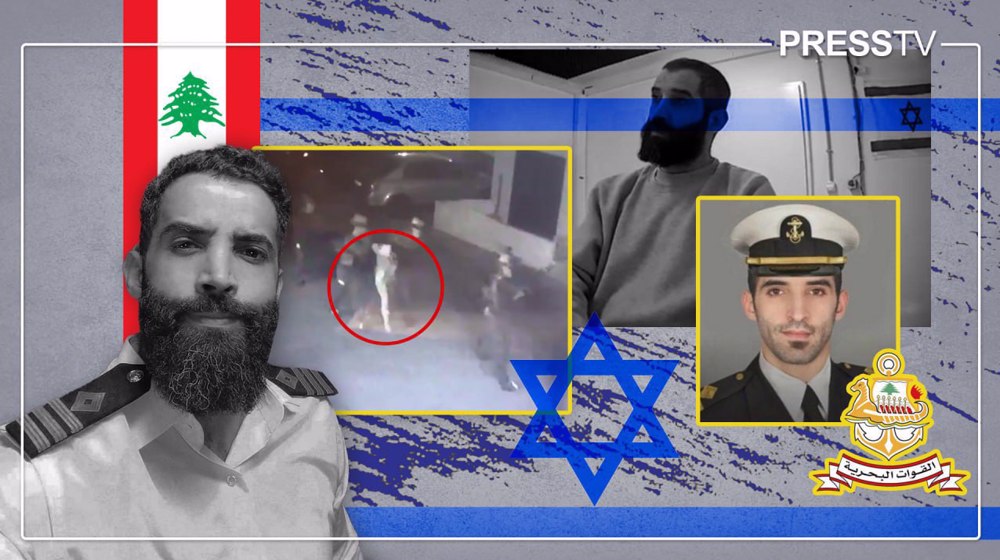
In an era when waves blur borders and truth drifts between competing narratives, the name Imad Amhaz emerges, a young Lebanese man bound to the sea, who studied its depths, understood its secrets, and made it both his profession and his lifelong dream.
Imad Fadel Amhaz was born in Lebanon in 1986, into a family known for its quiet demeanor and steadfast commitment to the values of work and stability. Now in his late thirties, he chose to shape his professional journey away from the spotlight, turning to maritime studies and graduating from specialized civilian institutions in maritime navigation, where, after years of rigorous study and hands-on training, he earned his captain’s license.
His love for the sea distinguished Amhaz – not merely as a profession, but as a passion and a space for tranquility and reflection. In its vastness, he found refuge from the noise and pressures of life. Within his social circle, he was known for his calm personality, his sense of responsibility, and his strong bond with his family, who remained a constant source of support and motivation.
Amhaz appeared to be an ordinary young man, quietly striving to build his future, until his life suddenly transformed into an open-ended wait, and a state of anxiety that extends beyond him alone, touching his family and, ultimately, the entire homeland.
During the Israeli war of aggression on Lebanon in 2024, the northern coastal city of Batroun witnessed an incident that sent shockwaves across both popular and media spheres: the abduction of Amhaz near the shoreline.
Late at night, a special Israeli military unit carried out a carefully orchestrated naval landing operation, approaching from the sea and exploiting the area’s calm, touristic atmosphere – one that did not indicate any military presence or mischievous plots.
During the operation, the regime forces stormed Imad’s residence, abducted him, and withdrew swiftly by sea in a scene reminiscent of covert abduction operations. That night, Batroun became the stage for a brazen kidnapping, as though the message was less about secrecy than about demonstrating the ability to reach, penetrate, and breach.
The abduction occurred at a time when Lebanon was engulfed in daily scenes of shelling and destruction, with news reports counting the dead by the tens and hundreds, and the entire country appearing trapped in an open war imposed on it beyond its control.
Hezbollah called for the Lebanese government to resist enemy demands and uphold the nation’s sovereignty.
— Press TV 🔻 (@PressTV) December 25, 2025
Follow: https://t.co/mLGcUTS2ei pic.twitter.com/lOXNcpSZFt
Amid this bloody reality, urgent questions arose: What connection did Amhaz have to all that was unfolding? And why was a man with no known partisan affiliation or declared military role abducted?
Soon after the kidnapping, the name Imad Amhaz mysteriously vanished from the news, as though his absence were not only physical but informational as well. The Lebanese government avoided serious pursuit, limiting its response to weak statements devoid of concrete action or a clear legal course.
In a country weighed down by crises and divisions, Imad’s case was lost amid competing priorities, as if the fate of an abducted individual had ceased to be an important concern for those in power.
During that period, information about him was almost entirely cut off, leaving his family and those close to him suspended in a harsh state of waiting – caught between hope and fear, without reassurance, without answers, and without even confirmation of his condition or fate.
The silence was broken only with the release of his video, which returned his name to the forefront, but in a painful way. Rather than offering reassurance, it underscored the harsh reality of captivity and deepened the sense that Amhaz had been reduced from a man with a family and a life to a mere bargaining chip between the Israeli regime and Lebanon.
While the video revived his case and ignited widespread public and media reaction, the response once again remained confined to words, never translating into meaningful or concrete action.
Moreover, as public opinion becomes absorbed in fleeting waves of sympathy, the Lebanese government continues to endure and tolerate daily Israeli aggressions across multiple regions, leaving behind victims and widespread destruction and entrenching a persistent violation of its sovereignty.
This reality raises a fundamental question: does a state that presents itself as weak and incapable possess either the ability – or the will – to take real action to secure the freedom of its hostages?
Or will their cases remain captive to statements, delays, and endless waiting?
The body language displayed in Imad Amhaz’s recorded appearance was laden with signs that are difficult to overlook, reflecting a state of intense psychological and physical pressure.
Hezbollah chief Sheikh Naeem Qassem says the resistance plays a defensive and liberating role that always supports the Lebanese state and its armed forces.
— Press TV 🔻 (@PressTV) December 13, 2025
Follow: https://t.co/B3zXG74hnU pic.twitter.com/0fpUVHH02l
His rigid facial features and the heavy, fatigued gaze of his eyes suggested clear exhaustion, inconsistent with the presumed calm of a voluntary recording.
Moreover, his minimal movements, restrained posture, and the manner in which he held his body are all indicators commonly identified in body-language analysis as signs of severe tension and discomfort. When he spoke, his voice was low and fragmented, as though the words were being forced out rather than spoken freely.
Despite the evident signs of torture and extreme exhaustion on Amhaz, it was clear that his recorded statement contained nothing beyond widely known facts. His words were confined to general ideas that have long been part of public political discourse, such as the notion that the resistance confronts Israel and the US.
He mentioned the names of individuals who had already been martyred and had become part of collective memory, without offering any new information or an actual confession that could carry security significance.
This narrow and cautious scope of speech, delivered under harsh and unmistakable circumstances, reflects the intensity of the pressure he was subjected to, while simultaneously revealing his awareness of the danger inherent in what could be said – even in his weakest state.
Conversely, the very act of releasing this video served more as an embarrassment for Israel than a triumph. The regime, which framed the recording as evidence of success, instead revealed its own failure to extract any substantive information despite the intense pressure applied.
The video appeared chiefly as a message aimed at Israeli settler society, crafted to showcase a media “achievement” that masked shortcomings in the field or intelligence efforts, rather than to disclose any new truth. In this way, it became a symbol of weakness, offering nothing more than recycled rhetoric.
Resistance is not confined to a single name or title. It arises wherever injustice persists, giving rise to unexpected men and women. Thus, a resistor often appears without announcement or prior label, just as Amhaz emerged among the ranks of this resistance, not by choice, but because circumstances made him a symbol.
What defines these individuals is their refusal to accept humiliation, their emphasis on dignity, and their determination to forge their own path in the face of oppression – not driven by violence or a culture of death, but by a culture of life and dignity – even if that path sometimes leads to resistance at sea.
Lama Almakhour is from Lebanon, who lost many members of her family in the recent Israeli aggression on her country, including her 5-year-old cousin and her mother. The article, originally written in Arabic, was translated into English by Roya Pour Bagher.
(The views expressed in this article do not necessarily reflect those of Press TV.)
Israeli strikes across southern Lebanon kill 17, leave 20 others injured
Israeli regime bombs residential building in southern Lebanese village
Israel turns Lebanon into ‘bloody ballot box’ in electoral race: Parliament speaker



Iran: Calls for unconditional IAEA Safeguards compliance ‘meaningless’
Hind Rajab files criminal complaint against Israel FM in Slovenia
VIDEO | Press TV's news headlines
VIDEO | News Review: Global economic impacts of US war on Iran
VIDEO | Madrid demonstrates to free Gaza donor Fergie Chambers from Spanish jail
Saudi aggression will not go unanswered, Yemen warns after Jawf massacre
VIDEO | News Review: Israeli aggression on Lebanon
Iran mass-producing home-grown weaponry: Air defense chief


 PressTV NEWSLETTER
now
PressTV NEWSLETTER
now
 This makes it easy to access the Press TV website
