
By Hamid Javadi
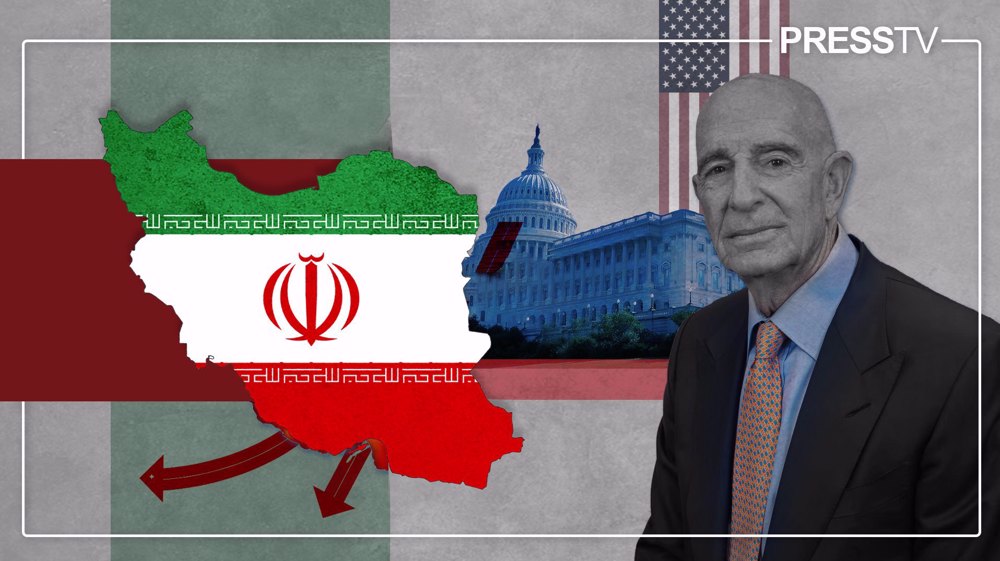
Recent comments by Tom Barrack, a close aide to US President Donald Trump and his special envoy to Syria, acknowledging two unsuccessful “regime change” attempts in Iran, are neither the first such admission by a US official nor likely the last.
The United States has pursued a policy of “regime change” in Iran ever since the Islamic Revolution of 1979 toppled the US-backed Pahlavi monarchy and replaced it with an Islamic Republic opposed to American hegemony - not just in Iran, but across the wider region.
The policy has taken many forms over the decades: crippling economic sanctions, diplomatic isolation, support for armed terrorist groups, acts of sabotage, espionage adventures, attempts to foment civil war and social unrest, and, more recently, direct military aggression against Iranian nuclear sites.
Yet, despite and perhaps because of this relentless pressure campaign, characterized by Trump as “maximum pressure” policy during his first presidential term, Iran has not only endured but thrived, particularly in the defense sector that makes Washington and Tel Aviv jittery.
In a recent TV interview, the real estate investor-turned diplomat, Barrack, insisted that Washington was not seeking to overthrow Iran’s ruling establishment, claiming instead that the Trump administration is batting for “genuine talks” on Tehran’s nuclear program.
Barrack said his bosses, Trump and Secretary of State Marco Rubio, believed that it was up to “the region itself” to come up with a regional solution.
Yet he contradicted himself by praising Trump’s decision to join Israel’s military assault on Iran in June, an act of aggression straight out of the American “regime change” playbook.
“It was amazing,” he said. “Our president has been clear. He is open to real discussions. He is not open to endlessly kicking the can down the road, and he knows the program.”
What the 78-year-old retired chairman of Colony Capital left out, however, was that Trump himself was the architect of the current stalemate, beginning with his foolhardy decision to “tear up” the landmark 2015 nuclear deal, known officially as the Joint Comprehensive Plan of Action (JCPOA).
That agreement had placed certain restrictions on Iran’s nuclear activities in exchange for easing some sanctions. Iranian officials have repeatedly said that if Washington truly had concerns about Iran’s nuclear program, the JCPOA was the best framework to address them
In his latest interview, US Special Envoy Tom Barrack admits that the United States had carried out two unsuccessful 'Regime Change' operations in Iran.
— PressTV Extra (@PresstvExtra) December 6, 2025
Follow Press TV on Telegram: https://t.co/h0eMpifVIe pic.twitter.com/RV1FKiBvas
From the outset, though, it has been clear that the nuclear issue was more a pretext than a genuine concern, a way to tighten economic and military pressure on the Islamic Republic with the ultimate aim of “regime change.”
In fact, the roots of US-Iran hostility can be found in Washington’s long-running policy of “regime change” in Tehran, stretching back to August 19, 1953, when the CIA and Britain’s MI6 orchestrated a coup against the government of Prime Minister Mohammad Mosaddegh after he nationalized the country’s oil industry.
The infamous coup helped Mohammad Reza Pahlavi consolidate his autocratic power and secure Western oil interests, but at the same time, it left Iranians feeling deeply betrayed.
Since the 1979 Revolution, tensions have ebbed and flowed depending on who held office in Washington and Tehran. They reached a boiling point during Trump’s first term, when the US withdrew from the JCPOA in May 2018, reimposed sanctions, and assassinated General Qassem Soleimani, the top anti-terror military commander, two years later.
At that moment, war seemed closer than ever.
When Joe Biden took office, he signaled a willingness to rejoin the JCPOA. But instead of addressing decades of mistrust and undoing the wrongs of his predecessor, his administration wavered between military threats, diplomatic escalation, and half-hearted attempts at rapprochement.
The supposed pause in the “regime change” policy looked more like a gesture to a war-weary American public than a genuine shift in strategy toward Iran and the wider region.
Trump’s return to the White House in 2024 brought back the “maximum pressure” campaign, in a different form and shape, even as he claimed to seek a new nuclear deal with Iran.
Diplomats from Iran and the US held five rounds of indirect talks mediated by Oman, and were preparing to hold a sixth when Israel launched a surprise aggression on Iran in mid-June.
A week later, Americans also jumped on the bandwagon, with Trump personally ordering strikes on three nuclear sites in different parts of Iran.
The objective, as propagated by Israeli Prime Minister Benjamin Netanyahu, was to incite people in Iran against the government and spark street protests in order to bring about “regime change.” The dastardly aggression, however, proved counterproductive
✍️ Feature - 72 years of Iran ‘regime change’ project: From 1953 coup to post-1979 failed plots
— Press TV 🔻 (@PressTV) August 21, 2025
Read More: https://t.co/IE4e1U8C8I pic.twitter.com/dDpvkegs8N
It turned out to be a disastrously wrong move. Instead of turning against their government, Iranians across the political spectrum rallied together in defense of their homeland.
The war produced the kind of national unity not seen in decades. It also revealed how badly Washington and Tel Aviv had misread Iran’s governing system, which has built extensive defensive, offensive, and intelligence networks precisely to withstand such scenarios.
Contrary to Netanyahu and Trump’s hallucinations, Iranians flatly rejected foreign intervention. The US should have learned from Iraq, Afghanistan, and Libya that top-down “regime change,” even when it succeeds in removing a government, rarely delivers the desired outcome.
Iran, moreover, is not Iraq or Libya. As the 12-day imposed war showed, Iran’s armed forces are capable of driving adversaries into retreat, as they did with Israel when Iranian missile capabilities turned Israeli cities into ghost towns in June, forcing it to request a ceasefire.
The continued reliance on coercion, sanctions, and military action has not only failed to effect regime change in Iran but has also fueled greater instability across the region.
If Trump truly seeks lasting peace in the region, as he claims he does, he must first acknowledge the failures of past US policies and recognize that Iran cannot be forced into submission.
The US president has laid out impossible conditions for Iran before any negotiations with Washington can begin: zero uranium enrichment and strict limits on its missile program.
For Tehran, these demands amount to nothing less than total surrender. It means compromising on the blood of martyrs and hard-earned gains since the 1979 Islamic Revolution.
By setting conditions that strike at the heart of Iran’s strategic red lines and vital deterrence, Washington has effectively closed the door on meaningful dialogue.
For the US to achieve peace in West Asia, it must confront the reality that Iran is not a country that responds to the language of force. The evidence is overwhelming: deterrence, containment, and military escalation have all failed.
Hamid Javadi is a senior Iranian journalist and commentator based in Tehran.
(The views expressed in this article do not necessarily reflect those of Press TV)
 This makes it easy to access the Press TV website