
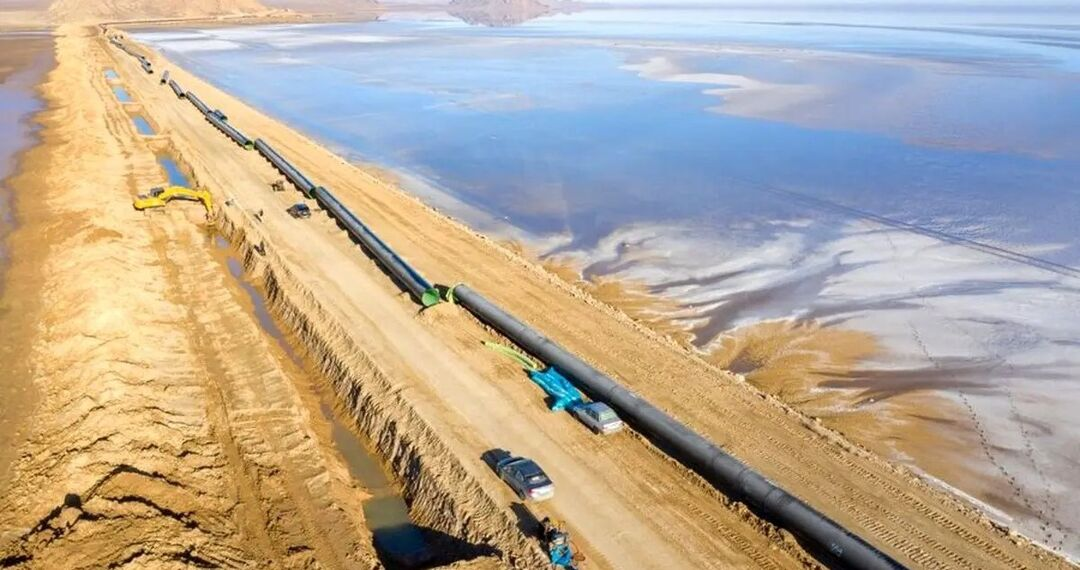
President Masoud Pezeshkianon on Saturday inaugurated one of Iran’s most ambitious infrastructure projects for the transfer of water from the Oman Sea to the central plateau, stretching over 800 kilometers from Sirjan to Isfahan.
The project demonstrates a remarkable national capability to tackle the twin challenges of climate change and persistent drought.
For decades, industries in Isfahan, particularly Mobarakeh Steel, relied heavily on the Zayandeh Rud, which has suffered from dwindling flows due to overuse, upstream diversions, and shifting rainfall patterns.
The new project ensures a stable water supply for these industrial hubs, reducing vulnerability to periodic water shortages that previously halted production and threatened regional economic stability.
However, the water transfer represents more than sustaining existing industrial capacity, marking a pivot in Iran’s economic strategy.
President Pezeshkian emphasized that future industrial and population growth should focus increasingly on southern coastal regions, initiating a deliberate transition toward a marine economy.
This shift is necessary because Iran’s industrial future can no longer depend solely on inland water sources.
By relocating or expanding industries near the seas, the country positions itself to exploit its vast maritime potential while simultaneously relieving pressure on overburdened inland water systems.
The southern coast, particularly the Makran corridor along the Oman Sea, emerges as the linchpin of this strategy.
Ports such as Chabahar and Bandar Abbas are being developed not merely as transit points but as centers of industrial and logistical activity capable of attracting investment and connecting Iran more deeply to global trade networks.
Chabahar port, Iran’s only deep-water ocean port, provides direct access to open seas and acts as a gateway for landlocked Central Asian countries.
Investments in infrastructure such as modernized berths, container terminals, and integrated transport links are set to increase Iran’s competitiveness in regional shipping.
These upgrades make the ports more attractive for international shipping lines and facilitate the efficient movement of goods, lowering costs for domestic industries and encouraging foreign investment.
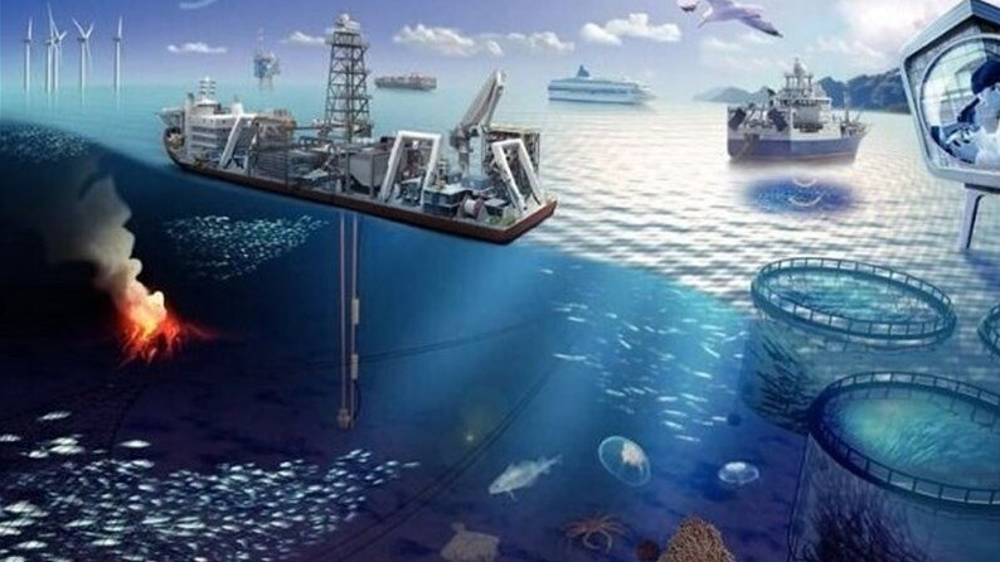
The marine economy vision extends well beyond shipping. Renewable energy projects on the southern coast, including wave, tidal, and ocean thermal initiatives, are being explored to supplement conventional energy sources.
The Makran coast, with its abundant wind, wave activity, and high solar potential, is particularly suited for these projects, which can provide stable and clean energy for coastal industrial zones.
Simultaneously, aquaculture and marine biofuels are opening new avenues for sustainable economic activity.
Coastal provinces are now positioned to benefit from fisheries, algae-based bioenergy, and other marine biotechnology ventures, which generate employment while contributing to local and national GDP.
The strategic development of Iran’s marine economy is tightly linked to its industrial policy. By connecting port modernization with energy, logistics, and manufacturing, Iran is creating a cohesive industrial ecosystem along its coastlines.
The water transfer project, while inland, complements this vision by securing the resource base for critical industries that will eventually integrate with coastal expansion.
Mobarakeh Steel, for instance, now enjoys a reliable water supply, ensuring uninterrupted production and providing confidence for further industrial investment.
The combination of water security and energy expansion underpins the long-term viability of both inland and coastal industries. Infrastructure development is central to the marine economy.
Ports such as Shahid Beheshti, Chabahar, Bandar Imam Khomeini, and Bushehr are being upgraded to handle larger cargo volumes, provide advanced logistics services, and integrate with national and regional transport networks.
Enhancing these ports’ capacity not only supports trade but also strengthens the supply chains of domestic industries, including steel, petrochemicals, and manufactured goods.
Islands like Qeshm, Kish, and Abu Musa are increasingly seen as nodes for industrial, commercial, and residential growth, complementing port activities and supporting economic diversification along the southern coast.
The water transfer project highlights the role of public and private investment in building a resilient economy. Beyond state funding, private sector participation, both domestic and foreign, is encouraged to accelerate industrial and maritime development.
By creating attractive investment conditions, Iran can channel capital into high-value industrial projects, logistics hubs, renewable energy, and maritime services. This infusion of investment promotes job creation, skill development, and technology transfer, strengthening the overall competitiveness of the economy.
The human dimension is equally important. Training and education programs are being developed to produce a skilled workforce capable of supporting the growing marine economy.
By focusing on multi-disciplinary maritime expertise, Iran can cultivate specialists in shipping, logistics, marine technology, and industrial engineering.
The transfer of water from the Oman Sea to Isfahan is emblematic of a broader economic transformation. It safeguards existing industrial capacity, ensures reliable production for key sectors like steel and petrochemicals, and serves as a strategic bridge toward the southern coastal expansion.
The project demonstrates Iran’s ability to implement large-scale engineering solutions to environmental and industrial challenges while signaling a forward-looking policy that aligns natural resource management with industrial strategy.
By integrating water security, industrial sustainability, and coastal development, Iran is laying the foundation for a resilient and competitive marine economy.
 This makes it easy to access the Press TV website