Inside Iran’s air defense network, a robust shield that repelled Israeli-US aggression
By Masoud Khalili
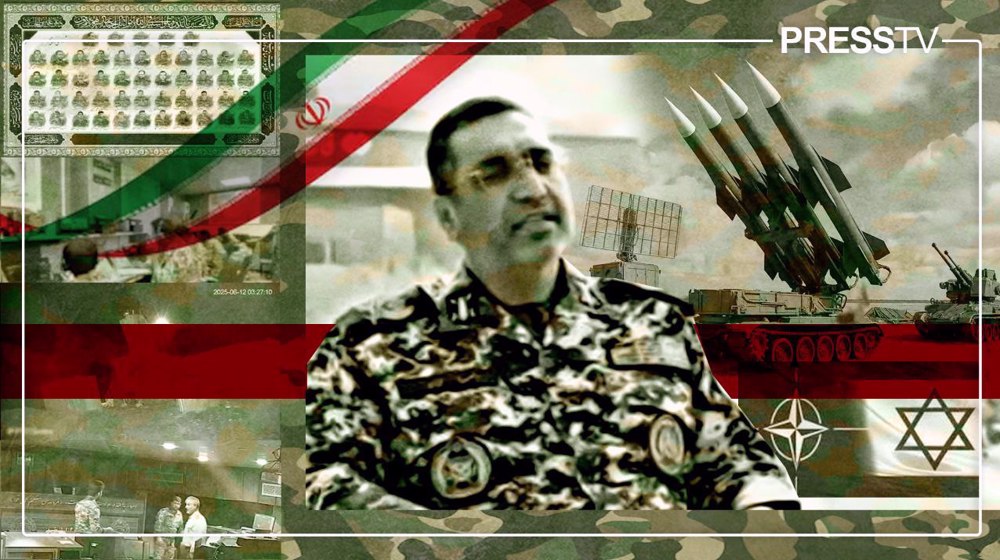
Iran’s air defenses units have never paused, not the least during the recent Israeli military aggression and multi-vector cyber attacks in June, bravely protecting the skies of the country.
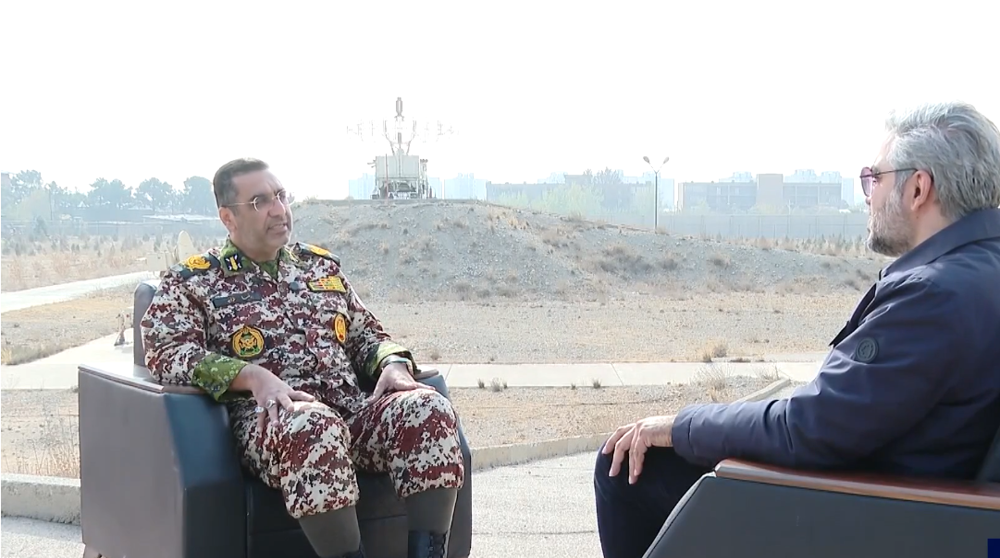
Deputy head of operations of the Iranian Army's Air Defense Force, Brigadier General Reza Khajeh, made it emphatically clear during an interview televised on Saturday.
His words embodied the spirit of Iran’s Sacred Defense in the 1980s, which was demonstrated with greater might and conviction during the 12-day war that ended in the enemy’s humiliation.
Khajeh’s comments offered a rare, firsthand account from someone high up in the chain of command.
He began by crediting the country’s air defense units, from the top commander, Major General Abdolrahim Mousavi, to the air defense commander, Brigadier General Alireza Sabahifard, for their continued presence at Khatam al-Anbia Air Defense Base, the central command of the Islamic Republic’s air defense forces.
Khajeh said that Mousavi and Sabahifard, who were responsible for overseeing the defense during the attacks, were closely watching the situation every second, even hours before the strikes began.
Other commanders and system operators across all air defense regions were also at their stations and ready before the attacks started, he added.
“Every missile and radar system had been placed on full operational status and were actively monitoring the skies over western Iran,” the military official said in the interview.
"Iran stood against the West during the 12-day aggression"
— Press TV 🔻 (@PressTV) November 29, 2025
Reza Khajeh, Deputy Commander for Operations of Iran's Army Air Defense Force, says that Western technology was fully deployed against Iran during the 12-day imposed war, but the Islamic Republic emerged victorious. pic.twitter.com/6yhtZeW65B
An invading monstrosity
“In truth, the first wave of strikes involved precision weapons, cruise missiles, and ballistic projectiles, in what was clearly a hybrid, multi-layered warfare strategy launched by the regime and its backers,” Khajeh recalled.
He noted that the attack was also supported by powerful drone swarms and loitering weapons launched from Israeli military bases, particularly command-and-control UAVs like the Hermes 900 and IAI Heron, which coordinated the regime’s operations.
Khajeh emphasized that Iranian fighters were not just facing two so-called egocentric invaders, but were up against the entire NATO military alliance and the broader Western military-technological complex during those 12 days.
He further explained that more than 33 countries backed the regime during the unprovoked and illegal invasion, describing their support as “the full weight of Western technology.”
“All of these (the hostile pawns of the Israeli-Western war machine) had to be continuously detected, identified, tracked, and engaged,” he said.
Israeli official admits Iranian capture of drones worth ‘hundreds of millions’ of dollars https://t.co/tBal5Jo4zb
— Press TV 🔻 (@PressTV) June 30, 2025
“These were neutralized in the western, central, and even metropolitan regions of Iran, including the capital Tehran, by the same air-defense units you see here,” the official added, pointing to the sprawling defensive network set up at the command center.
“By God’s grace, and through dedication, resolve, and extraordinary courage, the real victors of the 12-day war were our nation, the Islamic Republic of Iran and its people.”
The official said the country’s indigenous air defense forces fulfilled their role effectively, singling out the Khordad-3 road-mobile medium-range air defense missile system, Khordad-15 surface-to-air missile system, and Bavar (Belief)‑373long-range road-mobile surface-to-air missile system for outstanding performance.
According to Khajeh, the regime’s heavily Western-equipped missile systems, and the US’s backup missile defenses, fell far short of living up to their highly touted capabilities when confronted with the Islamic Revolution Guards Corps (IRGC) Aerospace Force’s ballistic and hypersonic missile retaliation.
“Air defense, anywhere in the world, is relative. You saw that despite the small size of the Zionist regime and despite implementing multiple defensive layers, our missiles penetrated those shields and struck their intended targets,” he remarked.
“This shows that air defense is highly specialized, complex, constantly evolving, and not absolute. There will always remain a proportional balance between defense and offense.”
US splurged $800m on THAAD in 12 days to shield Israel from Iranian missiles: Reportshttps://t.co/zg6xRzvYk1
— Press TV 🔻 (@PressTV) June 28, 2025
Volunteerism from retired, active forces
A young conscript stationed in the region facing the majority of hostile missiles and aircraft, who already had his service completion card in hand, refused to leave his post. He remained on duty throughout the entire 12-day imposed war, heroically defending the country.
Khajeh noted that this death-or-glory mindset was shared by many others.
One such example was Martyr Bostan-Afrouz, a senior officer who was studying at the National Defense University when the war began.
Although the university was shut down, he immediately returned, took command of a heavy missile defense system set up in an ambush around Tehran, and was ultimately martyred despite having no obligation to participate in the mission.
Similarly, two other personnel refused to abandon their air defense unit even after suffering severe burns, demonstrating the unwavering national zeal that defined Iran’s retaliation.
Midway through the war, the deputy commander added, veterans who had retired years earlier reached out to headquarters, volunteering to return to duty purely out of devotion.
Leader: Iran defeated both US and Zionist regime in 12-day war https://t.co/vTIYRlXZTe
— Press TV 🔻 (@PressTV) November 27, 2025
“As the deputy for air defense operations, I bear witness that from the lowest to the highest rank, our personnel stood their ground for 12 days with extraordinary resilience.”
Khajeh concluded his remarks by praising how, immediately after the war, Iranian scientists, the industrial sector, and the defense community united to address any shortcomings and upgrade existing systems.
“Rest assured, the enemy will no longer be able to impose itself. And should even the smallest threat be directed against Iran again, we will respond with even greater force and decisiveness.”
The key takeaway from the interview was that Iran’s air defenses proved a resilient network can withstand saturation warfare – even against state-of-the-art strike technology.
The layered shields of the Zionist regime and the West are proportional, not absolute – and Iran clearly demonstrated this principle during the 12 days that ended in the enemy’s crushing defeat.
Masoud Khalili is a Tehran-based writer and strategic affairs commentator.
(The views expressed in this article do not necessarily reflect those of Press TV.)
If Iran’s oil sales and security are not guaranteed, neither are anyone else’s: Parliament speaker
America hiding true casualties of wars on Iran: Senior Army commander
New front will open if Iran is attacked again, Leader’s advisor warns



VIDEO | Press TV's news headlines
VIDEO | Commentator: Iran’s education, unity and history strengthen its resilience
Barimanlou secures kurash gold as Iran reaches ninth gold in Aichi-Nagoya
2026 Asian Games: Iran’s 17-year-old Beheshti wins bronze in women’s weightlifting
From ‘four weeks’ to month eight: US senator condemns GOP for refusing to end Trump’s war on Iran
If Iran’s oil sales and security are not guaranteed, neither are anyone else’s: Parliament speaker
VIDEO | Netherlands takes stand for international law by banning Israeli settlement products
US Navy claims four personnel injured in unexplained shipboard ‘mishap’


 PressTV NEWSLETTER
now
PressTV NEWSLETTER
now
 This makes it easy to access the Press TV website
