Explainer: Why Trump banned S. Africa from 2026 G20 – and the truth behind ‘white genocide
By Humaira Ahad
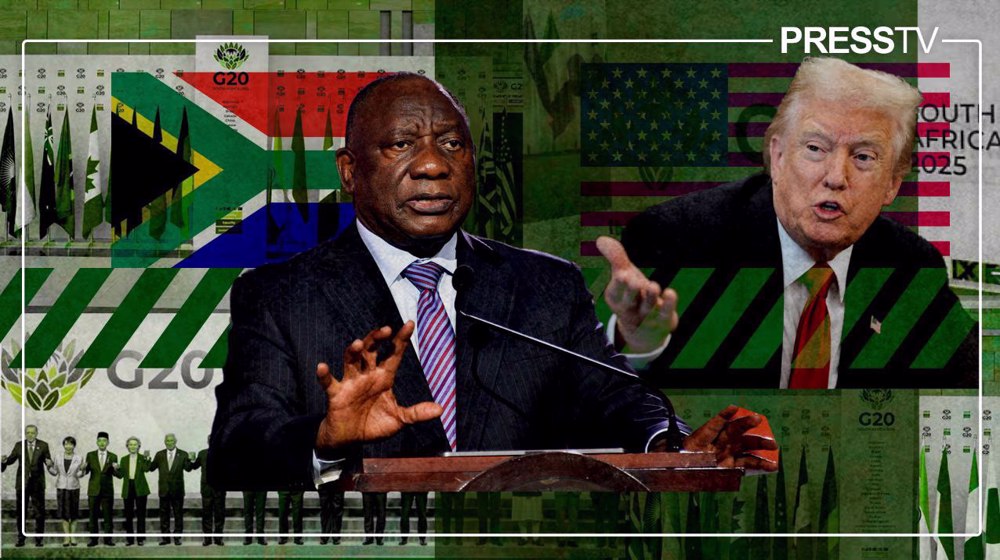
In a recent move that has stunned the international diplomatic community, US President Donald Trump announced that South Africa will not be invited to the 2026 G20 summit in Miami, Florida.
The announcement followed Washington’s boycott of last week’s leaders’ summit in Johannesburg, a decision South Africa has condemned as “punitive.”
Trump made the announcement on social media, framing it as a response to South Africa’s “alleged discrimination” against its white population - calling it "white genocide."
“Therefore, at my direction, South Africa will NOT be receiving an invitation to the 2026 G20, which will be hosted in the Great City of Miami, Florida next year,” Trump wrote on Truth Social.
“South Africa has demonstrated to the World they are not a country worthy of Membership anywhere, and we are going to stop all payments and subsidies to them, effective immediately,” he added.
G20 snub sparks diplomatic fallout
Tensions reached a breaking point during the Johannesburg summit when the White House attempted to send a "junior" representative from its embassy in Pretoria to receive the ceremonial gavel, traditionally handed by the host nation to the head of state assuming the next G20 presidency.
Pretoria rejected the move outright, describing it as a breach of diplomatic protocol and an unmistakable insult.
In retaliation, Trump issued a formal declaration that South Africa would not be invited to the 2026 summit in Miami.
“This gavel of this G20 summit formally closes this summit and now moves on to the next president of the G20, which is the United States, where we shall see each other again next year,” South African President Cyril Ramaphosa said in his closing remarks last week.
Yet despite South Africa’s adherence to protocol, Trump insisted the gavel had been “refused,” using the claim to justify a new round of "punitive measures.
South Africa warns Trump’s G-20 ban sets dangerous precedent as diplomatic rift widens https://t.co/zftERsSQ5X
— Press TV 🔻 (@PressTV) November 29, 2025
Ramaphosa’s office issued a firm rejection of the accusation.
“It is regrettable that despite the efforts and numerous attempts by President Ramaphosa and his administration to reset the diplomatic relationship with the US, President Trump continues to apply punitive measures against South Africa based on misinformation and distortions about our country.”
The presidency reiterated South Africa’s status in the bloc that South Africa is a member of the G20 "in its own name and right" and its G20 membership is "at the behest of all other members."
South Africa is a sovereign constitutional democratic country and does not appreciate insults from another country about its membership and worth in participating in global platforms.”
The G20 itself, established in 1999 as an informal forum of 19 countries and the European Union, has no mechanism for ejecting or banning a member state.
Yet Washington has used targeted attendance, visa limitations, and financial strain to exclude Pretoria, creating what analysts caution is a risky precedent for the integrity of multilateral institutions.
“White genocide” allegations
Trump has repeatedly claimed that white South Africans, particularly farmers, are being subjected to systemic persecution.
In his Truth Social post last week, he said the US did not attend the G20 in South Africa "because the South African Government refuses to acknowledge or address the horrific Human Rights Abuses endured by Afrikaners, and other descendants of Dutch, French, and German settlers."
“To put it more bluntly, they are killing white people, and randomly allowing their farms to be taken from them,” Trump wrote on social media, reiterating his narrative of “white genocide.”
South Africa says it will not withdraw its genocide case against Israel at the International Court of Justice (ICJ) despite US President Donald Trump’s order to freeze Washington’s aid to the country.
— Press TV 🔻 (@PressTV) February 13, 2025
Read more: https://t.co/7Q1ugpD4YV pic.twitter.com/dqplxnGWd8
However, these claims are widely discredited. South African crime data shows that murders of white farmers constitute less than 1 per cent of the country’s roughly 27,000 annual homicides.
In the last quarter of 2024, South Africa recorded 12 murders on farms, including black-owned smallholder plots, out of almost 7,000 murders across the country.
In a meeting in May with Ramaphosa, Trump presented videos he said proved a genocide.
Ramaphosa replied, “Have they told you where that is, Mr President? I’d like to know where that is, because this I’ve never seen.”
Despite the lack of evidence, Trump’s administration has taken extraordinary steps, granting refugee status to dozens of white South Africans, cutting foreign aid, and signing executive orders halting US payments and subsidies to South Africa.
In May, 59 white South Africans arrived in the US under a refugee program, even as the administration capped overall refugee admissions at 7,500 for the 2026 fiscal year, prioritizing white South Africans.
South Africa’s ICJ case against Israel
Much of the US-South Africa tensions stems from Pretoria’s proactive foreign policy.
South Africa last year launched a historic genocide case against Israel at the International Court of Justice (ICJ) over the regime’s genocide in Gaza that has killed more than 70,000 Palestinians.
Washington condemned the move, which led to bitter ties between the two sides.
In January 2024, then-National Security Council coordinator John Kirby described the case as “meritless, counterproductive and completely without any basis in fact whatsoever.”
🎥 Opening of Justice
— Press TV Documentary (@presstvdoc) October 4, 2025
🔻On 29 Dec 2023, South Africa took Israel to the ICJ over its Gaza campaign. Will Israel face trial?
📺Tune into Press TV
🗓 Premieres Tue, Oct. 7 | 06:30 GMT
📺Rebroadcasts:
Wed 10:30 & 20:30 | Thu 01:30 | Fri 07:30 | Sat 14:30 | Sun 04:30 GMT pic.twitter.com/0qq4qSg9tx
Trump has explicitly tied "punitive measures" to Pretoria’s stance on Israel. Recently, the US revoked the visa of former international relations minister Naledi Pandor, who spearheaded South Africa’s ICJ case, representing an escalating strategy of pressure.
According to reports, Pandor received immediate notice that her visa had been cancelled by the US Consulate.
In March, America expelled South Africa’s ambassador, Ebrahim Rasool, and suspended various forms of assistance to the country.
The White House cited Pretoria’s land expropriation policies, the ICJ case against Israel, and perceived ties with Iran as reasons.
In February, Trump signed an executive order cutting US financial assistance to South Africa.
“The United States cannot support the government of South Africa’s commission of rights violations in its country or its undermining of United States foreign policy, which poses national security threats to our Nation, our allies, our African partners, and our interests,” the order stated.
The US House also introduced the Bilateral Relations Review Act in February 2024, accusing South Africa of siding with “malign actors” including the Gaza-based Hamas resistance group, and of pursuing closer ties with China and Russia.
The bill further criticized African National Congress (ANC) leaders for allegedly making "anti-Israel statements" following the Al-Aqsa Storm operation, citing a statement from South Africa’s Department of International Relations and Cooperation that linked the operation to Israel’s continued illegal occupation of Palestine.
Experts suggest the latest US Department of State reports are designed to erode South Africa’s moral authority in the ICJ case, portraying it as incapable of critiquing Israel due to alleged domestic human rights shortcomings.
The measures form part of a broader pattern in which governments critical of Israeli policy have encountered diplomatic, economic, or administrative push-back.
Trump's escalation against Cuba aims to distract from humiliating defeat in Iran: Analyst
Rubio grilled on ‘dumpster fire’ foreign policy as US threatens Cuba militarily
Trump says he would be ‘honored’ to meet Iran’s new Leader


‘He sells out those who stand beside him’: Iran dismisses hostile remarks by Lebanon’s Aoun
From manufacturing consent to masking defeat: 'Iran Intl.' in service of US-Israeli war machine
VIDEO | Saudi Arabia and the push for normalization with Israel
Congress tables bill limiting Trump war powers
Iran’s Qamishloo-Dalankouh added to UNESCO Biosphere Reserve Network
US approves $2bn sale of counter-drone systems to Kuwait
VIDEO | From Palestine to Iran: Football and global politics
Lebanese army colonel, troops killed in Israeli air raid despite ceasefire




 PressTV NEWSLETTER
now
PressTV NEWSLETTER
now
 This makes it easy to access the Press TV website
