
By Ivan Kesic
In a demonstration of technological self-sufficiency, specialists from the Islamic Revolution Guards Corps (IRGC) Aerospace Force successfully tested the engine of the Shahed-161 unmanned aerial vehicle during a public exhibition at the National Aerospace Park on Tuesday.
This event showcased one of Iran's most significant indigenous drone developments, a sophisticated platform designed for a mix of reconnaissance, surveillance, and combat missions.
The live engine test provided a tangible look at a system that embodies years of dedicated research and reverse-engineering, highlighting Iran's strategic commitment to building an autonomous defense industrial base, which has in recent years become the best in the world.
With specifications including a 150-kilometer operational range, a 7,600-meter service ceiling, and the ability to carry two 50-kilogram bombs, the Shahed-161 represents a key asset in Iran's layered and versatile drone arsenal.
Its repeated display at national exhibitions since 2020 underscores its operational maturity and the pride Iran places in a homegrown capability developed in the face of international sanctions.

Technical characteristics and design philosophy
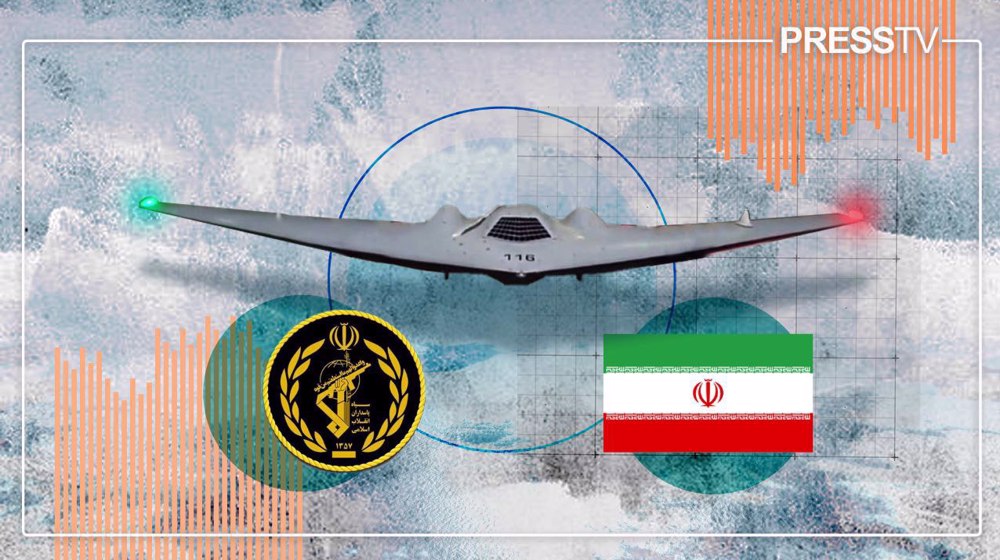
The Shahed-161 is a compact, jet-powered unmanned combat aerial vehicle (UCAV) that embodies a low-observable, flying-wing design.
Its airframe is a masterclass in efficient aerodynamics and reduced radar signature, featuring a blended fuselage and smooth, faceted surfaces that minimize right angles to deflect radar waves.
According to detailed infographics released by local media, the drone has a wingspan of 6.13 meters and a length of just 1.9 meters, making it the smallest in a family of drones reverse-engineered from the RQ-170 Sentinel, scaled to approximately 40 percent of the original's size.
This tactical platform is powered by a micro-jet engine, a propulsion choice that provides a significant performance advantage over slower, piston-engine drones.
The Shahed-161 boasts a maximum speed of 275 kilometers per hour and can operate at altitudes up to 7,600 meters (25,000 feet), allowing it to evade many short-range air defense systems.
With a maximum takeoff weight of 170 kilograms, it is a lightweight yet potent system. Its stated endurance is 3 hours, with an operational range of 500 kilometers, making it ideal for tactical-level missions behind enemy lines.
The drone is launched via a vehicle-mounted catapult system, enabling rapid deployment without the need for a runway, and it can carry a payload of up to 50 kilograms.
This payload capacity is typically allocated to two Sadid smart bombs or advanced optical and infrared sensor suites for intelligence, surveillance, and reconnaissance (ISR) missions, demonstrating its dual-role capability.

Development history and engineering
The genesis of the Shahed-161 is inextricably linked to a pivotal intelligence coup in December 2011, when the IRGC successfully captured an intact American RQ-170 Sentinel stealth drone after it illegally entered Iranian airspace.
This episode provided Iranian engineers with unprecedented access to one of the most secretive platforms in the US arsenal.
Rather than simply copying the captured vehicle, the IRGC Aerospace Force embarked on a systematic and meticulous reverse-engineering program, demonstrating profound strategic foresight.
The development process was methodical and knowledge-driven. It began with the construction of a 15 percent scale model for initial research and development to understand the fundamental principles of the flying-wing design and its complex wiring.
By 2014, this foundational work culminated in the creation of the 40 percent-scale prototypes: the Shahed-161 and its piston-engine variant, the Shahed-141.
The key difference between these two models was their propulsion; the Shahed-161's adoption of a micro-jet engine marked a significant step up in technological complexity and performance.
These initial models were used to master flight dynamics and aircraft configuration, serving as testbeds that would eventually lead to operational systems for surveillance and light combat operations.
This iterative development process highlights a sophisticated approach to aerospace engineering, where knowledge was systematically built and applied, transforming a captured asset into a springboard for a wholly indigenous family of unmanned systems.

The Shahed family: A spectrum of indigenous capabilities
The Shahed-161 is just one member of a cohesive and scalable family of unmanned systems developed by Iran, each designed to fulfill a specific niche in the nation's defense strategy.
As the piston-engine sibling to the Shahed-161, the Shahed-141 shares the same 40 percent scale airframe. Its use of a cheaper, lower-maintenance piston engine makes it a cost-effective solution for training and less demanding reconnaissance missions, establishing a new generation of efficient drones within the IRGC.
Representing a 60 percent scale of the RQ-170, Shahed-191 and Shahed-181 marked the next evolutionary step. The Shahed-191 is a jet-powered UCAV with enhanced capabilities, including a 1,500-kilometer range, 4.5 hours of endurance, and a 500-kilogram maximum takeoff weight.
Crucially, it features an internal weapons bay capable of carrying 100 kilograms of ordnance, a design feature that preserves its low-observable characteristics by avoiding external payload carriage.
The Shahed-181 is its piston-engine counterpart. The combat debut of the Shahed-191 in a coordinated swarm attack against Daesh targets in Syria in October 2016 was a historic moment, registering Iran as a pioneer in the operational use of drone swarm tactics.
The crown jewel of the family, the Shahed-171 (Simorgh), is a full-scale, one-to-one replica of the RQ-170. This strategic-level drone is a monumental engineering achievement, featuring a turbofan engine, a 4,400-kilometer range, and an endurance of 10 hours at altitudes up to 15,000 meters.
With a maximum takeoff weight of 3,700 kilograms and a payload capacity of 225 kilograms, the Simorgh is Iran's most advanced reconnaissance drone, capable of conducting deep-penetration missions deep within enemy territory.
Its design, which lacks right-angle surfaces and utilizes radar-absorbent materials, places it firmly in the category of stealthy, low-observable platforms.

Operational deployment and strategic significance
The Shahed-161 is far from a mere technology demonstrator; it is a battle-proven system integrated into the IRGC's order of battle.
Its public appearances have been consistent and widespread, featured in exhibitions in Tehran, Isfahan, Qom, and Kish Island between 2020 and 2023.
More importantly, it has been used in operational contexts, including combat operations against terrorist groups in Syria, where it provided vital reconnaissance and strike capabilities.
The strategic significance of the Shahed-161 and its sister platforms cannot be overstated. They represent a cornerstone of Iran's doctrine of asymmetric warfare and strategic self-reliance.
In the face of international sanctions and arms embargoes, Iran has not only maintained its defense capabilities but has advanced them, building a sophisticated aerospace sector from the ground up.
The Shahed family provides the IRGC with a layered UAV strategy, from the tactical Shahed-161 to the strategic Shahed-171, ensuring persistent ISR and precision strike capabilities across all levels.
This achievement is a symbol of national resilience, demonstrating that the Islamic Republic, relying on its own skilled engineers and scientists, can overcome external pressures and achieve technological sovereignty in one of the most complex and demanding fields of modern warfare.
 This makes it easy to access the Press TV website