Maiden flight of homebuilt Simorgh marks new chapter in Iran’s aviation industry
By Press TV Staff Writer
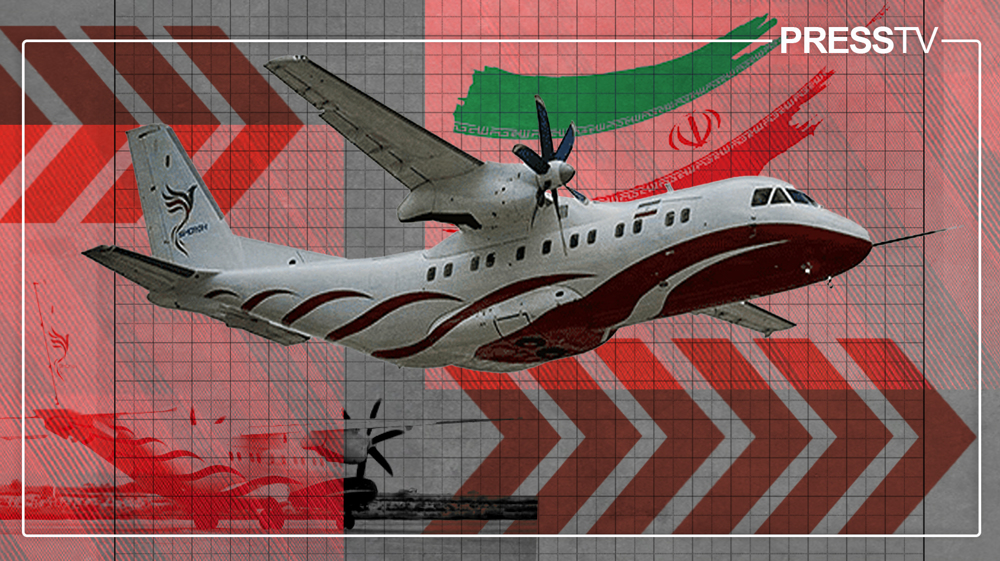
Last week, Iran’s domestically produced transport aircraft Simorgh completed its first official test flight under the supervision of the Civil Aviation Organization, marking the start of its final evaluation phase for airworthiness certification.
The event, held at the Shahin Shahr Special Aviation Zone, was attended by senior government and military officials and represented a milestone in a 15-year national effort to achieve self-sufficiency in aircraft design and production.
Developed by the Iran Aircraft Manufacturing Industrial Company (HESA) under the Ministry of Defense’s Aerospace Industries Organization, the twin-engine aircraft has a maximum take-off weight of 21,500 kilograms and can carry up to 6,000 kilograms of cargo over a range of roughly 3,900 kilometers.
Equipped with two 2,500-horsepower engines and a rear loading ramp for quick cargo access, the Simorgh has been designed for logistical, humanitarian and regional transport missions.
The aircraft’s flight signals not just a technological achievement but an expansion of Iran’s industrial capacity.
Building a functional aircraft requires expertise in aerodynamics, materials science, avionics, control systems and production engineering. The successful integration of these disciplines shows that Iran’s manufacturing base has reached a new level of sophistication.
Officials say the Simorgh’s production cost is roughly half that of comparable foreign aircraft, giving it potential cost advantages for domestic operations and regional exports.
The Simorgh project stems from earlier work on the Iran-140, itself adapted from Ukraine’s Antonov-140. Over years of redesign, Iranian engineers have altered key systems, including the fuselage structure, flight controls and avionics.
The addition of a rear cargo ramp marks a shift from passenger transport to multi-role airlift capability, requiring deeper domestic design competence and local sourcing of parts.
Each of these steps has forced the development of new manufacturing techniques and supply chains across Iran’s industrial landscape.
For a country long affected by trade restrictions, the economic logic behind such a program is clear.
The Iranian-made plane Simorgh has officially started its test flights as the aircraft prepares to join the country’s cargo fleet.
— Press TV 🔻 (@PressTV) October 29, 2025
Here is what you need to know about it. pic.twitter.com/bUmnWKPvJx
Sanctions have limited Iran’s access to imported aircraft, engines and spare parts. Building its own aircraft provides flexibility and ensures that basic transport needs, whether civilian, humanitarian or military, can be met without reliance on external suppliers.
This, in turn, helps protect domestic logistics against future disruptions in international trade.
The production of an indigenous aircraft has also drawn together a wide network of local industries. Metal fabricators, composite material producers, electronics firms and software developers have all contributed components and subsystems.
The process generates skilled employment and reinforces a national ecosystem of small and medium-sized enterprises.
HESA’s operations in Isfahan have become a regional industrial hub, providing hundreds of engineering and technical jobs and creating a base for further technological spin-offs.
The demands of aircraft manufacturing push suppliers to upgrade their production standards. Components must meet precise tolerances, and safety requirements are strict. These standards, once established, tend to influence other sectors.
Composite and alloy research, for example, can improve automotive production and renewable energy infrastructure. The Simorgh program, therefore, serves as a driver of technological diffusion throughout the Iranian economy.
Domestic use could provide a stable foundation for production. Iran’s vast geography, mountainous terrain and frequent need for emergency logistics make air transport valuable.
A fleet of home-built cargo aircraft can deliver relief supplies, evacuate patients, or transport goods between remote provinces at a lower operational cost than imported aircraft.
By adapting the same platform for multiple roles — from disaster response to military resupply — HESA can sustain production volumes while improving design efficiency.
The transition from prototype to serial manufacturing will test the country’s industrial management. Scaling up output requires reliable parts supply, trained technicians, and financial discipline.
To coordinate this process, a national support committee including ministries, universities and private industries has been established.
Iran begins test flights of home-made cargo planehttps://t.co/NLqkUM5DEq
— Press TV 🔻 (@PressTV) October 28, 2025
The effort reflects an understanding that aerospace programs depend on cooperation between research, industry and government rather than isolated defense spending.
Long-term, the project is expected to strengthen Iran’s technological workforce. Fifteen years of design and testing have produced engineers experienced in structural design, flight dynamics and systems integration.
These capabilities can feed into other aerospace ventures, including drone and satellite development. Iran’s growing pool of aeronautical specialists represents a durable form of industrial capital — one that could outlast the Simorgh program itself.
If the aircraft attains international certification under standards such as EASA or ICAO, Iran could seek export markets in countries requiring affordable light transport aircraft.
Even without that, domestic demand may keep production viable. The price advantage — 40 to 50 percent below imported models — gives the government and local operators an incentive to buy domestically.
In an economy seeking to replace imports with local production, the Simorgh offers a concrete case of substitution that reduces foreign currency outflow.
Beyond the numbers, the Simorgh embodies Iran’s ambition to stand among the limited group of nations capable of designing and producing aircraft from scratch. Fewer than twenty countries possess such an integrated capability.
Iran’s achievement suggests that its industrial base, though constrained, has reached a degree of technical maturity that allows it to produce one of the most complex manufactured goods.
The first flight of the Simorgh therefore shows that a decade and a half of steady investment in engineering, materials and human capital has yielded an aircraft that can fly, carry cargo and potentially be produced at scale.
For Iran, it is proof that advanced manufacturing and self-reliance can coexist and that a home-grown aviation industry may become one of the country’s most tangible expressions of technological progress.
Iran says international flights continue despite US sanctions pressure
Iran slams US for blaming Tehran over rising fuel prices, Strait of Hormuz closure
Iranian engineers develop indigenous engine control units, advancing automotive electronics



Yemen warns Arab, Muslim states against joining renewed Saudi war
Jordan: The Kingdom of Compromise (Part 3)
Over 124,000 schools reopen across Iran for new academic year
Iran restores half of damaged South Pars production capacity
Iran issues indictment against Israeli figures over Hezbollah pager explosions
Mahmoud Nemati delivers another karate gold for Iran at 2026 Asian Games
Russia’s Rosatom increases workforce at Iran’s Bushehr Nuclear Plant
Yemen shoots down Saudi UAV after deadly airstrikes by Riyadh




 PressTV NEWSLETTER now
  This makes it easy to access the Press TV website