Hezbollah delegation holds ‘open, friendly’ talks with Russia FM in Moscow
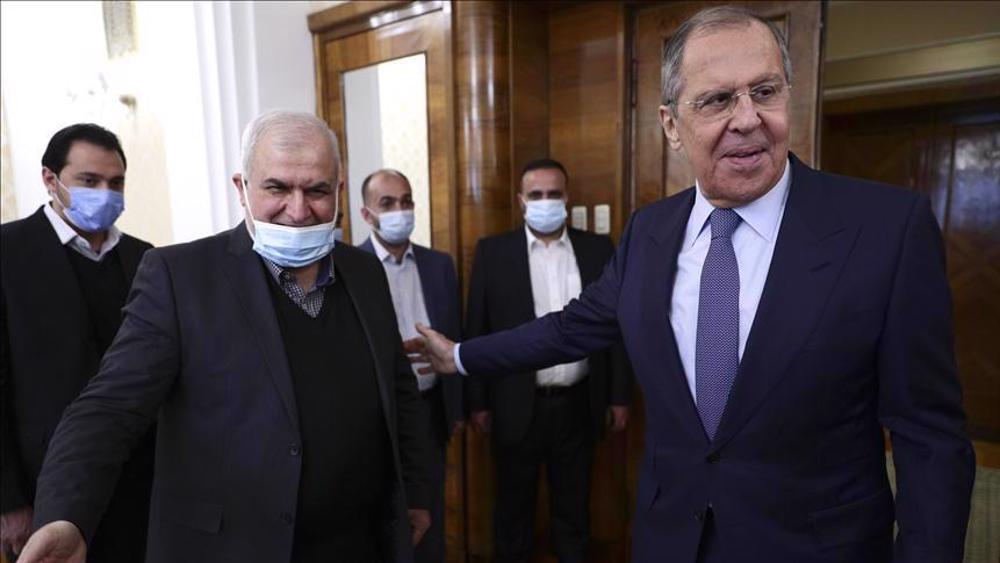
Russia’s Foreign Minister Sergei Lavrov and a visiting Lebanese lawmaker from the Hezbollah resistance movement and his accompanying delegation have held “open and friendly” talks.
Lavrov met with Mohammad Raad, the president of the Loyalty to the Resistance Bloc, Hezbollah’s political wing at Lebanon’s Parliament, in Moscow on Monday, the Russian Foreign Ministry said without giving details.
The visit by the four-member Hezbollah delegation to Russia comes at a time when Lebanon is mired in its worst economic crisis in decades as well as a political stalemate over the formation of a new government.
Speaking after the 40-minute meeting, Raad said the discussions were “open and friendly.”
“We discussed the latest developments in Lebanon and the region, as well as means to maintain stability and bolstering achievements secured in the field of counter-terrorism in both Syria and Lebanon,” al-Manar TV quoted the Lebanese MP as saying.
He added that “Russia’s support for friendly countries in the region, especially Lebanon” was also reviewed at the meeting.
Raad further stressed the importance of speeding up the formation of a new government in Lebanon “in a way that represents the people’s will,” noting that such a step is key to restoring stability and solving crises in the country.
He had earlier told Russia’s Sputnik news agency that the relationship between Hezbollah and Moscow is built on “common interests and a single or very close view regarding the situation in the region and the need for its stability.”
Lavrov also met with Lebanon's Prime Minister-designate Saad Hariri on the sidelines of his visit to the United Arab Emirates last week.
Hezbollah was established following the 1982 Israeli invasion and occupation of southern Lebanon. Since then, the popular resistance movement has grown into a powerful military force.
During the 2000 and 2006 Israeli wars on Lebanon, battleground contribution by Hezbollah proved an indispensable asset, forcing the Israeli military into a retreat and shattering the myth of the occupying entity’s invincibility.
Unlike the Western countries, Russia does not consider Hezbollah a terrorist organization.
“Some say Hezbollah is a terrorist organization. We maintain contacts and relations with them because we do not consider them a terrorist organization,” Russian Deputy Foreign Minister Mikhail Bogdanov was quoted by Interfax as saying on Sunday.
“They have never committed any terrorist acts on Russian territory. Hezbollah was elected by people to the Lebanese parliament. They are cabinet members and ministers who are from Hezbollah in Lebanon. It’s a legitimate socio-political force,” he added.
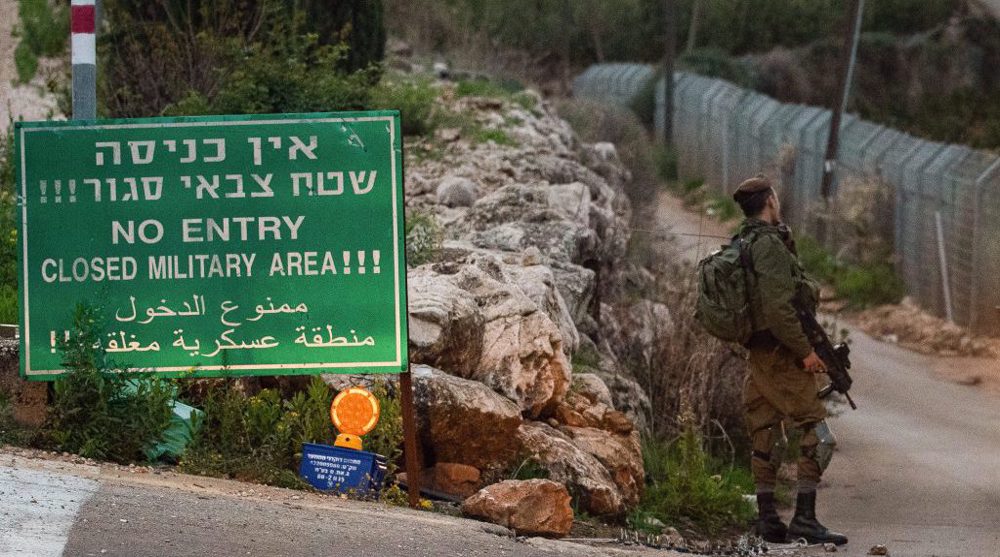
The Russian ambassador also referred to the tunnels under Lebanon’s border with the occupied territories, which Israel claims to have been dug by the Hezbollah resistance movement, saying there was “no proof Hezbollah created the tunnels.”
Protests continue in Lebanon as crisis lingers on
Prime Minister-designate Hariri has so far failed to form a cabinet to lift the country out of crisis.
Analysts say the main problem is the interference of Saudi Arabia, the United States and France in the country’s internal affairs and the adherence of some Lebanese groups to the Zionist-Takfiri axis.
On Monday, the local currency hit a new record low, with the dollar selling for 13,200 pounds, triggering fresh protests in Beirut and Tripoli.
The Lebanese protesters gathered at Beirut’s Martyrs Square on Monday night and torched tires.
The demonstrators in Tripoli set fire to trash bins and stormed into the electricity office while chanting slogans against corruption.
Surrender, humiliation have no place in our lexicon: Lebanese MP
Trump, Netanyahu orchestrated deadly riots to destabilize Iran: Hezbollah chief
Israeli strikes kill two in Lebanon as UNIFIL warns against ceasefire violations


Araghchi slams World Economic Forum for canceling his invitation
Iran condemns Argentina’s unfounded accusations against IRGC
VIDEO | Fighting British state
Pezeshkian calls recent riots in Iran part of ‘failed’ US-Israeli war
VIDEO | Iran unity nullifies sedition
UK ‘preemptively’ discharges pro-Palestine hunger strikers recovering in hospital
US dollar falls in Iran amid rising export currency supply
Trump’s ‘Board of Peace’ for Gaza an extension of Israeli occupation: Ex-UN rights chief





 PressTV NEWSLETTER
now
PressTV NEWSLETTER
now

 This makes it easy to access the Press TV website
