Obama trade agenda favors big corporations: Social Activist
US President Barack Obama’s proposed trade agenda, which he has recently urged Congress to approve, favors big corporations and is unfair to smaller businesses, a social activist in Maryland says.
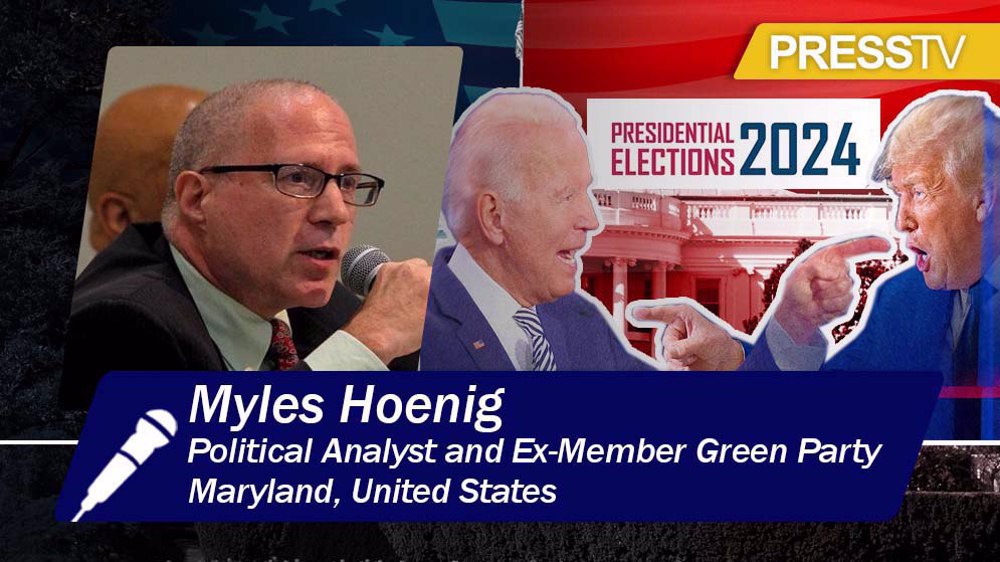
Myles Hoenig made the comments in a Sunday interview with Press TV about Obama’s call on the Congress to write trade rules and pass his agenda before China takes control of the global economy.
“It gives corporations an even stronger control of the market place without any due process that would be fair to small businesses or communities,” he said.
“In fact, corporations would be the judges in disputes, thus giving them near absolute control.”
Obama and the US Congress have specifically hit a roadblock on Trans-Pacific Partnership (TPP) bill, where House Democrats decided to vote against the president’s proposed fast-track trade authority legislations which would allow his administration to finalize the deal.
Hoenig said TPP will be similar to, if not more effective than, the North American Free Trade Agreement (NAFTA), which was reached between the United States, Canada, and Mexico during Bill Clinton’s presidency.
“Both these agreements are very anti-union, anti-environment and the TPP has now gone beyond the legal scope of NAFTA. It will permit foreign corporations to sue governments, which usually represented aggrieved citizens,” he maintained.
Hoenig also went on to criticize the secrecy that surrounds the deal, saying “the treaty is being negotiated in private between the countries and the largest corporations, yet the American public, even represented by Congress, is not permitted to know what is in it.”
In his latest weekly address on Saturday, Obama expressed the need for laying the grounds for an extensive trade agenda that will help prevent China from dominating the global economy.
According to Hoenig, China is Washington’s main competitor in the Pacific and that is why Obama has felt the need to put pressure on Congress.
“China is the US’s greatest economic competitor in the Pacific. In order for the US to remain dominant in this field, it feels a need to have a near absolute control of all trade,” he concluded.
MTM/AGB
Biden set to lose re-election over his genocidal policy in Gaza: US journalist
Frightful Biden-Trump rematch planned for November: Analyst
US Empire controlling people's minds to maintain hegemony: Scholar



VIDEO | Martyr Haj Qasem Soleimani Warship
Health system nears ‘complete paralysis’ as Israel uses medicine as weapon: Gaza officials
Mohammad Bakri, Palestinian director who exposed Jenin massacre, dies at 72
Iran president offers Christmas, New Year greetings to Pope
‘Normalization not in Iraq’s lexicon’: PM Sudani vehemently rejects ties with Israel
Hamas releases Al-Aqsa Flood narrative, says Palestinian resistance ‘cannot be erased’
VIDEO | Press TV's news headlines
Israel targeted radiopharmaceutical facility in first attack on Isfahan: Iran nuclear chief


 PressTV NEWSLETTER
now
PressTV NEWSLETTER
now

 This makes it easy to access the Press TV website
