
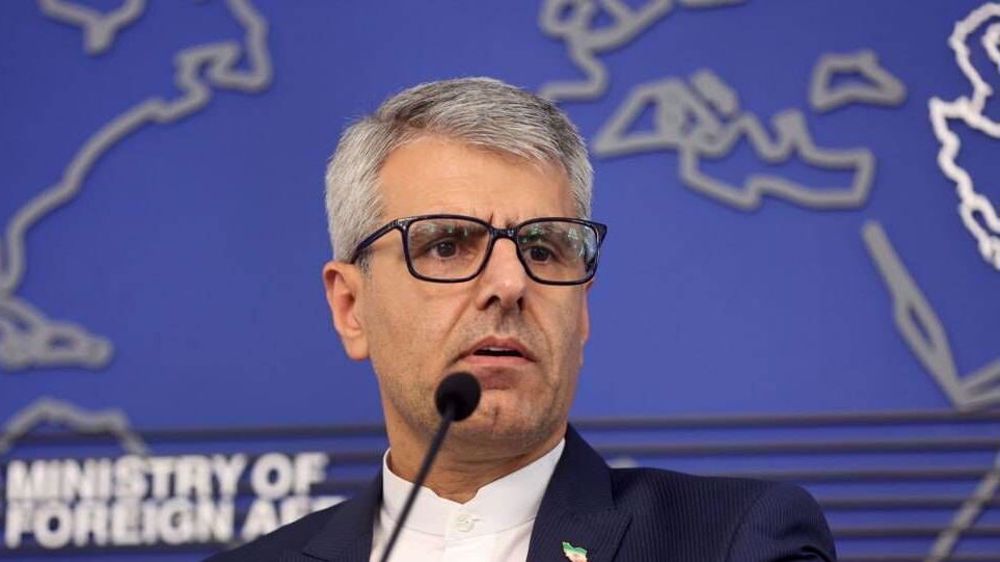
The Foreign Ministry’s spokesperson says Iran will not allow the United States to determine when war begins or ends, stressing that the country's decisions on defense and diplomacy are guided solely by its national interests and national security.
Esmaeil Baghaei made the remarks at a press conference on Monday in response to a question about media reports claiming that Iran and the United States had responded to a joint proposal by Pakistan and Qatar for a ceasefire and a return to negotiations, while US weapons transfers to the region continued.
Addressing Iran's decision-making process, Baghaei said the country's policies were shaped through established institutional mechanisms rather than external pressure.
“As a matter of principle, we are neither concerned about oil nor about America's concerns. What matters to us is our national interests and national expediency,” he said.
“Determining a country's national interests and expediency is not a one-variable equation; it involves many different considerations. Ultimately, what guides our decisions is our national security and national interests. Decisions in this regard are made through a fully transparent and well-defined process involving all the relevant decision-making bodies of the Islamic Republic,” the official went on.
“We have never allowed, and never will allow, the United States to dictate the timing of war and peace. We will continue to defend ourselves for as long as our national interests and national expediency require. Whenever we conclude that diplomacy can serve as an effective instrument for safeguarding our national interests, we will certainly make use of it.”
‘Ukrainian attack on Iranian vessel bears dire consequences’
Elsewhere in his remarks, the spokesperson strongly condemned a recent deadly Ukrainian attack on an Iranian commercial vessel in the Caspian Sea, saying the atrocity took place while the Islamic Republic has never had any involvement in the conflict between Russia and Ukraine.
The atrocity serves as an “unlawful act” that would not go unanswered, he added, asserting that countries that consider themselves supporters of the Ukrainian regime should also be held accountable for recent developments.
“[Ukrainian President Volodymyr] Zelensky's elders should control him and exercise caution” in light of the dire consequences that such aggression could have, the spokesperson stated, describing the attack as a symbolic action taken to attract international attention and “demonstrate your limited weight in international affairs.”
Pointing to scheduled meetings of Zelensky and Israeli prime minister Benjamin Netanyahu with US President Donald Trump, Baghaei criticized the destructive alignment among the trio.
“This grouping can only be described as a kind of triangle of evil,” he said, adding, "Such triangles have never had any positive effect on international peace and security.
‘Iran seeks good relations with neighboring countries’
The official stressed that Iran does not seek confrontation with its neighbors. “We have absolutely no hostility towards any of them. On the contrary, there are extensive ties and shared interests between Iran and the countries on the southern shores of the Persian Gulf.”
Some regional countries have, however, allowed their territories to be used by parties carrying out attacks against Iran and, in certain cases, have independently participated in those operations, prompting retaliatory action by the Islamic Republic against American interests in those states, he added.
According to the official, the Islamic Republic views such cooperation as an instance of “war crime” and expects it to cease.
‘Iran-Oman talks constructive, have nothing to do with US’
Baghaei also provided an update on bilateral talks between Iran and Oman, saying several rounds of discussions held on Friday and Saturday had been “useful and constructive.”
He said the negotiations concern the management of maritime traffic through the Strait of Hormuz and are aimed at developing mechanisms to ensure safe navigation while respecting the sovereign rights of the two coastal states.
Baghaei emphasized that the negotiations are strictly bilateral.
“These negotiations have no connection whatsoever with the United States. They are a bilateral matter between Iran and Oman, and the talks are continuing.”
 This makes it easy to access the Press TV website