
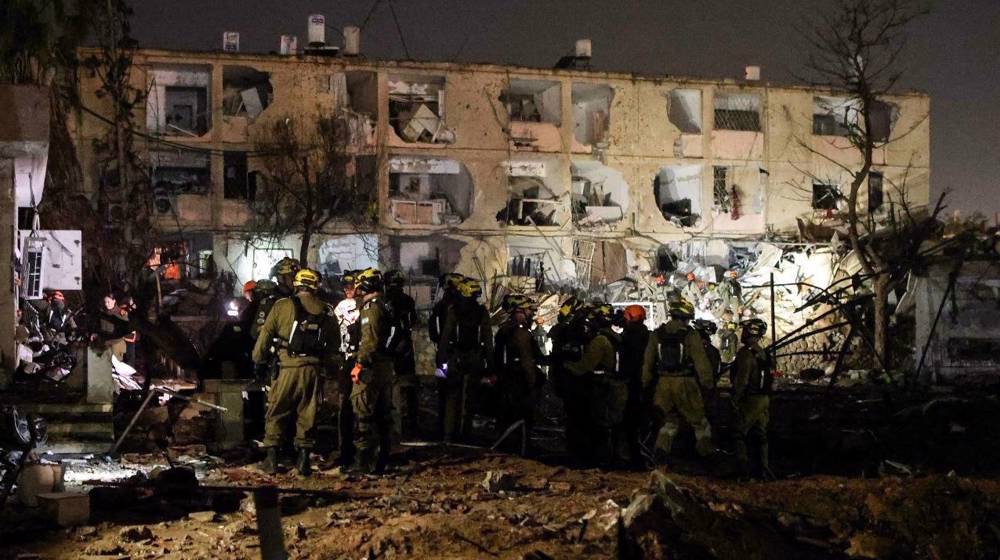
Iran's top legislator says reports of significant damage caused to the city of Dimona in the central occupied territories following Iranian missile strikes point to the disempowerment of the Israeli defenses in the face of Iranian retaliation.
"If the Israeli regime is unable to intercept missiles in the highly protected area of Dimona, it is, in operational terms, a sign of entering a new phase of the battle," Speaker of Majlis (the Iranian Parliament), Mohammad-Baqer Qalibaf, wrote in a post on X on Saturday.
He described the prominent feature of this phase as the occupied territories' skies having been rendered "defenseless."
"As a result, it appears that the time has come to implement the next pre-designed plans," the official concluded, referring to the surprises the Islamic Republic's Armed Forces have repeatedly promised they have in store for Tel Aviv.
The comments came after, despite widespread censorship of the real toll of the missile strike, local reports indicated that dozens had been killed in the reprisal targeting Dimona. The city is famous for being outfitted with extreme protective means due to its hosting the regime's notorious Dimona nuclear reactor in its vicinity.
CCTV footage captures the moment the Iranian missile struck its target in Dimona.
— Press TV 🔻 (@PressTV) March 21, 2026
Follow Press TV on Telegram: https://t.co/LWoNSpkc2J pic.twitter.com/KBMeclFa8m
Official sources have reported nearly 50 injured. However, the deployment of dozens of ambulances and several military helicopters to evacuate those affected has suggested that local accounts might be closer to reality.
While the regime's police have strictly prevented any form of filming of the scene, some residents of Dimona have reported seeing numerous body bags alongside the ambulances.
Israeli media describes 'hardest night'
Meanwhile, Israeli paper Yedioth Ahronoth reported that, due to the Iranian retaliation, the regime's so-called "home front" experienced its "most difficult night" since February 28. The day saw the Islamic Republic's Armed Forces begin unrelenting and decisive counterstrikes in the face of Tel Aviv's and Washington's most recent bout of unprovoked aggression targeting the Iranian soil.
The Israeli paper cited a high number of casualties in Dimona and the nearby city of Arad.
The Israeli military officially confirmed that the reprisal was carried out using a ballistic missile with a warhead carrying approximately half a ton of explosives.
According to military sources, two attempts were made to intercept the missile, both of which failed.
The Iranian reprisal, codenamed Operation True Promise 4, was launched momentarily after the unlawful aggression began late last month.
In the occupied territories, retaliatory strikes have targeted military sites in Tel Aviv, the occupied city of al-Quds, the occupied port of Haifa, the technological hub of Be'er Sheva, the Negev Desert, and other locations.
US military positions across the region, including in Qatar, Bahrain, the UAE, Kuwait, Saudi Arabia, and Jordan, have also faced sustained counterstrikes.
 This makes it easy to access the Press TV website