
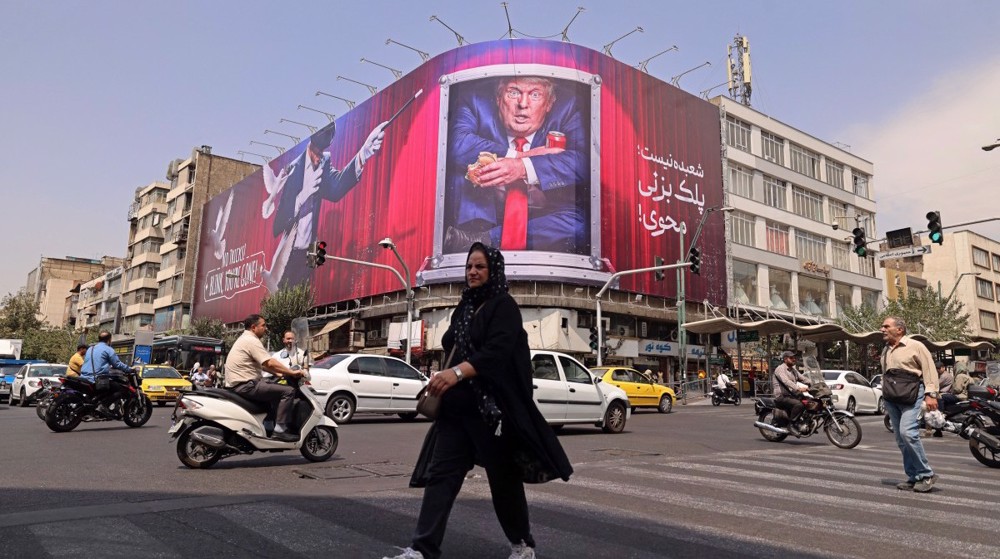
US President Donald Trump has refused to rule out authorizing the CIA to arm elements inside Iran to fuel a violent uprising, as Washington has failed to achieve its war aims more than six months after launching it.
Trump made the remarks on Wednesday while taking unscheduled questions in the Oval Office, one day after his attempt at inciting Iranians to “rise up and fight” against their government.
“Will you send the CIA in to arm Iranians?” a reporter asked. “I'd love to tell you that, but it wouldn't be appropriate to say,” Trump responded.
The renewed talk of intervention comes against the backdrop of foreign-backed riots that erupted in Iran earlier this year.
The economic protests, which initially began in Tehran, turned into violent riots in January following overt foreign interference, most notably statements by Trump. By January 12, order had largely returned following decisive action by ordinary citizens whose spontaneous mobilization helped restore stability.
However, widespread damage was inflicted during what some Iranian officials described as a US-Israeli-backed coup attempt on January 8-9, 2026. More than 3,000 citizens and security forces were martyred during the riots.
✍️ Feature -How Mossad and CIA sabotaged economic protests in Iran to stir up chaos – but failed https://t.co/TzVMGY7YBc
— Press TV 🔻 (@PressTV) January 21, 2026
By Yousef Ramazani
Follow: https://t.co/mLGcUTS2ei pic.twitter.com/zwvvHUuZRL
Iranian Judiciary’s Media Center said the elements involved had acted as enemy foot soldiers, providing the pretext and necessary conditions for hostile acts and aggression against Iran.
The latest remarks by Trump also revive memories of Washington’s earlier efforts to engineer political change in Iran.
In August 1953, the CIA and Britain’s MI6 orchestrated the coup known as the “TPAJAX Project” or “Operation Ajax.” The operation led to the overthrow and arrest of Prime Minister Mohammad Mosaddegh, who had nationalized Iran’s oil industry and taken it back from largely British control.
The US formally acknowledged its role after intelligence documents were declassified, making clear that the ousting of Mosaddegh was a joint CIA-MI6 project.
The coup triggered a series of events, including riots in Tehran. It also enabled the return of the pro-Western monarch Mohammad Reza Pahlavi from exile in Italy and consolidated his rule for the following 26 years, until the victory of the 1979 Islamic Revolution led by Imam Khomeini.
The historic overthrow remains a major reason for Iranians’ mistrust of Britain and the United States.
✍️ Feature - 72 years of Iran ‘regime change’ project: From 1953 coup to post-1979 failed plots
— Press TV 🔻 (@PressTV) August 21, 2025
Read More: https://t.co/IE4e1U8C8I pic.twitter.com/dDpvkegs8N
Trump’s comments come as his administration is also debating whether to bring the current war to an end.
According to sources cited by the Wall Street Journal on Wednesday, Trump is discussing with senior aides “whether to declare the Iran war over.”
“Trump has said he favors the idea. Trump also tells aides that he believes sticking with economic pressure will eventually force the regime either to dismantle its nuclear program or collapse,” the report states, citing US officials.
“Aides are advising Trump that an escalation of the Iran war beyond recent tit-for-tat strikes could endanger Republican prospects in the November midterm elections,” the Wall Street Journal added.
Despite the discussions, a massive US military buildup across the region continues. The newspaper says Washington is maintaining about 50,000 troops in West Asia.
This is “in part” intended to give Trump “flexibility” on “next steps,” as he is “not taking electoral consequences into account when making decisions on the war.”
“US forces … stand ready to launch larger offensive attacks should Trump choose to escalate the war,” the Wall Street Journal writes.
The developments coincide with major discontent among the US public over the illegal war launched by Washington and Tel Aviv in February.
They wanted to punish Iran; Punished themselves with triple-digit oil instead"
— PressTV Extra (@PresstvExtra) July 23, 2026
Iran's Speaker of Parliament Mohammad Bagher Ghalibaf shares a meme in reaction to the surge in oil prices.
Follow Press TV on Telegram: https://t.co/h0eMpifVIe pic.twitter.com/MTNqUmwEt9
The US and Israel launched their joint act of aggression against Iran on February 28. The first day of strikes saw top Iranian officials and commanders assassinated, while an elementary school in Minab, Hormozgan Province, was targeted, killing 168 schoolchildren and staff.
The war temporarily halted after 40 days following Iran’s retaliatory operations against US and Israeli assets across the region.
On June 18, the US and Iranian presidents signed a memorandum of understanding intended to permanently end the war. Washington, however, breached its commitments under the document and sparked a new round of fighting since July.
In one of the latest US crimes, American forces on Tuesday struck a residential home in Sirik, southern Iran, where a wedding ceremony was being held. Five people, including a four-year-old child, were killed and about 70 others injured.
The war has also produced widespread global energy consequences. US citizens are now facing surging fuel costs that have reached record levels.
Long-term US borrowing costs have climbed to a two-decade high as investors pull away from US Treasuries. The closure of the Strait of Hormuz has pushed Brent crude above $92 a barrel, driving up fuel prices for US consumers and feeding inflation fears that weigh most heavily on long-dated debt.
 This makes it easy to access the Press TV website