
By Press TV Strategic Analysis Desk
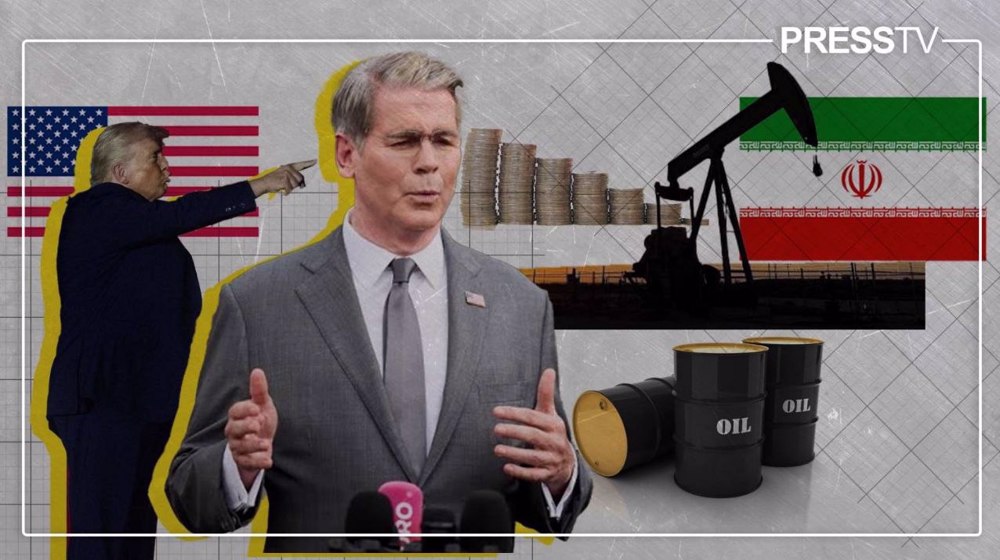
US Treasury Secretary Scott Bessent’s announcement of the so-called “Operation Economic Outcast” on Monday marks another reckless – and ultimately doomed – escalation in Washington’s long-running campaign of economic warfare against Iran.
Like every similar campaign before it, this latest gambit is also bound to fail.
Beginning August 24, the Treasury and other US agencies are expected to pursue what Bessent described as a “zero leakage” policy, seeking to close every channel through which Iran can generate revenue. The stated objective is to deprive Iran of resources.
Countries that do business with Iran could face exclusion from the US dollar-based financial system, with Bessent warning that even major powers such as China could be targeted.
Yet the strategy begs a fundamental question: how many times can Washington recycle the same failed policy before its bankruptcy becomes undeniable?
The new measures are little more than 'maximum pressure' repackaged – the same gambit that once promised to bring Iran to its knees, only to watch Tehran successfully adapt, diversify its economic partnerships, and fortify its strategic defenses.
This renewed sanctions push follows a US military aggression that, rather than delivering the outcome Washington so desperately wanted, only laid bare the limits of American coercion.
Doubling down on economic warfare now is an admission of defeat, a desperate attempt to weaponize sanctions. After nearly five decades of the similarly harshest sanctions, multiple forms of economic warfare, and two full-scale wars imposed on Iran in less than a year, the empirical record shows economic strangulation has never broken Iran, and it never will.
The United States should instead abandon its failed economic warfare, lift illegal sanctions as outlined in the memorandum of understanding (MoU) signed in the aftermath of the 4-day Ramadan War, and pursue diplomacy rather than coercion.
A chronicle of escalation without success
The history of American sanctions against Iran is a chronicle of foolhardy escalation without a semblance of success. Since the 1979 Islamic Revolution, when the US-backed regime in Tehran was overthrown, successive administrations in Washington have imposed harsh sanctions on Iran with the stated goal of toppling the Islamic Republic or forcing it into submission.
Each campaign has been heralded as the most crippling in history, and each has ultimately failed. The pattern is remarkably consistent and reveals a profound strategic blindness that has cost the United States dearly in terms of credibility, resources, and global standing.
In 2012, the Obama administration described its measures as the most crippling sanctions ever imposed. They failed to bring Iran to its knees. In 2018, President Trump launched the maximum pressure campaign after unilaterally and illegally withdrawing from the Joint Comprehensive Plan of Action (JCPOA), commonly known as the Iran nuclear deal.
That too failed to produce the desired results. Biden continued the same hard-nosed approach with no better results. Now, the Trump administration, in its second innings, has vowed the most crushing economic campaign ever taken against any country.
Yet the pattern is clear and the outcome predictable. The United States has exhausted its economic arsenal without achieving its political or military objectives, yet continues to cling to the illusion that just one more round of pressure will produce a different outcome.
This is the very definition of insanity: doing the same thing over and over again while expecting different results. The Iranian leadership has weathered these storms for decades and has developed sophisticated mechanisms to survive and even thrive under duress.
Each new round of sanctions is met with greater ingenuity, deeper regional integration, and a more diversified economy. The Iranian people have not risen against their government in the way Washington had hoped. The resilience of the Islamic Republic has confounded every prediction and every model that American policymakers have relied upon.
'Bullying won't work': Pezeshkian warns US as he meets Pakistan's army chiefhttps://t.co/sEKeH8tIbX
— Press TV 🔻 (@PressTV) August 24, 2026
The structural flaws in coercive diplomacy
The failure of US sanctions against Iran is not accidental but structural, embedded in the very logic of coercion. For decades, experts and veteran Iran watchers have cautioned that neither economic strangulation nor military threats can force Tehran's surrender.
American rulers have already lost whatever was left of their credibility. They pulled out of the JCPOA in 2018 despite Iran's verified compliance and imposed two wars of aggression in the middle of diplomacy. This credibility deficit is the fatal artery of America's coercive strategy.
Over successive sanction cycles, Tehran has demonstrated that it can not only neutralize the sanctions but make them redundant. While the Islamic Republic has learned to adapt, the Americans have not. American consumers are also paying a heavy price for this failed policy. International oil prices surged following the announcement of new sanctions. US gasoline prices have increased approximately twenty-nine percent over the past year, putting a significant strain on American households already struggling with inflation.
If the Strait of Hormuz remains closed for even a quarter, reports suggest oil prices could drive a significant increase in US inflation. The paradox is clear and growing more acute: sanctions against Iran are increasingly becoming sanctions against the American consumer and the global economy. The economic war is having a significant cost backlash on the US itself.
The question is no longer whether Iran can endure the pressure, but whether the United States can afford to continue a policy that punishes its own citizens while failing to achieve its objectives. The American people are not well served by a strategy that raises their fuel costs, disrupts global supply chains, and inflames regional tensions without producing any results.
The cost-benefit analysis of sanctions has become increasingly unfavorable, yet Washington seems unable or unwilling to change course, which is a sign of strategic inertia, a reflexive adherence to failed policies because the alternatives appear politically difficult.
The military option has been tested and found wanting
The recent two wars of aggression against Iran represent perhaps the most dramatic illustration of Washington's strategic bankruptcy. After years of economic warfare failed to produce the desired results, the US war machine resorted to direct military action against Iran, imposing two unprovoked wars in June of last year and February of this year.
Both wars failed catastrophically, and none of the United States military objectives were realized. The financial cost of these wars runs into the hundreds of billions of dollars for US taxpayers, which produced nothing but the killing of innocent Iranians, from scientists and athletes in Tehran to schoolchildren in Minab. This is how the US taxpayers' money is used.
The military option was supposed to be the ultimate guarantor of American dominance, the final arbiter when all other tools had failed. Yet it too proved incapable of achieving any of Washington's stated goals. The Iranian military and the Iranian people demonstrated a capacity for resistance that surprised American war planners.
Rather than bringing Iran to heel, the wars only strengthened Iranian resolve and deepened its regional alliances. The failure of the military option should have been a wake-up call, a moment of reckoning that forced a fundamental reassessment of United States strategy. Instead, Washington has simply reverted to the same old economic warfare that had already failed.
This pattern of escalation and failure reveals a profound inability to learn from experience. The United States has exhausted both its economic and military tools without achieving its objectives, yet it continues to cycle through the same failed approaches. The Iranian leadership has watched this pattern unfold and has drawn the logical conclusion that Washington has no real strategy, only a series of reflexive responses that are ultimately self-defeating.
Iran’s trade partners won’t listen to US ‘big talk’: Qalibafhttps://t.co/kIu6YFZMkD
— Press TV 🔻 (@PressTV) August 24, 2026
Why more sanctions will not work now
The new round of sanctions planned by the Trump administration faces the same fundamental obstacles that have defeated every previous round. The Iranian economy has already adapted to the maximum pressure campaign. The networks and mechanisms that have been developed to circumvent sanctions are already in place and are continually being refined.
Each new round of illegal and draconian sanctions faces diminishing returns because the most effective measures have already been deployed. The additional sanctions are unlikely to impose significant new pain on Iran while carrying significant risks for the global economy.
Moreover, the context for sanctions is fundamentally different now than it was even a few years ago. The geopolitical landscape has shifted dramatically. China and Russia have deepened their economic and strategic relationships with Iran, providing alternative markets, financing, and diplomatic support. The US no longer enjoys the unquestioned economic dominance it once did, and its ability to enforce sanctions unilaterally is more limited than ever.
The global economy has become more multipolar, and countries are increasingly reluctant to align themselves with US sanctions policies that damage their own economic interests.
The Iranian leadership has also developed a more sophisticated understanding of how to weather sanctions. The economy has been restructured to reduce dependence on oil exports, non-oil exports have been expanded, and domestic production has been incentivized through various policies.
While these measures have not eliminated the pain of sanctions, they have made the Iranian economy more resilient than it was during earlier rounds of pressure. The leadership has also developed a more nuanced diplomatic strategy, engaging with regional powers and building coalitions that make it harder for the US war machine to isolate Iran internationally.
The framework for a sustainable solution
The current stalemate demands a fundamental shift in approach. The MoU signed between Tehran and Washington following the 40-day Ramadan War provides a clear framework, explicitly requiring the lifting of all primary and secondary sanctions imposed against Iran over the decades to definitively end the ongoing war.
This is a precondition for any sustainable deal. The document deserves to be taken seriously as a foundation for negotiations. Its provisions were carefully calibrated to address the legitimate concerns of both sides while providing a path toward long-term regional peace and stability.
For a deal to have any chance of success, Iranian demands must be fulfilled in letter and spirit. Sanctions relief must be genuine, comprehensive, and durable. Partial or reversible measures will only reinforce Iranian skepticism and incentivize continued resistance.
The United States must demonstrate that it is willing to honor its commitments and that diplomacy is not merely a prelude to renewed war or sanctions. This requires a fundamental shift in how Washington approaches negotiations, moving away from the take-it-or-leave-it ultimatums that have characterized previous attempts and toward genuine give-and-take diplomacy.
The Strait of Hormuz will only be reopened when legitimate Iranian demands are fulfilled – not one, but all of them. The reopening of the strait would benefit the global economy but the dynamics have changed and the administration of the waterway will now be decided by Iran.
Iran’s top security official says US must change its behaviorhttps://t.co/O3FJUJ65uv
— Press TV 🔻 (@PressTV) August 24, 2026
The strategic imperative for change
The United States faces a critical strategic choice: continue down a path of proven failure or embrace a new approach rooted in ground realities and the new world order. The current policy has achieved none of its stated goals. American credibility has been eroded, alliances have been strained, and the global economy has been disrupted.
The so-called “maximum pressure” campaign has been attempted in various forms for over a decade, and each time it has failed. The military option has been tested and proven catastrophic for the US war machine. The only remaining path is diplomacy and a clear-eyed understanding and acknowledgement of Iranian red lines.
The fundamental flaw in United States strategy is the absence of an exit ramp. Economic pressure does not produce capitulation but only fuels resistance and sharpens the incentive to find workarounds. The United States has created a situation where the people of Iran have no incentive to negotiate because they have no confidence that any agreement would be honored. Restoring that confidence requires more than just promises; it requires concrete actions that demonstrate a genuine commitment to diplomacy over coercion.
The time has come to acknowledge that the US war machine has exhausted all its options – military and economic. The path forward is clear: lift all primary and secondary sanctions as called for in the MoU and allow Iran to reopen the Strait of Hormuz.
The United States must understand that it cannot force Iran to its knees through military aggression or economic pressure. It must accept the reality that Iran is a new regional superpower. The US must also recognize that its current approach is not merely failing to achieve its objectives but is actively undermining its own interests.
The sanctions imposed over decades are not only illegal but manifestly inhumane. Their continuation serves no American interest other than perpetuating a failed policy. For the American people, it only results in diminished global standing and frayed alliances.
The only coherent course is the full and irrevocable removal of all sanctions, coupled with a binding guarantee on any future imposition as recognition that a policy devoid of legal foundation, moral justification, and strategic viability has no rightful place in today’s multipolar world.
 This makes it easy to access the Press TV website