
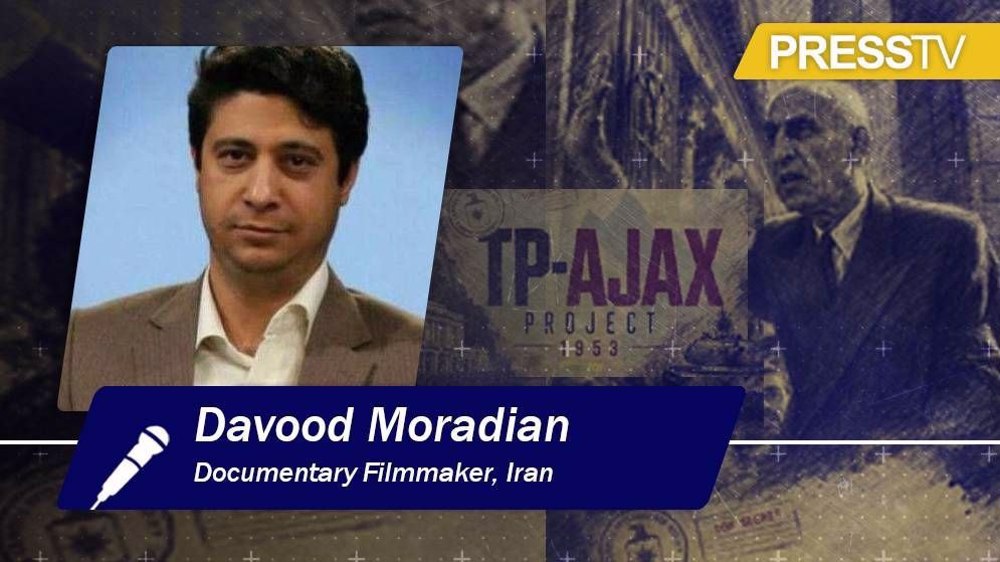
By Sheida Eslami
The documentary film Operation Ajax 1953, one of Press TV’s latest productions, is not simply a retelling of the CIA-MI6 coup of August 19, 1953, which overthrew the democratically elected government of Iranian Prime Minister Mohammad Mosaddegh.
Rather, it seeks to uncover a recurring “code” or “algorithm” that the West has employed over the decades to change governments in independent and sovereign countries in pursuit of hegemonic control over their resources and wealth.
Davoud Moradian, the producer and director of the documentary, tells the Press TV website in this wide-ranging interview why the 1953 Anglo-American coup has evolved into an operational model for modern-day interventions.
Moradian, a 47-year-old Iranian documentary filmmaker, has created a diverse body of work, including Brick Dream, Forty-Three Days, After the Siege, Enemy of the Nation, Iranian Weapon, Open Case, and the six-part documentary series American Kalashnikovs, among others.
For his latest production, made for Press TV, Moradian retraces the events that led to the overthrow of Mossadegh’s government 73 years ago, drawing on rarely seen documents and historical analyses.
The documentary was broadcast on Press TV on Wednesday, August 19, marking the 73rd anniversary of the Anglo-American coup.
Following are excerpts from the interview:
Q. Why did you set aside the conventional approach of providing a historical overview of the August 19, 1953 coup and instead turn to the concept of a “recurring algorithm”?
A. In this documentary, we are dealing with the story of a historical and consequential paradigm shift in the fate of the Iranian nation.
We did not want merely to report what happened in 1953. Our goal was to show that Churchill’s rhetoric at the time was exactly the same as the rhetoric used by American and Western politicians today regarding energy resources and countries’ sovereign rights.
“Operation Ajax” is not an isolated historical event; rather, it is a successful model in the minds of intervention planners that has been reproduced from Guatemala to Indonesia, Chile and Venezuela.
Once the audience realizes that this is an algorithm, they will no longer view today’s news as a coincidence either. Instead, they will see the strategic depth of what is happening and pay attention to the common pattern behind these operations.

Q. One of the boldest sections of your documentary is your examination of the different pillars behind Mossadegh’s government being brought down, from economic pressure to foreign media pressure and so on. How does this analysis relate to the national security of the region today, particularly that of the Islamic Republic of Iran, amid the developments that have taken place in the decades since the victory of the Islamic Revolution in 1979, as well as the war I imposed on it since February 28, 2026, and the events of January 8 and 9 in Iran, which Ayatollah Seyyed Ali Khamenei, Iran’s martyred Leader, rightly described as a “quasi-coup”?
A. The reality is that a coup does not succeed through guns and tanks alone; this is a naive assumption and a kind of analytical error.
The August 19 coup had three pillars: First, a foreign-dependent oligarchy for distributing money and hiring thugs; second, a media apparatus for managing public opinion that bombarded society with propaganda; and third, an educated class that, in an atmosphere of self-defeatism, played on the enemy’s field instead of seeing reality.
Our documentary shows that the same hybrid war is being waged today, albeit with more modern tools. Another important dimension of this multifaceted combination is economic pressure.
We want the documentary’s audience to make the comparison themselves and see that, during Mossadegh’s time, the Americans implemented exactly the same policy toward Iran that they are pursuing today.
In this documentary, we reviewed how, during Mossadegh’s time, the country’s currency lost 39/40ths of its value and the economy fell into disarray, just as the enemy is trying to make the rial lose its value today. This policy has been pursued by the US not only in Iran but also in many other countries, including Chile and Indonesia.
In Chile, many women from the middle class gathered in front of the presidential palace and banged spoons against empty pots. Under such a model, the ultimate goal is to create an economic and social crisis and push the country toward a change of government.
They applied the same policy against Nicolas Maduro in Venezuela, and currently, through a naval blockade and economic sanctions, they are seeking to implement this model against Iran. That is why they have activated their media outlets against the country.
Therefore, one of the most important lessons from revisiting Operation Ajax is to pay attention to how psychological operations are conducted alongside economic sanctions. If the peoples of the world and the Iranian people do not recognize this psychological-economic algorithm today, they will once again be bitten by the same snake hole.
🔸 1953 TP-AJAX PROJECT 🔸
— Press TV Documentary (@presstvdoc) August 19, 2026
The Coup That Overthrew Mossadegh
How the CIA revived its failed coup, mobilized its networks and helped overthrow Mossadegh. pic.twitter.com/2A2pp0VMJA
Q. You referred in the documentary to the takeover of the US Embassy in Tehran in 1979. Many consider this event to have been a sudden occurrence, but your narrative is different. Why did you consider this historical connection necessary?
A. Because history is a nation’s security memory. In 1979, the Iranian people clearly remembered how, 26 years earlier, the US Embassy had been transformed into the command center of the coup against the democratically elected prime minister of the country.
The takeover of the embassy by students was not a momentary emotional reaction; rather, it was a preemptive action based on accumulated historical fears. In the documentary, we tried to show the international audience why Iran had reached such a level of distrust toward US institutions that claim to be diplomatic.
This distrust is rooted in a lived, bloody and consequential experience, one of its most prominent examples being the very coup that is the focus of our documentary.
Q. The audience of Press TV is generally non-Iranian. What change do you think watching this documentary could make in a global audience’s perception of Western interventions?
A. We want viewers in Latin America, Africa, Southeast Asia and elsewhere, when they watch the documentary, to instinctively look for their own country within this picture as well.
When we talk about the tools used by Western powers to carry out the 1953 coup, people in Venezuela or Cuba have experienced this pain firsthand.
Our ultimate goal is for the global audience to understand that this pattern of economic-media pressure, aimed at maintaining domination, plundering nations or seizing new resources in other lands, is a standard “imperialist” practice for bringing independent nations to their knees.
In parts of this documentary, our focus has been on recounting how economic pressure on Iran began after the nationalization of the country’s oil industry in 1953. Mossadegh entered into talks with the US government and Harry Truman in an effort to break this pressure, but Churchill responded to Truman by declaring: “You do not switch off a machine that is working.”
This was a direct reference to continuing the blockade and economic pressure against Iran; a pattern that, by the admission of US officials, has been applied against the country in various forms over nearly the past 50 years and was employed even more openly during the recent US-Israeli war of aggression against Iran.
 This makes it easy to access the Press TV website