
A draft resolution introduced by Russia and China at the UN Security Council represents a final chance to defuse tensions over Europe’s activation of a dispute mechanism linked to the Iran nuclear deal, Deputy Foreign Minister Kazem Gharibabadi says.
On Friday, the UN Security Council is expected to vote on a proposed resolution that aims to extend the existing diplomatic framework for resolving disputes related to the Joint Comprehensive Plan of Action (JCPOA) and UN Security Council Resolution 2231 (2015).
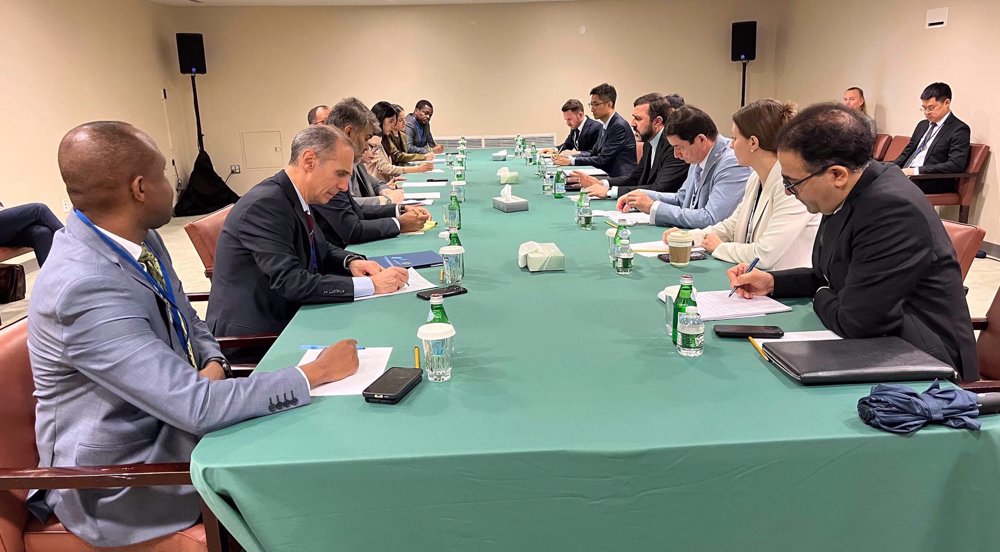
In a meeting with representatives of 10 non-permanent Security Council members at UN headquarters in New York, Gharibabadi emphasized Iran’s commitment to a diplomatic resolution of the nuclear issue.
“I noted that the draft resolution submitted by Russia and China for the technical extension of Resolution 2231 represents the last opportunity to prevent the escalation of tensions caused by the US and the Europeans,” he said.
“I also stressed that each member of the Security Council bears a heavy responsibility in this regard. They must either reaffirm their commitment to diplomacy and fulfill their duty to maintain international peace and security, or fully accept accountably for disrupting the diplomatic path and its consequences.”
He criticized recent claims by American and European officials about their commitment to diplomacy as “unrealistic and insincere,” highlighting Iran’s diplomatic efforts in recent weeks.
Last month, the European signatories to the US-abandoned JCPOA, namely Britain, France, and Germany, initiated a 30-day process to activate the so-called snapback mechanism in order to restore all UNSC sanctions against Iran.
Iran has rejected the move as illegitimate, citing the US unilateral withdrawal from the JCPOA and the European trio's decision to align with unlawful sanctions rather than fulfilling their JCPOA obligations.

On September 9, Iran, in a goodwill gesture, signed an agreement with the International Atomic Energy Agency (IAEA) in Cairo to resume cooperation with the UN’s atomic watchdog.
Gharibabadi said, “Iran will respond appropriately to any hostile actions, such as the reinstatement of [previously] terminated UNSC resolutions. As a first step, the Cairo agreement between Iran and the Agency will end.”
The JCPOA required Iran to scale back some of its nuclear activities in return for sanctions relief.
However, the US ditched the deal in 2018 before returning the illegal sanctions that it had lifted against Iran and launching the so-called “maximum pressure” campaign.
Following the US withdrawal, the European signatories to the JCPOA failed to uphold their commitments and made no efforts to save the agreement.
Now, UN sanctions on Iran are due to be re-imposed at 0000 GMT on Saturday. However, the Russia-China draft resolution delays the process by six months and calls on all initial parties to the JCPOA to "immediately resume negotiations."
 This makes it easy to access the Press TV website