Greenhouses herald Iran’s new era in farming

Along the Aras River, where the borders of Iran, Armenia, and Azerbaijan converge, lies the city of Jolfa - home to the largest greenhouse complex in Iran and one of the largest in West Asia and Asia.
The sprawling 50-hectare farm, with 30 hectares under glass, is transforming how Iran grows food, helping the country deal with water shortages, boost its economy, and reach new markets abroad.

Since 2017, this giant greenhouse has been growing vegetables and fruits using modern hydroponic technology brought in from the Netherlands.
Hydroponics means plants grow in water enriched with nutrients rather than soil. This technique, combined with carefully controlled greenhouse conditions, allows farmers to produce about 450 tonnes of crops per hectare, which is many times more than traditional farming.
Most of what is grown in Jolfa is exported. Under the brand name Atavita, the greenhouse sends over 90% of its fresh produce to markets in Russia and the Arab world.
For Iran, which faces illegal sanctions and economic challenges, these exports are a vital source of foreign currency and economic stability.
Decades of drought, shrinking rivers, and overuse have strained the nation’s fragile ecosystems, threatening the livelihoods of millions. Traditional agriculture, heavily reliant on unpredictable rainfall and vast water withdrawals, has become increasingly untenable.
Jolfa’s greenhouse employs more than 450 people directly and expects to create up to 1,000 jobs as it expands. That’s a big deal in a country where rural unemployment and migration to cities have been growing problems.
Local investors say the project’s goals extend beyond food production to include introducing cutting-edge agricultural technology to Iran, boosting job creation, and supplying consumers with healthy, organic produce.
The greenhouse’s success signals a shift in Iran’s agricultural sector toward more modern, efficient, and export-oriented farming.
Across Iran, the greenhouse industry is growing fast. There are about 7,000 hectares of greenhouses today, employing roughly 150,000 people. Another 28,000 hectares are under construction, signaling big growth ahead.
Government data indicate that Iran produces roughly 3.5 million tonnes of greenhouse-grown products annually, of which 700,000 tonnes are exported, generating $370 million in foreign currency earnings.
One of the biggest challenges for Iran’s farmers is water scarcity. The country’s dry climate and years of drought have made traditional farming difficult and unsustainable.
Greenhouses offer a solution. Because they use hydroponics and controlled environments, they can produce far more food with much less water.
For example, the Jolfa greenhouse produces 55 to 60 kilograms of crops per cubic meter of water, which is several times more than open-field farms. In hot, arid regions like Yazd, modern greenhouses have boosted crop yields by up to 30 times compared to traditional methods.
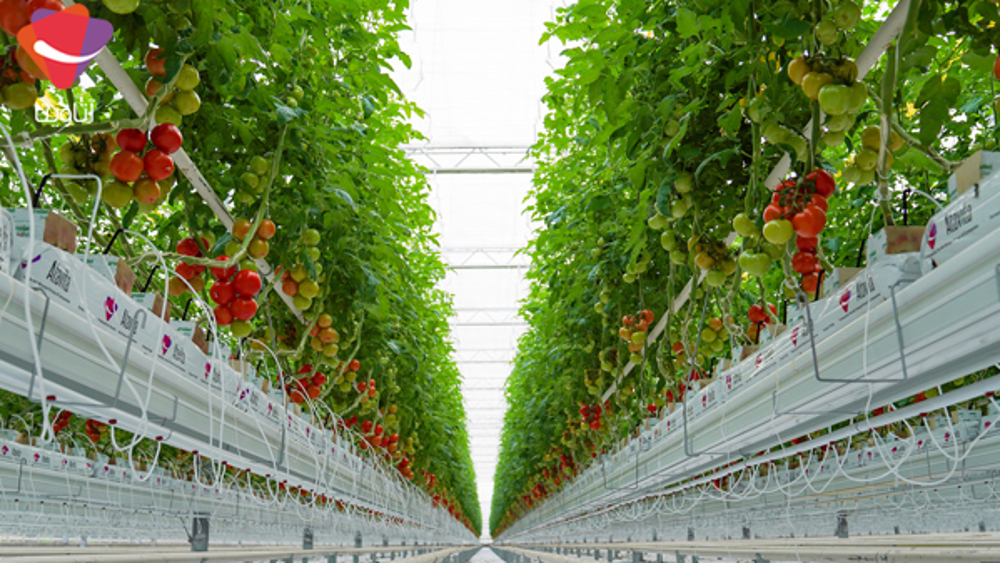
This water efficiency, other than being good farming practice, is critical for Iran’s food security. By using water wisely, greenhouses help ensure that the country can produce enough food despite growing water shortages.
Another impressive aspect of Iran’s greenhouse sector is its reliance on domestic manufacturing. Around 90% of the equipment for structures, cooling and heating systems and irrigation used in these greenhouses is made in Iran by more than 100 local companies.
This reduces dependence on foreign suppliers, which is especially important given the country’s illegal sanctions.
Iranian companies are even exporting greenhouse technology and services abroad, showing that the country is developing expertise in this field.
The government encourages further expansion and modernization of greenhouses, recognizing their role in boosting productivity and exports.
Iran’s plans for the greenhouse sector are ambitious. The government wants to increase the total greenhouse area by over 48,000 hectares in the coming years. This expansion is part of broader development plans focused on food security, job creation, and economic resilience.
Pilot projects are underway in several provinces to move vegetable farming from open fields into controlled greenhouse environments. These initiatives reflect a strategic approach to modernizing Iran’s agriculture and adapting to climate challenges.
Agricultural fairs and exhibitions, such as the iFarm event to be held in Tehran on Monday, help spread new technologies and bring farmers and investors together.
The sector’s growth is tightly aligned with national development strategies. The sixth five-year development plan, alongside the new seventh development plan, highlights the expansion of greenhouse farming as a pillar for food security and economic resilience.
Iran’s investment in large-scale greenhouses like the Jolfa complex represents a strategic shift towards resilient, efficient, and export-oriented agriculture.
By growing more food with less water and exporting high-quality produce, the country is strengthening its economy and improving food security.
In a country grappling with water scarcity, sanctions, and economic volatility, controlled-environment agriculture offers a pragmatic pathway to enhance food security, generate employment, and earn valuable foreign currency.
Iran’s orchards: A new frontier for non-oil exports
Strait of Hormuz closure exposes AI’s hidden helium dependence, putting global chipmaking at risk
Filling the giants’ shoes in Iran’s auto industry



Israeli forces detain Palestinian newlywed couple, storm wedding hall
VIDEO | Press TV's news headlines
Qalibaf says he halted talks, warned of immediate strike after Israeli assault on Dahiyeh
Pakistan celebrates 79 years of independence
Iran’s Intelligence Ministry demands answers from France over diplomats’ ‘illegal’ activities
US Navy scrambles to deploy ship to replace USS Lincoln aircraft carrier: Report
US foreign policy regarding Iran, region driven by 'extreme reliance on lies': FM spokesman
Judiciary chief to Trump: Iran is owner and ruler of Strait of Hormuz


 PressTV NEWSLETTER
now
PressTV NEWSLETTER
now
 This makes it easy to access the Press TV website
