How Iran’s Air Force and IRGC defended country’s skies and forced enemy to retreat

By Masoud Khalili
The 12-day Israeli-imposed war on Iran in June showcased remarkable cohesion within the country’s armed forces, as well as extraordinary self-reliance and resilience in the face of an enemy backed by Western powers, including the United States.
Recalling the events of those 12 days, the Islamic Republic of Iran Air Force (IRIAF) pilots and the servicemen of the Aerospace Force of the Islamic Revolution Guards Corps (IRGC), in separate TV interviews, spoke of the heavy odds they faced and the way they prevailed.
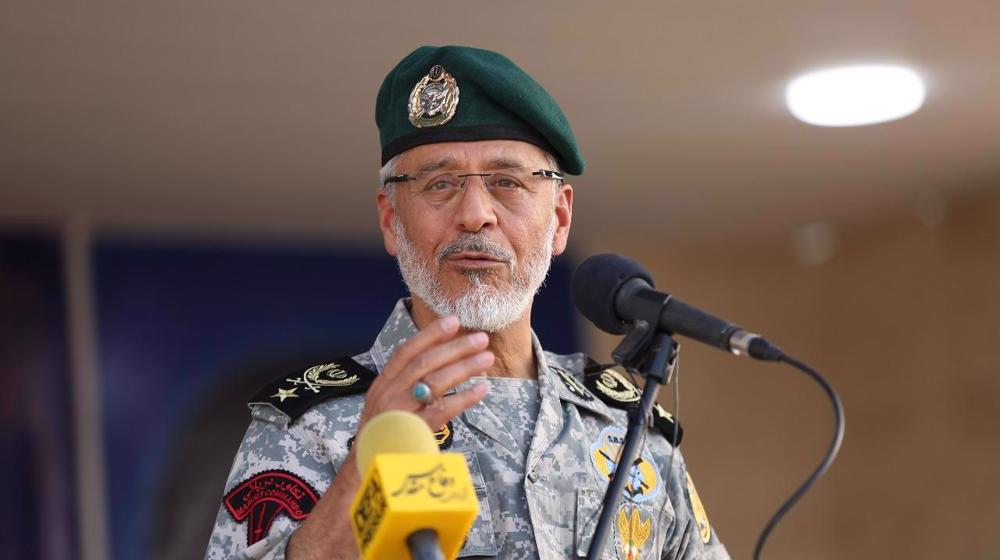
One broadcast aired on Sunday featured separate visits by Major General Amir Hatami, the Iranian Army’s chief commander, to three key fortresses serving to shield the country’s skies.
The commander’s first visit was to IRIAF’s Eighth Predator Tactical Fighter Base (TFB.8), aka Shahid Babayi Airbase in the central Iranian province of Isfahan – the outpost that houses the Air Force’s F-7 and F-14 fighter planes as well as other military aircraft, and where some of the aircraft had earlier been staging formation flights.
General Hatami sat down with a group of pilots who were involved in defending the country during the war imposed by the Zionist regime, with military, intelligence, and political support from the Trump administration.
“We locked onto an invading warplane from behind, which forced it to abandon the strike pattern it was setting up, break off, and pull away,” recounted one pilot.
“This fight lasted roughly from one hour to one hour and 10 minutes. During that time, the Zionist aircraft kept locking their radars onto us. We kept receiving lock-on alerts, and we kept breaking out,” he added.
Commending the defensive prowess, General Hatami hailed the country’s armed forces for standing up to “the distilled essence of all Western and NATO technology.”
“The Americans threw their full weight into the field, but you stood tall,” he told the pilots, in remarks that powerfully conveyed how steadfastness could overcome forces of great size, vast diversity, and cutting-edge military technology.
Flying westwards, his next destination was the Nojeh Airbase in the western Iranian province of Hamedan, where he inspected F-4 fighter hangars and other air defense capabilities.
Iran’s Army Chief Major General Amir Hatami says the Islamic Republic brought the enemy to its knees with its missiles during the 12-day aggression.
— Press TV 🔻 (@PressTV) September 6, 2025
Follow Press TV on Telegram: https://t.co/LWoNSpkJSh pic.twitter.com/42yXh7EJOk
There, he joined an air force commander’s description of an officer who stood by his defense system to the last moment, continuing to fire despite his injuries.
“His body was full of shrapnel, but the first thing he said was, ‘Where’s the drone?’ He kept insisting, ‘Let me fire.’ That spirit was something extraordinary. Abandoning your position simply wasn’t an option,” he said of the fight that continued till the end.
Shahid Fakouri Airbase in the city of Tabriz, northwestern Iran’s major metropolis, was also on the itinerary, with its MiG-29 fighter shelters. Here, the top commander turned his focus on the next phase of Iran’s response to the warfare, namely the IRGC’s retaliation.
“Look at the situation that arose in [the occupied port of] Haifa, Tel Aviv, and beyond. They tried very hard to conceal; the censorship was intense," General Hatami said about the regime’s imposition of draconian penalties for leaking information regarding the extent of damage and human losses resulting from the Iranian reprisal.
He went on to note how the Islamic Republic maintained its chokehold on the regime until it finally capitulated. “We kept firing until the last day. In fact, in the final days, we escalated deployment of our firepower,” he stated.
While the Air Force was keeping the skies safe, the IRGC made sure the enemy paid a heavy price with its missile strikes that shook the occupied territories.
Another broadcast aired on Saturday featured two IRGC Aerospace Force servicemen discussing how they complemented the Air Force’s defensive maneuvers by returning incoming fire with retaliatory strikes that even reached the Israeli airbases from which the attacks had originated.
The duo spoke about their death-defying actions in the pursuit of vindicating an entire nation, which had been eagerly anticipating the revenge for the martyrdom of hundreds of fellow Iranians in the regime’s unprovoked aggression.
“Our servicemen knew something could happen to them, but they stood at their missile launch pads until the very end. Their lives were literally on the line,” one said.
He cited former IRGC aerospace commander, Brigadier General Amir-Ali Hajizadeh, who was martyred during the war, as saying once to the servicemen that “we are the people’s shield.”
🎥 Iranian Weapons: IRGC’s Missile Achievements - Part 1
— Press TV Documentary (@presstvdoc) July 6, 2025
🔻Iran is a leading missile maker. But what made the country build its own missiles, and how did it become a major manufacturer?
📺 Tune into Press TV
🗓 Monday, July 7th
🕧 00:30 | 05:30 | 11:30 | 16:30 | 21:30 GMT pic.twitter.com/9mUxJwQKvP
“Wherever there’s a difficult mission, even when we know we may not survive, we always remember the commander’s words,” he remarked with conviction and confidence.
Another recounted how he was literally burned and pierced all over by shrapnel from a wayward missile, yet still struggled to drag himself to a nearby launch pad, from which he could fire missiles at strategic Israeli targets.
“When I tried to stand up, my back was burned, my legs were burned, my knees and other parts of my body were injured. But I dragged myself to another launch pad, because the only thought in my mind was: 85 million people are waiting for this missile to be fired,” he said.
“I remembered the martyrs who had fallen in different parts of Tehran. Those memories wouldn’t leave me. In the end, I managed to launch the missile, and it was extremely successful.”
The personnel of the country’s armed forces thus made a ceasefire request an absolute imperative for a regime that had been historically pampered and armed to the teeth by its Western patrons with fire, steel, and technology designed to inflict harm.
For many, it refreshed memories of Iran’s Sacred Defense during the 1980-88 war imposed by Iraq’s former dictator Saddam Hussein, who was similarly supported by the West.
A saga that, in the words of Defense Minister Brigadier General Aziz Nasirzadeh, compelled the enemy to forgo any prolonged engagement.
“If the war had lasted 15 days, in the final three days, the enemy might not have been able to defend itself against any of our missiles,” he said in a televised interview on August 22.
Foreign Minister Abbas Araghchi also echoed it days later: “We have no fear of negotiations, just as we have no fear of war.”
Masoud Khalili is a Tehran-based writer and strategic affairs commentator.
(The views expressed in this article do not necessarily reflect those of Press TV.)
Strategic imperative: Iran's dual approach blends robust military readiness with assertive diplomacy
Lessons of war: Strait of Hormuz and nuclear sovereignty define Iran’s inviolable red lines today
Finger on trigger: Iran prefers diplomacy to end imposed war, yet military stands locked and loaded


Trump’s remarks on US-Iran talks ‘distortion of reality’: Report
Leader’s advisor: Iran remains formidable obstacle to US-Israeli malicious plans in West Asia
Iran says no final understanding with US yet, rejects Trump's 'language of must'
Iran, Oman FMs discuss administration of Hormuz Strait in ‘very productive’ call
Italy: Protesters stage nationwide strike, demand end to Israeli genocide in Gaza
US will not be allowed to control Cuba's destiny through coercion, military threats: Diplomat
Iran’s active role in Eurasian bloc reflects its strong commitment to development: President
Champions again: Iran women’s volleyball retains CAVA title




 PressTV NEWSLETTER now
  This makes it easy to access the Press TV website